
Rental Scam
A rental scam is fraud in which someone advertises a property they do not control — or does not exist — and collects deposits or first month’s rent from applicants who never receive keys. It works because the rental market rewards speed, and because paying before viewing has become normal for remote moves.
| Common forms | Phantom listing, hijacked listing, bait-and-switch, unauthorized sublet, application-fee harvesting |
| Typical loss | Security deposit plus first month’s rent |
| Payment methods requested | Wire transfer, peer-to-peer apps, gift cards, cryptocurrency — all irreversible |
| Primary targets | Students, relocating workers, recent immigrants, anyone renting sight-unseen |
| Peak periods | University term starts and summer moving season |
| Key tell | Pressure to pay before viewing, and a reason the landlord cannot meet |
| Secondary harm | Identity theft — rental applications collect SSN, employer and bank details |
| Platform exposure | Listing sites, marketplaces, and social groups where listings are user-generated |
How it works
The mechanics are simple and the variations are all about where the fake part sits.
A phantom listing advertises a property that is not available — often lifted photos from a real listing elsewhere, repriced attractively. A hijacked listing copies a genuine for-sale or for-rent property, sometimes one standing empty, and reposts it as a rental. The scammer may know the address is vacant, which lets them survive a drive-by inspection. An unauthorized sublet involves a real tenant collecting deposits from several applicants for a property they do occupy but have no right to re-let. Application-fee harvesting skips the deposit and monetizes volume — a modest fee from hundreds of applicants for a property that was never available.
The constant is a plausible reason the landlord cannot meet in person: relocated for work, overseas on a posting, a missionary abroad. That reason justifies both the remote payment and the refusal to hand over keys before funds clear. Payment is always by a method that cannot be reversed.
The under-reported harm is the second one. A rental application collects a Social Security number, employer details, bank information and often a copy of a government ID — everything needed to open accounts in the applicant’s name. Victims who lose no money at all may still have handed over a complete identity package.
Why it matters for identity verification
Rental fraud is a two-sided identity problem, and platforms usually solve only one side.
Most listing sites verify renters, because renters are the ones being screened for creditworthiness. Comparatively few verify that the person posting a listing has any relationship to the property. That asymmetry is the vulnerability: the fraudster occupies the unverified role by design.
Verifying the lister changes the economics. A scam that requires a genuine, authenticated government ID linked to a live face — before a listing goes up — costs far more to run at volume than one requiring only an email address. It does not eliminate the fraud, since a determined operator can verify with a stolen or synthetic identity, but it converts a free, infinitely repeatable attack into one with a real per-attempt cost and an evidence trail.
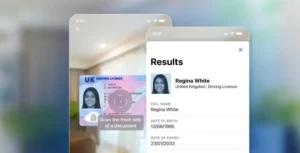
The same check protects applicants from the identity-theft side. If a platform can confirm a lister is who they claim, applicants have less reason to hand documents to strangers off-platform. Authenticating the ID and matching it to a live face is the check that does this, and Microblink’s synthetic and stolen identity detection covers the case where the fraudster arrives with someone else’s documents.
Rental scam vs legitimate remote rental
| Rental scam | Legitimate remote rental | |
|---|---|---|
| Viewing | Refused, or a self-tour with no one present | Virtual tour, agent, or an authorized third party |
| Payment method | Wire, P2P app, gift cards, crypto | Traceable transfer, often escrow or an agency account |
| Payment timing | Full deposit before any lease is signed | After a signed lease, frequently on move-in |
| Landlord identity | Unverifiable, always remote, story-driven | Verifiable against property records |
| Pricing | Noticeably below comparable listings | In line with the local market |
| Pressure | Urgency, competing applicants, expiring offer | Normal application timeline |
| Documentation | Lease appears after payment, if at all | Lease provided for review before payment |
No single row is conclusive on its own — legitimately remote landlords exist, and below-market rents do occur. The combination of below-market pricing, irreversible payment demanded before viewing, and a reason the landlord cannot appear is what distinguishes them.
What it can’t be solved by
Listing moderation alone will not fix it. Content review catches duplicated photos and implausible pricing, and fraudsters adapt within days. Moderation raises the effort; it does not change who can post.
Verifying renters does nothing. Most platforms already screen applicants thoroughly. The fraud sits entirely on the other side of the transaction, which is why heavily-screened marketplaces still carry it.
Payment controls only work on-platform. A scam that moves the conversation to email and the payment to a wire transfer leaves the platform’s protections behind at the first message. Detecting the move off-platform matters more than securing payments on it.
Identity verification does not prove property control. Confirming that a lister is a real, verified person is necessary and not sufficient — a verified person can still list a property they have no right to let. Closing that gap requires checking the listing against property records, which is a separate problem from checking the human.
Frequently asked questions
What is the most common sign of a rental scam?
A demand for payment by an irreversible method — wire, peer-to-peer app, gift cards or cryptocurrency — before any viewing has taken place, paired with a reason the landlord cannot meet in person.
Can I recover money lost to a rental scam?
Rarely. Scammers choose payment methods specifically because they cannot be reversed. Reporting to the platform, local police and the FTC is worthwhile for enforcement, but recovery is uncommon.
Why do rental scams target students and people relocating?
Both groups rent remotely under time pressure, often in unfamiliar markets where they cannot judge whether a price is plausible. Term starts and summer moving season concentrate that vulnerability into predictable windows.
How do rental scams lead to identity theft?
Rental applications legitimately collect Social Security numbers, employer details, bank information and ID copies. A fraudulent listing harvests that package from every applicant, so victims can lose their identity data even if they never send money.
Related reading
- Marketplace fraud — the broader pattern of fraud on two-sided platforms
- Fraud ring — how listing scams get run at volume
- Synthetic identity fraud — how a fraudster passes verification with a fabricated identity
- Drop address — the related use of addresses the fraudster does not occupy