
Best AML Software in 2026: 10 Platforms Compared


AML software has one job that never changes: find the money that should not be moving, and prove to a regulator that you looked. What keeps changing is how hard that is. Real-time payments leave minutes to stop a transfer, mule networks spread across dozens of accounts, and alert queues grow faster than compliance teams.
The best AML software catches more real risk with fewer false alerts, then shows an examiner exactly why each decision was made. Most platforms do that across four jobs: screening customers and payments, monitoring transactions, managing cases, and filing reports.
This guide compares ten platforms on how well they cover those jobs: Microblink, NICE Actimize, ComplyAdvantage, SAS, Nasdaq Verafin, Sumsub, Quantexa, Oracle, Napier AI and Unit21. If you are still mapping your program, start with our anti-money laundering glossary, or see how Microblink handles KYC and AML in one flow.
Key takeaways
- Microblink is our pick for the first AML control: knowing who your customer is. It was the only system to meet every threshold in the DHS RIVR evaluation and screens each person against sanctions, PEP and adverse media lists at capture. It does not monitor transactions, so pair it with a monitoring platform.
- NICE Actimize is the most complete AML suite for large banks, and ComplyAdvantage is the strongest choice for screening plus monitoring with a published entry price.
- Nasdaq Verafin fits U.S. and Canadian banks and credit unions, Sumsub fits fintechs that want KYC and AML in one contract, and Quantexa leads on network analytics.
How we ranked these tools
We built this list from vendor product pages, documentation, pricing pages, press releases and analyst announcements, checked in November 2026. G2 ratings were checked on November 5, 2026. It is a desk comparison, not a hands-on test. Microblink publishes this guide and ranks itself first, so we attribute every competitor claim to that vendor’s own materials.
We weighted four criteria, in this order: independently tested accuracy at the identity step, where every AML control starts; coverage across screening, monitoring, case management and reporting; analyst recognition and AI that cuts false positives; and how quickly a team can see pricing and go live.
That order favors accuracy at the identity step over breadth. On coverage alone, NICE Actimize would rank first, which is why every review lists its gaps.
| Tool | Best for | AML jobs covered | Deployment | Independent proof |
|---|---|---|---|---|
| Microblink | Stopping bad actors at onboarding | Onboarding, screening | On-device or cloud | DHS RIVR: only system to pass every threshold |
| NICE Actimize | Large banks that want one full suite | Screening, monitoring, cases, reporting | Cloud or on-premises | Forrester Wave AML Leader, Q2 2025 |
| ComplyAdvantage | Screening and monitoring with a published price | Screening, monitoring | Cloud | Chartis Category Leader, screening, 2026 |
| SAS | Analytics-heavy enterprise teams | Monitoring, cases, reporting | Cloud or on-premises | Forrester Wave Leader, Q3 2026 |
| Nasdaq Verafin | U.S. and Canadian banks and credit unions | Screening, monitoring, cases, reporting | Cloud | Chartis RiskTech100 award winner, 2025 |
| Sumsub | Fintechs that want KYC and AML together | Onboarding, screening, monitoring | Cloud | Chartis Category Leader, screening, 2026 |
| Quantexa | Network analytics and entity resolution | Monitoring, network analytics | Cloud or on-premises | Chartis Category Leader, AML monitoring, 2026 |
| Oracle | Banks already running Oracle | Screening, monitoring, cases, reporting | Cloud or on-premises | Chartis RiskTech100 AML category leader, 2026 |
| Napier AI | Mid-size firms that want deployment choice | Screening, monitoring, cases | Cloud or on-premises | Datos Impact Awards honourable mention, 2026 |
| Unit21 | Fintechs and sponsor banks | Screening, monitoring, cases, reporting | Cloud | Datos Impact Award, crypto AML, 2026 |
Swipe to see more →
What changed in 2026
The first change is AI agents in investigations. NICE Actimize, Nasdaq Verafin, Unit21 and Oracle all now ship agents that triage alerts, gather evidence or draft filings. Verafin says more than 650 institutions use its agentic workforce, and it announced an agentic AML alert analyst in June 2026.
The second is payment speed. Instant payment rails leave little time to screen a transfer, so vendors are moving screening closer to the payment itself. ComplyAdvantage added real-time payment screening to its Mesh platform in May 2026.
The third is identity fraud at the front door. Microblink reports a 23%+ rise in AI-generated fake IDs detected over the last 12 months, and a fake identity that passes onboarding weakens every later control. In the EU, the AML Regulation brings one rulebook from July 10, 2027, under the new Anti-Money Laundering Authority.
1. Microblink

Best for: Stopping bad actors at onboarding, before they can move money.
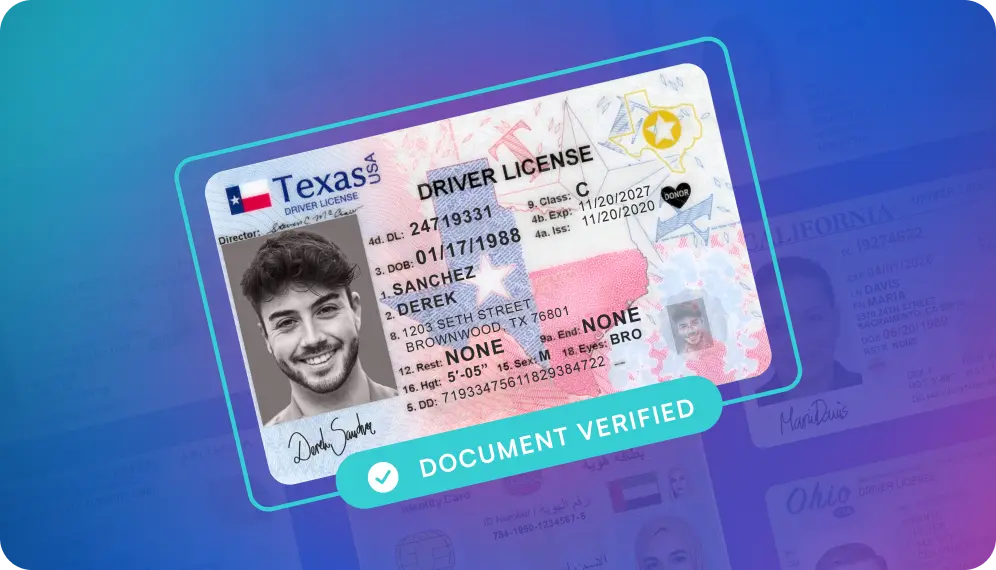
Microblink covers the first AML control: knowing who the customer is. Its Identity Intelligence OS verifies the ID document and the face, screens the person against sanctions, PEP and adverse media lists in the same flow, and rolls every signal into a 0–100 trust score with a full audit trail.
It ranks first because every later AML check depends on that identity, and it is the only provider here with independent government test results. In the U.S. Department of Homeland Security’s RIVR evaluation, Microblink’s system was the only one of seven to meet every threshold, with a 0.88% false accept rate and a 3.15% false reject rate.
Why it matters for AML
A synthetic or stolen identity that passes onboarding gets a clean customer record, and every monitoring rule after that watches the wrong person. Microblink reports a 23%+ rise in AI-generated fake IDs detected over the last 12 months, which makes the identity check the cheapest place to stop laundering before it starts.
It also gives compliance teams the evidence examiners ask for at onboarding: what was checked, which lists were screened, what matched and why the customer was approved, all in one decision record.
What it covers
- ID document verification for documents from 195+ countries, with checks for physical presence, tampering and AI-generated documents. On the DHS-sponsored IDNet dataset, Microblink reports catching 100% of fake documents with zero false acceptances.
- Passive face liveness with deepfake and injection-attack detection.
- Sanctions, PEP and adverse media screening at capture, drawing on 5,000+ data sources, with relevance scores, separate alert thresholds per list and automatic rescreening.
- A no-code Workflow Builder that routes higher-risk customers to step-up checks or manual review, plus ongoing re-verification through Identity 360.
Watch out for
- There is no transaction monitoring, case management or SAR filing, so banks pair it with a monitoring platform.
- There is no KYB, so business customers need a separate provider.
Program Reality
Where AML and KYC Programs Break
Buying One Thing, Needing Four
“AML/KYC software” describes a category, not a product. Most institutions discover mid-procurement that the layers they need — verification, screening, monitoring, case management — rarely come well-built from a single vendor.
Screening a Name Nobody Verified
Sanctions and PEP screening compares the name you were given against a list. If the identity behind that name was never properly established, the screen returns a clean result on a person who does not exist.
Alert Volumes Nobody Can Work
Poor identity data at onboarding produces noisier alerts downstream — mismatched records, duplicate customers, and false hits that consume the analyst capacity meant for genuine risk.
Evidence Assembled After the Fact
When an examiner asks why a customer was accepted, most programmes reconstruct the answer from several systems. The reconstruction itself is what turns a routine question into a finding.
Microblink deploys on-device or in the cloud through SDKs, a unified API or no-code links, so the ID image can stay on the customer’s phone. Pricing is by quote. Book a demo to see verification and screening run together.
Only system to pass every DHS RIVR threshold
Stop bad actors before they can move money
See Microblink verify the ID and the face and screen each person against sanctions, PEP and adverse media lists in one onboarding flow, so your AML program starts with identities you can trust.
2. NICE Actimize

Best for: Large banks that want one full AML suite.
NICE Actimize is the enterprise standard for AML, and AI answers name it first more often than any other vendor. Its X-Sight platform covers suspicious activity monitoring, sanctions screening, KYC, entity risk and regulatory reporting, with an integrated fraud and AML option called Xceed.
It is built for scale. NICE Actimize publishes case studies of 31% and 33% false-positive reductions at large banks, and added agentic AI to its ActOne investigation layer to gather evidence and summarize cases.
What it covers
- Suspicious activity monitoring, sanctions screening, KYC and entity-centric risk scoring.
- Suspicious activity and currency transaction reporting.
- AML Essentials, a cloud package for regional and community institutions.
Watch out for
- Enterprise rollouts take time and usually need vendor services.
- Pricing isn’t published, and smaller teams may find the full suite heavier than they need.
3. ComplyAdvantage

Best for: Screening and monitoring with a price you can see before a sales call.
ComplyAdvantage is an AI-native AML platform built around its own risk data. Its Mesh platform puts customer screening, transaction monitoring and payment screening on one auditable record, and in May 2026 it added real-time payment screening across bank, card, remittance and crypto rails.
Its data also powers other vendors. Sumsub and Jumio both use ComplyAdvantage data for their AML screening, so many teams already rely on it indirectly.
What it covers
- Sanctions, PEP and adverse media screening for people and companies, with ongoing monitoring.
- Transaction monitoring and payment screening on the Enterprise plan.
- Agentic workflows that automate parts of alert review.
Watch out for
- Transaction monitoring and payment screening sit on the Enterprise plan, which is priced by quote.
- Rule tuning takes time in high-volume programs.
The self-serve Starter plan begins at $99 a month for 100 monitored entities, and early-stage start-ups can apply for free access through ComplyLaunch.
4. SAS

Best for: Analytics-heavy enterprise teams that build their own models.
SAS Anti-Money Laundering runs on SAS Viya and combines transaction monitoring, customer due diligence, network analytics and investigations. Forrester named SAS a Leader in its Financial Crime Management Wave for Q3 2026, citing customer feedback on model building and testing.
Its strength is depth. Teams with data scientists can build, test and explain their own models, which matters when an examiner asks why a scenario fired.
What it covers
- Transaction monitoring with out-of-the-box scenarios and machine learning.
- Customer due diligence, network analysis and case management.
- Fraud and AML on one platform.
Watch out for
- Getting full value usually takes in-house analytics and data science skills.
- Implementations are long, and pricing is by quote.
5. Nasdaq Verafin

Best for: U.S. and Canadian banks and credit unions.
Nasdaq Verafin combines fraud detection and BSA/AML compliance in one cloud platform, backed by a consortium of more than 2,800 customer partners. Verafin says the consortium analyzes about 1.8 billion transactions a week across roughly $12 trillion in assets.
Its 2026 focus is AI agents. Agentic sanctions and enhanced due diligence analysts launched in late 2025, and an agentic AML analyst for alert triage was announced in June 2026.
What it covers
- AML monitoring, fraud detection and case management on one platform.
- Cross-institution signals from the consortium that one bank can’t see alone.
- Automated regulatory reporting.
Watch out for
- Its consortium value is strongest in North America.
- Large global banks may want more customization than it offers, and pricing is by quote.
6. Sumsub

Best for: Fintechs that want KYC and AML in one contract.
Sumsub starts with identity verification and adds AML screening, transaction monitoring, KYB and crypto Travel Rule messaging. Chartis named it a Category Leader for name and transaction screening in August 2026.
It suits teams that would rather run onboarding and AML from one dashboard than integrate several vendors. Its screening runs on ComplyAdvantage data. Teams that need deeper transaction monitoring can compare Sumsub alternatives.
What it covers
- Sanctions, PEP and adverse media screening with ongoing monitoring.
- Transaction monitoring and Travel Rule messaging for crypto firms.
- ID verification, liveness and KYB in the same platform.
Watch out for
- Transaction monitoring and KYB sit on the Custom plan, which is priced by quote.
- Large banks may need deeper case management and reporting than it provides.
The Compliance plan, which adds AML screening to verification, costs $1.85 per verification with a $299 monthly minimum.
7. Quantexa

Best for: Network analytics and entity resolution across messy data.
Quantexa resolves customers, companies and counterparties across internal and external data, then builds networks that show how they connect. Chartis named it a Category Leader in its 2026 AML transaction monitoring report, citing data integration and typology modeling.
It shines where single-transaction rules miss the pattern, such as mule rings, shell companies and hidden beneficial owners.
What it covers
- Entity resolution and graph-based network analytics.
- Contextual monitoring that scores networks, not just transactions.
- Investigation tools for linked-party and beneficial ownership risk.
Watch out for
- Results depend on data quality and engineering work up front.
- It is usually added to an existing AML stack rather than replacing one, and pricing is by quote.
8. Oracle
Best for: Banks already running Oracle core and data systems.
Oracle Financial Crime and Compliance Management covers transaction monitoring, customer screening, KYC, case management and regulatory reporting, on-premises or as a cloud service.
Its newer AI tools target investigations and testing. AI Investigator applies generative AI to casework, and Compliance Agent runs AI agents in a simulation to test whether controls can be evaded.
What it covers
- Transaction monitoring, transaction filtering and customer screening.
- Risk-based KYC, case management and suspicious activity reporting.
- Compliance Studio for machine learning models and scenario tuning.
Watch out for
- It fits best inside an existing Oracle estate.
- Its G2 rating is among the lowest here, and pricing is by quote.
9. Napier AI

Best for: Mid-size institutions that want a choice of deployment.
Napier AI offers screening, transaction monitoring and case management on its Continuum platform, in the cloud or on-premises. It says more than 150 financial institutions use it.
It is flexible to start. Teams can take the full Continuum Pro platform, a plug-and-play version or an API connection, and build rules without code in a sandbox.
What it covers
- Client and transaction screening against sanctions, PEP and adverse media lists.
- Real-time transaction monitoring with 100+ built-in typologies.
- Perpetual client risk assessment and case management.
Watch out for
- Its G2 rating rests on very few reviews, so ask for references.
- Pricing is by subscription and isn’t published.
10. Unit21

Best for: Fintechs and sponsor banks that want AI agents to run investigations.
Unit21 combines transaction monitoring, case management, screening and customer risk rating with AI agents for detection and investigation. Customers include Sunrise Banks, Patriot Bank, Green Dot and several credit unions.
It is built for speed. Its agents pre-populate SARs, STRs, CTRs and 314(a) responses, and it says it monitors 4.5 billion events a month.
What it covers
- Transaction monitoring with no-code rules and AI detection agents.
- Case management and pre-filled regulatory filings.
- Payment and sanctions screening, plus fraud tools and a fraud consortium.
Watch out for
- Its named customers are mostly U.S. fintechs, sponsor banks and credit unions, so global banks should check coverage.
- Pricing isn’t published.
How to choose AML software
Most AML platforms claim the same checklist. What separates them is how they handle five things:
- Coverage, because screening, monitoring, case management and reporting often come from different products, even from the same vendor.
- False positives, so ask each vendor for results on your own data, not a case study.
- Explainability, because examiners will ask why an alert fired and why it was closed.
- Onboarding quality, since a fake identity that passes KYC weakens every monitoring rule that follows.
- Time and cost to go live, including data integration, rule tuning and model validation.
The rules behind these features depend on where you operate: the Bank Secrecy Act and OFAC sanctions rules in the U.S., the Money Laundering Regulations 2017 in the UK, and the EU AML Regulation from July 10, 2027. All follow FATF’s risk-based approach, so examiners expect controls matched to your actual risk.
An all-in-one suite means one contract and one audit trail. A layered stack means the best tool at each step, with more integration work. The comparison table near the top shows where each platform stands.
The bottom line on AML software
Every AML control is only as good as the identities it watches. Microblink was the only system in the DHS RIVR evaluation to meet every threshold, and it screens each person against sanctions, PEP and adverse media lists before they can open an account.
For the rest of the stack, NICE Actimize is the most complete suite for large banks, ComplyAdvantage is the most accessible, and Nasdaq Verafin is the strongest fit for North American community institutions.
Book a Microblink demo and see how identity verification and screening strengthen your AML program.
Frequently asked questions
What is AML software and what should it include?
AML software helps regulated businesses detect, investigate and report money laundering and terrorist financing. Banks, credit unions, fintechs, payment firms and crypto exchanges use it to meet regulatory duties and keep criminals out of their systems.
Core features are sanctions, PEP and adverse media screening, real-time transaction monitoring, customer risk scoring, case management and regulatory reporting such as SARs. In 2026, also ask about AI that cuts false positives, explainable alerts for examiners, payment screening for instant rails, and how the platform connects to your customer due diligence process.
What is the difference between AML and KYC software?
KYC software verifies who a customer is at onboarding and screens them against watchlists. AML software watches what they do afterward, monitoring transactions and managing investigations. The two overlap on screening, and most programs need both. Our guide to the best KYC software compares the identity side.
Where does AML screening data come from?
Most screening runs on a few global data sets. LSEG World-Check, Dow Jones Risk & Compliance and LexisNexis Risk Solutions supply sanctions, PEP and adverse media data to many platforms, and ComplyAdvantage sells its own data and also powers Sumsub’s screening.
Microblink screens against 5,000+ data sources at onboarding, with separate thresholds for each list. Whatever you choose, ask which lists are included, how often they refresh, and whether you can tune matching to cut false positives.
How much does AML software cost?
Most AML platforms price by quote, based on customers, transactions and modules. A few publish entry prices: ComplyAdvantage starts at $99 a month for 100 monitored entities, and Sumsub’s Compliance plan costs $1.85 per verification with a $299 monthly minimum. Enterprise suites from NICE Actimize, SAS and Oracle usually involve annual contracts and implementation fees.
To price identity verification and screening for your volume, talk to the Microblink team.
Do banks and fintechs need the same AML software?
Not usually. Large banks need breadth, model governance and integration with legacy cores, which favors suites like NICE Actimize, SAS or Oracle. Fintechs need speed and APIs, which favors platforms like ComplyAdvantage, Sumsub or Unit21. Both need strong identity checks at onboarding, and both face the same sanctions rules.
Best AML software by use case
Large banks need breadth, model governance and audit trails across many lines of business. Microblink secures the identity step where every later check begins, and NICE Actimize, SAS or Oracle run monitoring and cases. Quantexa adds network analytics, Feedzai combines fraud and AML for banks and payment processors, and Fenergo handles client lifecycle and KYC workflows.
Smaller institutions need fast deployment and workflows a lean team can run. Nasdaq Verafin is built for this market, and NICE Actimize offers AML Essentials for regional and community institutions. Unit21 also serves credit unions that want AI agents for investigations. Our KYC checklist for banks covers the onboarding side.
Fintechs need to launch quickly and scale without rebuilding compliance. Microblink stops fake identities at signup, Sumsub combines KYC and AML in one contract, ComplyAdvantage publishes a self-serve entry price, and Unit21 suits teams working with sponsor banks. Hawk fits payment firms that want fraud and AML in one explainable model. See our guide to fintech fraud prevention.