The Barcode Tell: How Perfect Fakes Give Themselves Away

For years, document fraud has largely been a visual problem. Fraud analysts learned to look for blurry fonts, mismatched typefaces, inconsistent shadows, and signs that someone had altered a photo in Photoshop. As image editing tools improved, those visual tells became harder to spot, but they were still there.
Generative AI changes that equation.
Today, creating a document that looks authentic no longer requires technical expertise. With modern image generation and editing models, fraudsters can produce IDs that appear remarkably convincing in minutes. In many cases, they’re almost too perfect. Every edge is crisp. Every character is aligned. Every surface is unnaturally clean.
Ironically, perfection itself is beginning to look suspicious. But while AI has transformed the appearance of fraudulent documents, it hasn’t changed a fundamental truth about identity documents: they’re more than images.
They’re structured records containing layers of information that can be validated independently.
Looking Beyond What the Eye Can See
One of the emerging fraud patterns we’ve observed is a growing number of AI-assisted documents that successfully imitate the visual appearance of legitimate IDs but fail when examined beneath the surface.
The reason is simple: Most fraudsters focus on what humans and many automated systems actually inspect: the front of the document.
Far fewer pay attention to the data embedded inside it.
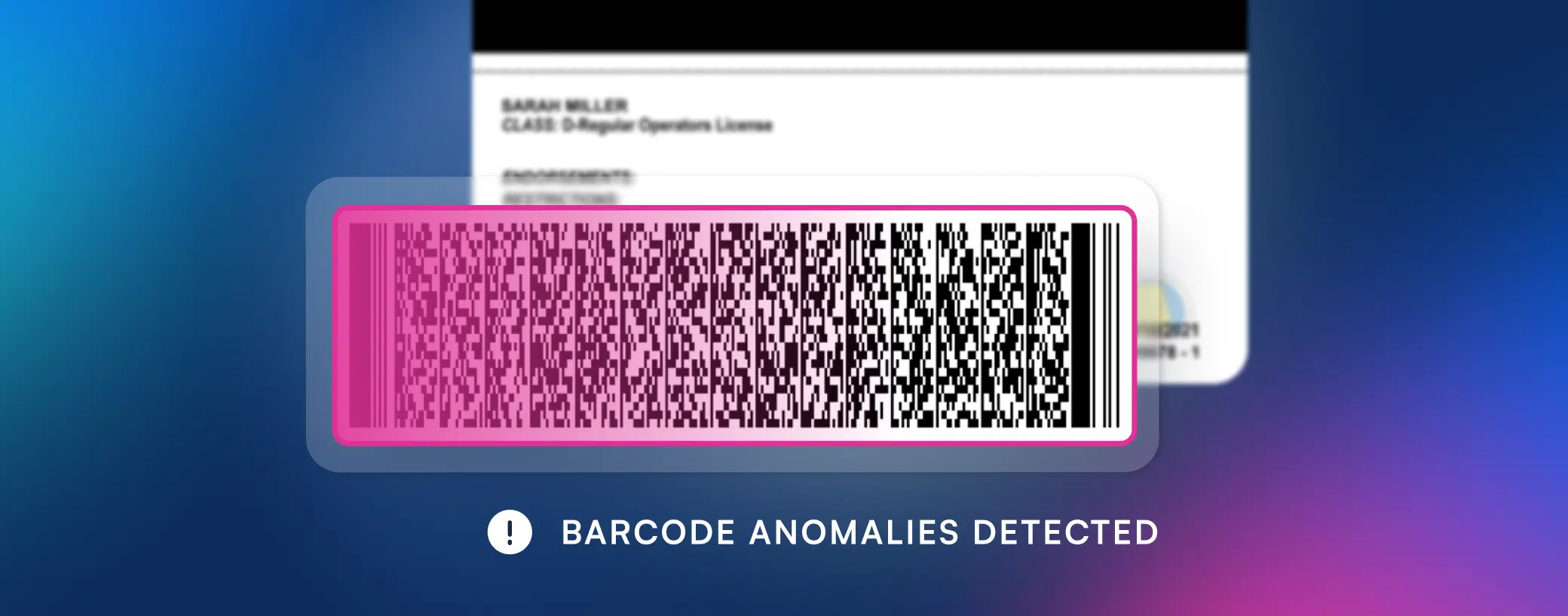
Modern driver’s licenses and many government-issued IDs contain machine-readable zones, PDFs417 barcodes, and other encoded data that represent the document’s identity in a structured format. That information should precisely match what appears on the face of the credential. When it doesn’t, the document tells on itself.
The Barcode Doesn’t Care How Good the Fake Looks
Think of a barcode as the document’s own witness statement. The visible information says one thing. The encoded data says another. When those two stories don’t match, authenticity breaks down.
We’ve increasingly seen documents that appear physically flawless but contain barcode anomalies that reveal manipulation. Sometimes names don’t align. Dates differ. Fields have been modified visually but never updated within the encoded payload. In other cases, inconsistencies suggest synthetic generation rather than legitimate issuance.
These mismatches are easy to overlook if verification stops at image analysis. They’re difficult to ignore when the underlying data is actually validated.
Why This Trend Matters
Today, AI-assisted document manipulation still represents a relatively modest percentage of overall fraud attempts.
Every new generation of AI tools lowers the cost of producing convincing fakes while increasing their quality. Tasks that once required specialized software and significant expertise can now be completed in minutes using widely available models.
The economics continue to improve for attackers. That means organizations shouldn’t simply prepare for more sophisticated fraud. They should prepare for fraud that becomes dramatically easier to produce at scale.
Identity Verification Needs More Than Image Analysis
As AI-generated content improves, organizations will naturally invest in better AI detection.
That’s important. But equally important is validating the information that AI cannot simply “paint” onto a document.
Cross-checking visible information against encrypted barcode data, document structure, security features, and other independent signals creates a much stronger foundation for establishing trust than relying on appearance alone.
In many cases, the question isn’t whether an image looks authentic. It’s whether the document can consistently prove its authenticity across every layer of validation.
Trust Requires Multiple Signals
The next generation of document fraud won’t always be obvious.
Many fraudulent IDs will look convincing enough to pass a visual inspection, whether performed by a person or an automated system.
That’s why identity verification is increasingly becoming an exercise in corroboration rather than observation. Every signal tells part of the story. The image. The barcode. The document’s security features. The issuing authority’s expected data structure.
When those signals agree, confidence grows. When they don’t, even the most visually convincing fake begins to unravel.