
What Is True Rejection Rate?

When an identity verification system encounters a fraudulent user, manipulated document, or other invalid input, one of its most important jobs is simple: reject it. True Rejection Rate (TRR) measures how often a system gets that decision right.
TRR is an important metric for evaluating fraud detection, identity verification, biometric authentication, and other systems that must distinguish between legitimate and illegitimate inputs. A high True Rejection Rate indicates that a system is successfully identifying and rejecting invalid attempts. But TRR cannot be evaluated in isolation. Organizations also need to understand how security thresholds affect legitimate users, false rejections, conversion rates, and the overall customer experience.
As generative AI makes deepfakes, synthetic identities, and manipulated identity documents easier to create at scale, understanding these relationships is becoming even more important. Organizations need verification systems capable of identifying sophisticated fraud without creating unnecessary friction for legitimate users.
Understanding the True Rejection Rate
True Rejection Rate measures the proportion of invalid or unauthorized attempts that a system correctly rejects. In identity verification, for example, this could include a fraudulent identity document, an unauthorized user attempting to access an account, or an identity that fails to meet the required verification criteria.
TRR also applies beyond identity and biometrics. In manufacturing, it can describe a quality control system’s ability to correctly reject defective products. In pharmaceutical production, it can help measure whether products that fail to meet required standards are successfully identified and removed. Across these applications, the underlying principle remains the same: TRR measures how reliably a system recognizes something that should not be accepted.
A high TRR is generally desirable because it indicates that invalid inputs are being detected successfully. However, maximizing TRR without considering other metrics can create problems. A system configured to reject nearly everything suspicious could achieve strong fraud detection while simultaneously rejecting large numbers of legitimate users.
That’s why TRR needs to be considered alongside metrics such as False Rejection Rate (FRR), False Acceptance Rate (FAR), and True Acceptance Rate (TAR).
True Rejection vs. False Rejection
True and False Rejection Rate (FRR) respresent two entirely different outcomes. A true rejection occurs when an invalid user or input is correctly rejected. A false rejection occurs when a legitimate user or valid input is incorrectly rejected.
This is because TAR and FRR are mathematical complements, as are TRR and FAR. Specifically:
- TAR = 1 – FRR
- TRR = 1 – FAR
In other words, if a system has a False Acceptance Rate of 2%, its True Rejection Rate is 98%. Similarly, a False Rejection Rate of 5% corresponds to a True Acceptance Rate of 95%.
The relationship illustrates why organizations shouldn’t optimize a verification system around a single number. Raising a decision threshold may make it harder for fraudulent users to get through, but it can also make verification more difficult for legitimate users. The objective is to find the appropriate balance between stopping fraud and allowing legitimate users to proceed with as little friction as possible.
How Do You Calculate True Rejection Rate?
rue Rejection Rate is calculated by dividing the number of invalid attempts correctly rejected by the total number of invalid attempts:
TRR = True Rejections / Total Invalid Attempts
For example, suppose an identity verification system is tested using 1,000 known fraudulent or otherwise invalid attempts. If the system correctly rejects 980 of them and incorrectly accepts 20, its True Rejection Rate would be:
980 / 1,000 = 98% TRR
That also means the system has a 2% False Acceptance Rate.
Testing methodology matters, however. A TRR calculated from a small or unrepresentative sample may not accurately reflect how a system performs in the real world. Testing should include a sufficiently large and representative dataset containing the types of documents, devices, users, attack methods, and environmental conditions the system is likely to encounter.
Organizations should also evaluate performance over time rather than treating a single test as permanent proof of effectiveness. Fraud techniques change, user behavior evolves, new devices enter the market, and AI-generated attacks continue to improve. Verification performance should therefore be continuously measured against changing real-world conditions.
Applications of True Rejection Rate
TRR finds its application in various real-world scenarios beyond traditional security and biometrics.
In digital platforms, particularly in the eCommerce sector, TRR’s role is becoming increasingly critical. With the surge in online payment fraud, estimated at $41 billion globally in 2022 and expected to grow to $48 billion by 2023, TRR is essential in accurately identifying and rejecting unauthorized access to financial accounts or sensitive data.
TRR ensures that only products meeting stringent quality criteria make it to the market in industrial settings. This is particularly important in sectors like automotive or electronics manufacturing, where a single faulty component can have far-reaching consequences.
Machine learning applications of True Rejection Rate
In the field of machine learning, TRR is essential in refining algorithms and models. It ensures these systems learn to accurately identify and reject outliers or erroneous data, thus improving their decision-making capabilities. This application is particularly crucial in systems where precision is key, such as fraud detection or predictive analytics.
Role of TRR in facial recognition
Facial recognition technology heavily relies on TRR to ensure accuracy and reliability. The technology must correctly identify and grant access to authorized users while maintaining a robust defense against unauthorized access attempts.
A high TRR in these systems means they can effectively differentiate between similar facial features and prevent mistaken identity cases, which is critical for maintaining security and user trust.
Why True Rejection Rate Matters for Fraud Prevention
For fraud and risk teams, TRR provides an important indication of how effectively a system identifies illegitimate activity. A low TRR means more fraudulent attempts are being incorrectly accepted, potentially exposing an organization to account takeover, payment fraud, identity theft, regulatory risk, and reputational damage.
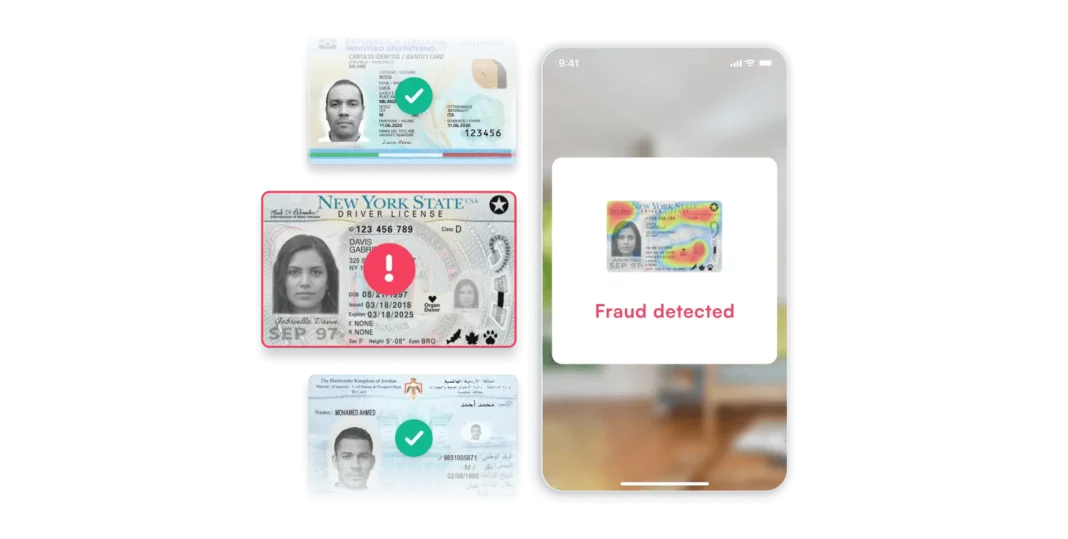
This has become particularly important as identity fraud evolves. Generative AI allows attackers to produce highly convincing fake or manipulated identity documents, while deepfakes can be used to impersonate legitimate users during biometric verification. Fraudsters may also use presentation attacks or attempt to inject synthetic imagery directly into a verification session rather than presenting a real person to a physical camera.
A modern verification system therefore needs to evaluate more than whether an image or face appears convincing. Document authenticity, biometric matching, liveness, injection attack detection, device information, behavioral signals, and other contextual indicators can all contribute to determining whether an interaction should be trusted.
The Business Impact of Rejection Rates
While failing to reject fraud creates obvious financial and security risks, rejecting legitimate users carries its own cost. A high False Rejection Rate can force genuine customers to repeat verification, submit additional information, contact customer support, or abandon onboarding entirely.
For businesses operating digital onboarding or payment workflows, those failures can translate directly into lost conversion and revenue. A prospective customer who repeatedly struggles to capture an identity document may simply leave. A legitimate account holder blocked from completing a transaction may lose trust in the service. At scale, even a relatively small increase in unnecessary rejection can create thousands of additional support requests or manual reviews.
The challenge for risk teams is therefore not simply maximizing fraud detection. It’s accurately separating legitimate users from fraudulent ones. Effective verification should create friction when risk warrants it rather than applying the same level of scrutiny to every interaction.
TWhat Factors Affect True Rejection Rate?
A variety of technological, environmental, and user-related factors can influence TRR. Image and sensor quality are particularly important in systems that rely on document capture or biometrics. Poor lighting, glare, blur, low-resolution cameras, or improperly positioned documents can make it harder for a system to distinguish between legitimate and fraudulent inputs.
Algorithm performance is equally important. Verification models must be capable of detecting meaningful indicators of fraud while accommodating the natural variations that occur among legitimate users and identity documents. That becomes increasingly difficult as fraudsters use generative AI to produce more realistic manipulated documents and biometric attacks.
User behavior can also influence results. People may hold documents at different angles, use older smartphones, capture images in poor lighting, or interact with verification systems differently because of age, disability, or other circumstances. Systems that aren’t designed to accommodate reasonable variation risk disproportionately rejecting certain legitimate users. Measuring rejection rates across different user populations, document types, devices, and environments can help organizations identify these disparities.
How Can Organizations Reduce Error Rates?
Reducing error rates begins with recognizing that identity verification is rarely best served by a single signal. A document that appears suspicious, for example, may warrant additional verification rather than an immediate rejection. Combining document analysis with biometric verification, liveness, device intelligence, behavioral analytics, and contextual risk signals can provide a more complete picture of an interaction.
Organizations can also use risk-based thresholds to determine when additional verification is necessary. A routine interaction from a known device may require very little additional friction, while an unusual transaction or significant change in behavior could trigger step-up verification. This allows businesses to concentrate stronger verification measures where risk is highest.
Fallback processes are equally important. When legitimate users cannot successfully complete one verification method, providing an alternative path can prevent an uncertain result from becoming an abandoned customer. Organizations should also continuously evaluate verification data to identify recurring sources of false rejection and adjust models, workflows, and user guidance accordingly.
What Is a Good True Rejection Rate?
There is no universal TRR benchmark that applies to every organization or use case. The appropriate threshold depends on the consequences of accepting an invalid user compared with the consequences of rejecting a legitimate one.
A high-security financial transaction, for example, may justify a much stricter threshold than a low-risk interaction. Organizations in highly regulated environments may also have different risk tolerances than businesses where user convenience carries greater weight.
Rather than pursuing a theoretically perfect TRR, organizations should determine acceptable error rates based on their specific fraud exposure, regulatory requirements, customer experience goals, and operational capacity. TRR should then be evaluated alongside FAR, FRR, TAR, conversion rates, manual review volumes, and other metrics that reveal the broader impact of verification decisions.
Building More Accurate Identity Decisions
True Rejection Rate remains an important measure of how effectively a system identifies and rejects invalid inputs. But the metric becomes far more valuable when viewed as part of a larger picture.
For identity verification, the goal isn’t simply to reject as much suspicious activity as possible. It’s to distinguish fraud from legitimate behavior accurately enough that organizations can strengthen security without unnecessarily disrupting genuine users. That requires continuously evaluating multiple signals, monitoring performance, and adjusting verification decisions as both user behavior and fraud techniques evolve.
As deepfakes, synthetic identities, document manipulation, and other AI-enabled attacks become more sophisticated, that balance will only become more important. Organizations that understand not just their True Rejection Rate, but why legitimate and fraudulent users are being accepted or rejected, will be better positioned to reduce fraud while maintaining the seamless experiences their customers expect.
If you are interested in learning more about how Microblink can help with TRR, request a demo today for all your verification needs.