
Demand Deposit Account (DDA) Fraud
Demand deposit account fraud is fraud against everyday transaction accounts — checking and current accounts, the ones customers can draw on without notice. It covers accounts opened fraudulently, accounts taken over, deposit and check schemes exploiting funds availability, and accounts recruited to move other people’s criminal money. What unites them is that the account is the instrument rather than the target.
| What a DDA is | An account payable on demand — checking and current accounts |
| Fraudulent opening | The account was never legitimate; it exists to receive or move funds |
| Account takeover | A genuine customer’s account is seized |
| Deposit fraud | Exploiting the gap between funds availability and settlement |
| Mule accounts | Genuine accounts used to move criminal proceeds |
| Structural driver | Funds are made available before a deposit finally settles |
| Sector information sharing | Account-abuse reporting databases used by many U.S. institutions |
| Control point | Account opening, for most of the categories |
Why the funds availability gap exists
The mechanism behind deposit fraud is regulatory rather than technical, and worth understanding before the fraud makes sense.
Customers expect deposited money to be usable quickly, and in the United States rules require institutions to make funds available within defined timeframes. Final settlement takes longer. That difference is deliberate policy — it stops banks holding customers’ money indefinitely — and it opens a window in which funds can be withdrawn against a deposit that has not cleared.
Check kiting, deposits of worthless or altered items, and the social-media variants that periodically go viral all exploit that same window. The institution is left having paid out against something that never settled, and it is usually pursuing a customer who has gone.
The window cannot be closed without breaking the availability rules, so the control has to be the account rather than the transaction: how confident is the institution about who opened it?
The four categories, and where each is caught
| Category | Whose account | Where it is caught |
|---|---|---|
| Fraudulent opening | Nobody real — stolen or fabricated identity | Account opening |
| Account takeover | A genuine customer’s | Login, step-up and recovery |
| Deposit and check schemes | Often a fraudulently opened account | Opening, and deposit-level risk rules |
| Mule activity | A genuine customer, knowingly or otherwise | Ongoing monitoring of flows |
Three of the four resolve to account opening. That is the pattern this glossary keeps returning to, and it is particularly stark here because a demand deposit account is the cheapest useful thing a fraudster can obtain — it receives money, moves money, and provides a verified-looking relationship with a bank that other services will then trust.
Why this matters for identity verification
A fraudulently opened DDA is new account fraud without a credit line, and the absence of credit changes the risk profile in a way that is easy to underestimate. There is no underwriting to pass and no limit to build, so the account is usable immediately — and because no money is lent, the opening receives less scrutiny than a card or loan application at many institutions.
That is backwards relative to how the account is actually used. A deposit account is the endpoint for P2P scam proceeds, the collection point for advance-fee and investment schemes, and the vehicle for mule networks. Its value to a fraudster is not what it contains but what passes through it.
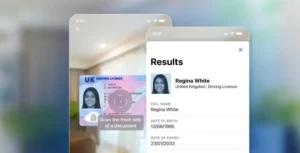
The control is the same one everything else here points at, applied to a product that has historically had less of it: an authenticated identity document and a biometric comparison at opening, so the account belongs to a real and identified person. Database and bureau matching is not sufficient, for the reason given under synthetic identity fraud — a fabricated identity built on a real identification number validates correctly. Identity document verification is what closes the opening vector, and payment fraud controls cover what moves through the account afterwards.
What controls can’t do
They cannot close the availability window. Making funds available before settlement is a rule, not an oversight, and the exposure it creates has to be managed at the account rather than the deposit.
Transaction monitoring does not see a fraudulent opening. Activity on the account is genuine activity by whoever opened it.
Mule accounts pass every account check. They are real accounts belonging to real, correctly identified people.
Tightening opening excludes real customers. Deposit accounts are the entry point to the financial system, and raising the evidence bar falls hardest on people with the fewest documents.
Frequently asked questions
What is a demand deposit account?
An account whose funds are payable on demand — a checking or current account, as opposed to one requiring notice for withdrawal. It is the everyday transaction account most customers hold.
What types of fraud affect deposit accounts?
Four broadly: accounts opened fraudulently with a stolen or fabricated identity, takeover of a genuine customer’s account, deposit and check schemes exploiting the gap between funds availability and settlement, and mule accounts used to move criminal proceeds. Three of the four are decided at account opening.
Why is deposit fraud possible at all?
Because funds are made available to customers before a deposit finally settles, which is a deliberate requirement rather than a flaw — it stops institutions holding customers’ money indefinitely. The gap creates a window in which funds can be withdrawn against a deposit that never clears.
Why do deposit accounts get less verification than credit products?
Because no money is being lent, so there is no underwriting step and the perceived risk is lower. That underestimates how the account is used: it is the endpoint for scam proceeds, the collection point for fraudulent schemes, and the vehicle for mule networks. Its value to a fraudster is what passes through it.
Related reading
- New account fraud — the same opening problem, on products that lend
- Money mule — the category that passes every account-level check
- P2P fraud — where a great deal of the money flowing through these accounts comes from
- Account validation service — confirming an account exists, and why that is not confirming a person