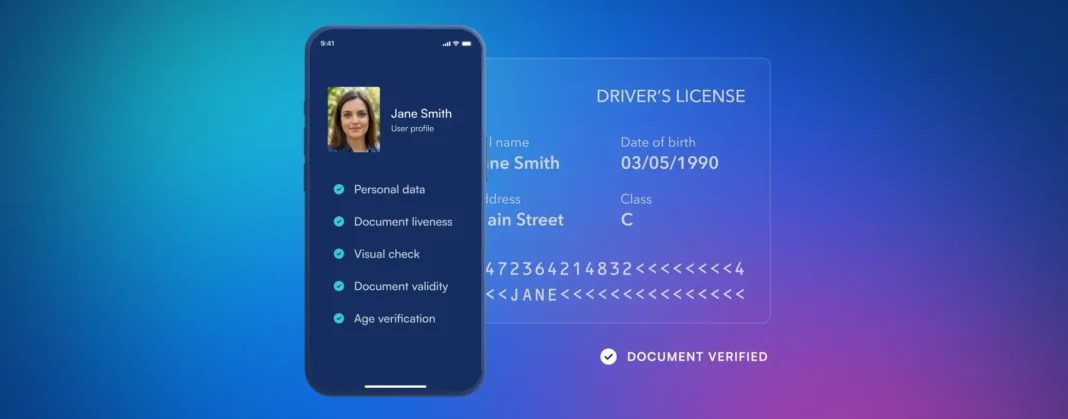

3 ways automated document verification software speeds up onboarding


By automating the verification of important documents like IDs, passports, and licenses, businesses can expedite the process, reduce manual effort, improve accuracy, and aid compliance. In this article, we’ll explore three key ways that automated document verification can help organizations onboard new customers or employees more quickly and efficiently.
For highly-regulated and fraud-vulnerable products and services, ID verification is a practical, often seamless way to confirm a user’s identity. Digital banks, payment apps, home delivery services, and online gambling sites are just a few examples of where some level of ID verification is required.
Without automation, identity verification is marred by slow processing times, false positives, and significant operational overhead. One survey found that 26% of financial services customers who dropped from onboarding did so due to experiencing friction in the identity verification process.
Smoothing out that friction and reducing lost revenue is possible with the right solution. Thanks to advancements in ID scanning software, organizations can now streamline document verification and speed customers through that tedious section of an onboarding process.
What Is Automated Identity Document Verification?
Automated verification is the use of AI-powered software to instantly inspect identity documents, extract and validate user information, and confirm legitimacy with little or no manual review.
Automated vs. Manual Verification
Understanding the value of automation starts with recognizing the limitations of manual verification:
| Manual Verification | Automated Verification | |
|---|---|---|
| Speed | Minutes to days | Seconds |
| Scalability | Limited by headcount | Scales on demand |
| Accuracy | Prone to human error | Consistent, ML-driven |
| Cost | High per-review labor cost | Lower cost per verification |
| Availability | Business hours only | 24/7 |
Manual processes require trained staff to visually inspect documents, cross-reference data, and make judgment calls—a process that is slow, inconsistent, and difficult to scale. Automated systems apply the same checks instantly and consistently across every submission, reducing both error rates and operational costs.
From a user’s perspective, automated verification is simple:
- Scan the front and back of an ID with a mobile camera
- Take a selfie (if required)
- Submit for instant verification
Types of Automated ID Verification Methods
Automated ID verification is not a single process—it encompasses several distinct methods, each with different strengths and applicable use cases. Most robust solutions combine two or more of these approaches.
1. Document Verification
Document verification focuses on authenticating the identity document itself. The system analyzes the physical and digital properties of the submitted document—security features, data consistency, formatting, and structural integrity—to determine whether it is genuine and unaltered.
Best for: Confirming that a submitted ID, passport, or license is authentic and has not been tampered with.
2. Biometric Verification
Biometric verification compares a live image or selfie of the user against the portrait on their identity document. Advanced implementations include liveness detection to confirm the user is physically present and not submitting a photograph or video of someone else.
Best for: Confirming that the person submitting the document is its legitimate owner.
3. Database Verification
Database verification cross-references extracted identity data against external records—such as government databases, sanctions lists, politically exposed persons (PEP) lists, or watchlists—to validate identity claims and flag high-risk individuals.
Best for: Meeting KYC and AML compliance obligations, and identifying fraudulent or high-risk applicants.
For industries like banking, fintech, crypto, e-commerce, and gig-economy services, combining all three methods eliminates the delays, errors, high costs, and regulatory risks associated with manual KYC processes.
How Automated ID Verification Works: Step by Step
Behind the scenes, a complete automated verification flow typically follows this sequence:
- Image capture and quality enhancement — The system detects the document, checks for blur, glare, or obstruction, and separates it from the background to produce a clean, horizontally aligned image.
- OCR and data extraction — Optical character recognition (OCR) and machine learning extract printed data from the Visual Inspection Zone (VIZ), as well as encoded data from barcodes and the Machine-Readable Zone (MRZ).
- Field consistency checks — The system compares data across all document zones to identify mismatches that may indicate tampering.
- Security feature authentication — The system checks for the presence and correct placement of holograms, watermarks, microprint, and other document-specific security elements.
- Biometric face matching — The portrait on the document is compared against the user’s selfie using facial recognition technology.
- Liveness detection — The system verifies that the selfie was captured from a live person rather than a static image, video replay, or deepfake, preventing presentation attacks.
- Database cross-referencing — Extracted identity data is checked against sanctions lists, PEP lists, watchlists, or other relevant databases to flag high-risk individuals.
- Decision delivery — A verification result is returned in seconds, either approving the user, flagging for review, or rejecting the submission.
3 Ways Automated Verification Speeds Up Onboarding
1. Comparing ID Fields for Consistency
Almost every ID has the document holder’s personal data encoded in some way, whether in a barcode or a Machine-Readable Zone (MRZ). Any mismatch between this encoded data and the data printed on the rest of the document (i.e., the Visual Inspection Zone or VIZ) is a telltale sign of tampering.
Reading unstructured data across diverse document types requires deep document expertise and flexibility on the part of the ID scanner. IDs vary significantly from country to country in their structure, encoding conventions, and field layouts—making this a task that is both time-consuming and error-prone when performed manually.
AI-based solutions stand out here because extensive machine learning training enables them to understand the context of the information being read and extracted. Within seconds, the solution verifies consistency across all ID fields, including comparing the back of the document to the front—a check that would take a human reviewer significantly longer to perform reliably.
2. Checking Security Features
Every ID comes with its own unique set of security features, including holograms, logos, watermarks, and microprint. Checking for the presence and correct location of these security features is a crucial step in verifying whether a document is genuine or fraudulent.
A key challenge is image quality. Studies have found that images of insufficient quality were the main reason for failed verification of identity documents. People tend to submit ID photos that are blurry, obscured, low in resolution, or held at an unreadable angle.
Intelligent document verification software addresses this automatically—first detecting the document, checking for any blurring or other hindrances, and then separating it from its background. The result is a clear, properly aligned image ready for security feature analysis, removing human error and camera quality variability from the equation.
3. Matching the User’s Face and ID Portrait
Confirming that an ID is authentic is only part of the verification challenge. Organizations must also confirm that the person submitting the document is its legitimate owner—particularly given the rise of synthetic identity fraud, where fraudsters combine fabricated identities with real personally identifiable information (PII) such as social security numbers.
Biometric face matching addresses this by comparing a user’s selfie to the portrait on their identity document. Sophisticated technology, trained on diverse ID types and real-world images, automates what a bank teller, cashier, or TSA agent does when verifying customers in person.
Critically, liveness detection is applied alongside face matching to prevent presentation attacks—ensuring the selfie was captured from a live person rather than a photograph or video of someone else. If the distinctive physiological characteristics across both images match and liveness is confirmed, there is a high likelihood the user is the genuine owner of the submitted document.
Compliance and Regulatory Context
Compliance is one of the most significant drivers for adopting automated ID verification. Regulatory requirements across industries mandate that organizations verify customer identities, monitor for financial crime, and protect personal data—obligations that are difficult to meet consistently at scale with manual processes.
KYC and AML Requirements
Know Your Customer (KYC) regulations require financial institutions and other regulated businesses to verify the identity of their customers before establishing a relationship. Automated ID verification directly supports KYC compliance by providing a documented, auditable verification process.
Anti-Money Laundering (AML) directives—including the EU’s 5th and 6th Anti-Money Laundering Directives (5AMLD/6AMLD)—extend KYC obligations and require organizations to conduct enhanced due diligence on high-risk customers, screen against sanctions and PEP lists, and maintain detailed records of verification activities. Automated systems with integrated database cross-referencing are well-positioned to support these requirements.
Data Privacy Obligations
GDPR (General Data Protection Regulation) governs how organizations in the EU collect, process, and store personal data—including the biometric and identity data captured during verification. Organizations must ensure that their verification solution:
- Processes only the minimum data necessary for the verification purpose
- Retains data only for as long as legally required
- Provides appropriate security controls for sensitive PII and biometric data
- Supports data subject rights, including access and deletion requests
Industry-Specific Regulations
- PSD2 (Payment Services Directive 2): Requires Strong Customer Authentication (SCA) for electronic payments in the EU, making robust identity verification a compliance requirement for payment service providers.
- HIPAA: In the US healthcare sector, identity verification is a component of protecting patient data and ensuring that only authorized individuals access sensitive health information.
- FinCEN requirements: In the United States, the Financial Crimes Enforcement Network mandates Customer Identification Program (CIP) procedures that require identity document collection and verification for financial institutions.
Automated ID verification solutions that provide audit trails, configurable data retention policies, and documented verification decisions help organizations demonstrate compliance during regulatory reviews.
Key Benefits of Automated ID Verification
Beyond speed, automated document verification delivers measurable business and operational advantages:
- Faster onboarding: Verification decisions in seconds rather than hours or days reduce drop-off and improve conversion rates.
- Reduced operational costs: Eliminating or significantly reducing manual review lowers the cost per verification and frees staff for higher-value tasks.
- Improved accuracy: Consistent, ML-driven checks reduce the false positive and false negative rates associated with human review.
- Scalability: Automated systems handle volume spikes without additional headcount, supporting business growth.
- Fraud reduction: Multi-layered checks—document authentication, biometric matching, liveness detection, and database screening—create compounding barriers to fraudulent onboarding.
- Compliance support: Automated audit trails and configurable workflows help organizations meet KYC, AML, and data privacy obligations.
Summary
Automated identity document verification combines document authentication, biometric verification, and database cross-referencing to confirm user identity quickly, accurately, and at scale. By replacing slow, error-prone manual review with AI-powered checks—including OCR extraction, security feature analysis, face matching, liveness detection, and sanctions screening—organizations can onboard customers faster, reduce costs, improve fraud detection, and meet regulatory compliance obligations across KYC, AML, GDPR, and industry-specific frameworks.
For any organization still relying on manual verification processes, automated ID verification represents a direct path to a faster, more secure, and more compliant onboarding experience.