
Underbanked
An underbanked household has a bank or credit union account but still relies on financial services outside the banking system — check cashing, money orders, payday or pawn loans. The distinction from unbanked matters: these customers are already inside the system, and something about it is not meeting their needs.
| Definition source | FDIC National Survey of Unbanked and Underbanked Households |
| Definition | Has a checking or savings account, but used at least one nonbank financial service in the past 12 months |
| Latest figure | 14.2% of U.S. households — about 19 million — in 2023 |
| Trend | Up from 14.0% and 18.7 million households in 2021 |
| Qualifying services | Nonbank money orders, check cashing, international remittances, rent-to-own, payday, pawn, auto title and refund anticipation loans |
| Distinct from | Unbanked — no bank account at all |
| Common drivers | Timing of fund availability, fee structures, credit access, trust, documentation friction |
| Survey cadence | Biennial, conducted with the U.S. Census Bureau |
How it works
The FDIC definition is deliberately behavioral rather than attitudinal. A household counts as underbanked if it holds an account and used any of eight specific nonbank services in the past year. No judgment about why, no threshold on frequency — one payday loan in twelve months qualifies a household.
That precision is useful and also the source of most misreadings. Underbanked is not a synonym for low-income, and it is not a credit-quality signal. It describes a pattern of use, and the reasons behind the pattern vary enormously. Some households use check cashing because funds are available immediately rather than after a hold. Some use money orders because the fee is predictable while overdraft is not. Some use remittance services because their bank’s international transfer is slower and more expensive.
The eight services split into two groups. Three are transactional — money orders, check cashing, international remittances — and usually indicate a gap in speed, cost or convenience. Five are credit alternatives — rent-to-own, payday, pawn, auto title, refund anticipation — and usually indicate a gap in access. A household in the first group is a product problem; a household in the second is a credit problem. Treating them as one segment obscures both.
Why it matters for identity verification
Underbanked households are disproportionately affected by identity verification friction, and the mechanism is specific rather than general.
Traditional verification leans on data that assumes a long, stable, well-documented financial history — credit bureau records, address continuity, a thick file. Households that transact partly outside the banking system generate thinner files by definition. They fail knowledge-based authentication questions drawn from records they barely appear in. They get routed to manual review, asked for additional documentation, and abandon. The verification failed not because the person is risky but because the method assumed a footprint they do not have.
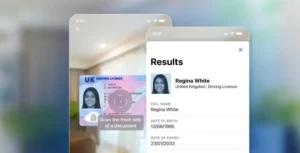
Document-based verification changes that dependency. A government-issued ID plus a biometric check establishes identity from something the applicant physically holds rather than from an accumulated record. Authenticating the document and matching it to a live face works the same way for a thin-file applicant as for anyone else — which is what makes it the more equitable method, not just the more secure one. Microblink’s eKYC workflow is built on that model.
Underbanked vs unbanked
| Underbanked | Unbanked | |
|---|---|---|
| Has a bank account | Yes | No |
| Share of U.S. households (2023) | 14.2% — about 19 million | Roughly 4% — about 5.6 million |
| Uses nonbank services | Yes, alongside a bank account | Yes, as the only option |
| Barrier to onboarding | Usually thin file or verification friction | Often documentation, minimum balance, or distrust |
| Opportunity for a provider | Deepen an existing relationship | Establish a first relationship |
Both segments are frequently discussed as one, and the reason to separate them is practical: the underbanked have already cleared account opening once, so the barrier is product fit. The unbanked have not, so the barrier is often onboarding itself.
What it can’t tell you
It is not a credit risk indicator. Using a check casher says nothing about repayment behavior. Treating the classification as a risk proxy conflates a service-usage pattern with creditworthiness, and does so in a direction that reliably disadvantages the households in question.
It is not a proxy for income. Underbanked households appear across the income distribution. Recent immigrants with substantial earnings frequently qualify through international remittance use alone.
The classification is binary and coarse. One money order in a year and weekly payday borrowing produce the same label. The category is useful for measuring a population and poor for assessing an individual.
It says nothing about identity risk. There is no relationship between thin financial data and likelihood of fraud — but because thin files fail data-based verification more often, underbanked applicants are systematically over-represented in manual review queues. That is an artifact of method, not a signal, and it is worth measuring separately before it hardens into policy.
Frequently asked questions
What percentage of Americans are underbanked?
14.2% of U.S. households — roughly 19 million — according to the FDIC’s 2023 National Survey, up from 14.0% in 2021. The survey is conducted biennially with the Census Bureau.
What is the difference between underbanked and unbanked?
Underbanked households have a bank account but also use nonbank services like check cashing or payday loans. Unbanked households have no account at all. They are separate populations with different barriers.
Why do people with bank accounts use check cashing services?
Usually speed and predictability. Cashed checks provide immediate funds while a deposit may be held for days, and a flat check-cashing fee is more predictable than the possibility of an overdraft charge.
Does being underbanked affect identity verification?
Indirectly but substantially. Verification methods that rely on credit bureau data and long address histories fail more often for thin-file applicants, so underbanked customers hit manual review disproportionately — a limitation of the method rather than a sign of elevated risk.
Related reading
- Account validation service — confirming a bank account belongs to the person opening it
- Sponsor bank — how fintechs reach underserved segments
- Know your customer — the requirement thin-file applicants struggle against
- Client onboarding in financial services — where verification friction turns into abandonment