
Step-Up Authentication
Step-up authentication asks for stronger proof of identity partway through a session, when the risk of the moment justifies it. The user is already signed in. Something about what they are attempting — the amount, the recipient, the device, the change — warrants more assurance than the login gave.
| Also known as | Step-up verification, adaptive authentication |
| Triggered by | Risk assessed in real time — amount, recurrence, channel, device, behavior, action sensitivity |
| Decision layer | Risk-based authentication scores the moment; step-up is what it invokes |
| Regulatory anchor | PSD2 strong customer authentication — Article 97 and Delegated Regulation (EU) 2018/389 |
| Exemption logic | Where risk analysis cannot rate a payment low risk, the provider reverts to full SCA |
| Dynamic linking | For payments, the code must be bound to the amount and payee, so it cannot be reused |
| Common factors | Device-bound passkeys, authenticator apps, biometric or document re-verification |
| Weakest common choice | SMS one-time codes — exposed to SIM swap and interception |
How it works
Authentication is usually a gate at the start of a session, which forces a bad choice: make every login demanding and lose customers, or make it easy and extend that weak assurance across everything the session then does. Step-up defers the cost to the moments that warrant it.
A risk engine scores each sensitive action on signals the user never sees — device reputation, location plausibility, behavior, the value and recipient of a transfer, whether a profile field is changing. Most actions clear without interruption; those that do not trigger an additional factor first.
European payment rules encode this pattern. Exemptions from strong customer authentication are calibrated on the level of risk, amount, recurrence and payment channel, and the transaction risk analysis exemption holds only while real-time analysis rates a payment low risk. Supervisory guidance is explicit that a payment which cannot be qualified as low risk reverts to strong customer authentication. One further requirement matters: the code must be dynamically linked to the amount and payee, so a captured code cannot authorize a different transaction.
Why it matters for identity verification
Most account takeover plays out after a successful login, on credentials obtained by phishing or breach. A login gate cannot catch it, because the attacker passes properly. The defensible position puts assurance where the loss occurs — the transfer, the payee addition, the address change, the credential reset.
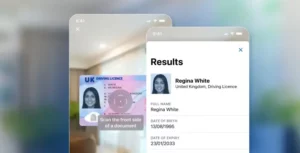
Which factor gets used decides whether any of this helps. A possession factor proves access to a device, not the presence of the account holder, and a stolen phone or swapped SIM satisfies it. Re-verifying the person — a live biometric against the identity enrolled at onboarding, or re-reading the document — closes the gap knowledge and possession factors leave. That makes identity document verification a step-up factor, not only an onboarding step.
Step-up vs MFA vs reauthentication
| Dimension | Step-up authentication | Multi-factor authentication | Reauthentication |
|---|---|---|---|
| When it happens | At a risky action mid-session | At login, every time | When a session ages or context shifts |
| Driven by | A real-time risk score | Policy, applied uniformly | Elapsed time or a changed condition |
| User experience | Invisible until it is needed | Consistent friction for everyone | Periodic interruption |
| Targets | The specific action | The session | The session |
| Catches post-login takeover | Yes | No | Sometimes |
| Can use biometrics | Yes | Yes | Yes |
What step-up authentication can’t do
It can’t be stronger than the factor it invokes. A step-up to an SMS code against an attacker who has already executed a SIM swap adds a step and no assurance. The trigger logic gets the attention in design reviews while the factor choice decides the outcome.
It can’t stop a victim who has been talked into it. In authorized push payment fraud the account holder completes every challenge willingly, believing the payment is legitimate. Authentication confirms the right person approved the transfer, which is what the scam needs. The control there is scam warnings and payee checks.
It can’t rescue a weak original enrollment. Re-verifying against the identity captured at onboarding proves continuity with that record, not that the record was ever true. A synthetic identity that passed onboarding will satisfy every subsequent step-up, because the comparison target is itself the fraud.
It can’t absorb a badly tuned threshold. Trigger too often and users approve prompts reflexively, the precondition for notification-fatigue attacks. Trigger too rarely and high-value actions pass unchallenged. The calibration is the control, and it is not set once.
Frequently asked questions
How is step-up authentication different from MFA?
Timing and selectivity. Multi-factor authentication applies a fixed set of factors at login for everyone. Step-up withholds the extra factor until a specific action looks risky, so most sessions never see it and the demanding moments get more assurance than a uniform policy would allow.
What triggers a step-up?
A risk score crossing a threshold. Typical inputs are transaction value and recipient, an unrecognized device or location, behavior diverging from the account’s pattern, and sensitive actions such as adding a payee. In European payments, failing to qualify for an exemption is itself the trigger.
Is step-up authentication required by PSD2?
The regulation does not use the term but builds the mechanism. Exemptions depend on a real-time low-risk assessment, and providers must revert to strong customer authentication when it fails — a risk-triggered escalation in all but name.
Which factor should a step-up use?
Prefer factors bound to the person or device rather than a phone number. Device-bound passkeys and biometric re-verification resist interception and SIM swap; SMS codes do not. For the highest-value actions, re-verifying the document and the face gives assurance about the human, not the handset.