
Security Laminate
A security laminate is the transparent film bonded over the printed surface of an identity document. It does two jobs at once: it protects the print underneath from wear, and it carries optical security features of its own — diffractive images, fine line work, sometimes microtext. The same component is also sold as a holographic overlay or holographic laminate.
| Also called | Holographic overlay, holographic laminate, security overlay, OVD patch |
| Two functions | Physical protection, and carrying optical features |
| Typically carries | A diffractive image, fine line patterns, microtext, sometimes UV-reactive elements |
| Applied by | Heat and pressure over the personalized surface |
| Designed to | Destroy itself on removal — tamper evidence |
| Found on | Driver licenses, ID cards, laminated passport data pages |
| Less common on | Polycarbonate documents, which have no separate layer |
Why the film destroys itself
A laminate is the last layer over the personalized data, which makes it exactly the thing an attacker needs to get past. Lift it, alter the photograph or the date of birth underneath, seal it back down, and you have a genuine document carrying false data. That attack is the reason security laminates exist in their current form.
The response is to engineer the film so it cannot survive removal. The adhesive bonds more strongly than the film’s own structure, so peeling tears it. Many designs add a frangible layer that fragments, or a pattern that transfers to the substrate and leaves a visible ghost where the laminate used to be.
The optical features on the film compound this. A diffractive image is applied as a continuous structure across the surface; disturb it and the effect breaks along the damage. Even a skilled removal and reapplication leaves the image discontinuous at the edges, which is visible when the document is tilted.
Which is why polycarbonate documents took a different route entirely. Rather than protecting the data with a layer, they fuse it inside the material so there is no layer to attack.
Why security laminates matter for identity verification
The laminate is where a great deal of the checkable evidence on a card actually lives. The diffractive image, the tilt behavior, the surface texture, the edge condition — all of it belongs to the film rather than to the print underneath.
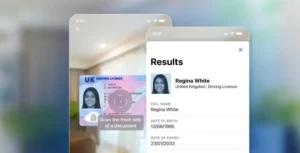
For remote verification, laminate features are partly reachable. The diffractive image is angle-dependent, so a single photograph does not show it, but capturing several frames as the document tilts does. Edge condition and lifting are visible in a good still image. This is one of the features where a live capture is meaningfully stronger evidence than an uploaded photograph, and where identity document verification benefits from motion rather than a single frame.
The counterintuitive part is that the laminate is often more informative than the data it protects. Printed values can be read from a flat scan; whether the document is genuine frequently comes down to how the overlay behaves.
What the laminate can carry
| Feature | How it appears | Survives a photograph? |
|---|---|---|
| Diffractive image | Shifts or moves as the document tilts | Only across multiple frames |
| Fine line work | Continuous hairlines across the surface | Yes, given resolution |
| Microtext | Legible only under magnification | Only at close range |
| UV elements | Invisible until placed under ultraviolet | No |
| Tamper pattern | Fragments or ghosts on removal | Yes, if damage is present |
What a security laminate can’t do
It protects a surface, not a substrate. A wholly counterfeit card with a convincing laminate passes a laminate check. The film speaks to the finishing process, not to whether the card was issued.
Quality varies enormously. Generic holographic overlays are commercially available and look plausible at a glance. The check is whether the image matches the known design for that document, not whether an image is present.
It wears. Scratches, clouding, and edge lifting accumulate on genuine documents. Damage is not evidence of tampering, which makes the judgment harder than it first appears.
Absence is not a finding on its own. Polycarbonate documents have no separate laminate at all. Expecting one on every card produces false alarms.
Frequently asked questions
What is the difference between a security laminate and a holographic overlay?
Nothing substantial — they are the same component under different names, along with holographic laminate and security overlay. Usage varies by manufacturer and by country. All describe the protective film applied over the personalized surface that also carries optical features.
Can a security laminate be removed and replaced?
It is engineered to make that fail. The adhesive bonds more strongly than the film itself, so peeling tears it, and many designs fragment or leave a ghost pattern on the substrate. Even a careful removal leaves the diffractive image discontinuous at the edges.
Do polycarbonate documents have a laminate?
Generally not a separate one. Polycarbonate cards are fused into a single block with the data engraved inside, so there is no overlay layer to protect or attack. Optical features are built into the material instead.
How can you check a laminate on a phone?
Tilt the document while capturing rather than taking a single still. The diffractive image only reveals itself across changing angles. Edge lifting and surface damage are visible in a single sharp image.