
Digital ID Verification: How to Avoid Common Pain-Points


In today’s digital landscape, digital identity verification (confirming an individual’s identity remotely) is crucial for nearly every online interaction. It builds trust between users and organizations while ensuring adherence to regulatory standards.
However, it’s not without its challenges. Users grapple with slow or complex onboarding while organizations navigate evolving threats. This constant balancing act between security and usability is a make-or-break situation. That’s why understanding digital identity verification is paramount, no matter what your organization does, as it forms the cornerstone of safe, reliable, and lawful digital transactions.
So, let’s talk about the challenges you’ll face with ID verification and what you can do about them.
What is digital ID verification?
Digital ID verification is the process of confirming that an individual is who they claim to be—remotely, without requiring physical presence. Unlike traditional in-person verification, where a person presents a physical document to a human agent face-to-face, digital verification uses technology to replicate and often exceed that level of assurance entirely online.
In a traditional setting, a bank teller or border agent visually inspects an ID card and compares the holder’s face to the photo. Digital verification automates and scales this process: a user submits a photo of their document and a selfie or video from any device, and the system performs the same checks—plus additional ones—in seconds. This means businesses can onboard customers anywhere in the world, at any time, without requiring a physical visit.
Digital ID verification combines multiple data inputs to establish identity:
- Identity documents such as passports, driver’s licenses, and national ID cards
- Biometric data such as facial recognition or fingerprint scans
- Digital signals such as device data, IP address, and behavioral patterns
Identity verification solutions combine document verification, biometric checks, and data validation to confirm that a document is genuine, that it belongs to a real person, and that the person presenting it is physically present during the verification attempt.
What are the benefits of digital identity verification?
The right remote identity verification system means more than just better security—although it certainly does that. Key benefits include:
- Improved customer experience: Eliminates cumbersome in-person verification and simplifies onboarding, reducing drop-off rates.
- Lower customer acquisition costs: Faster, automated processes reduce the operational overhead of manual reviews.
- Fraud reduction: Real-time document and biometric checks make it significantly harder for bad actors to use stolen or forged identities.
- Regulatory compliance: Supports adherence to KYC (know your customer) and AML (anti-money laundering) standards, reducing the risk of fines and reputational damage.
- Remote and global customer access: Businesses can verify and onboard customers across geographic borders without requiring a physical presence, opening access to international markets that in-person verification cannot serve.
- Scalability: Automated systems handle high verification volumes without proportional increases in cost or staffing.
How does digital ID verification work?
Understanding the mechanics of digital ID verification is essential for evaluating any solution. While implementations vary, most modern systems follow a consistent sequential process:
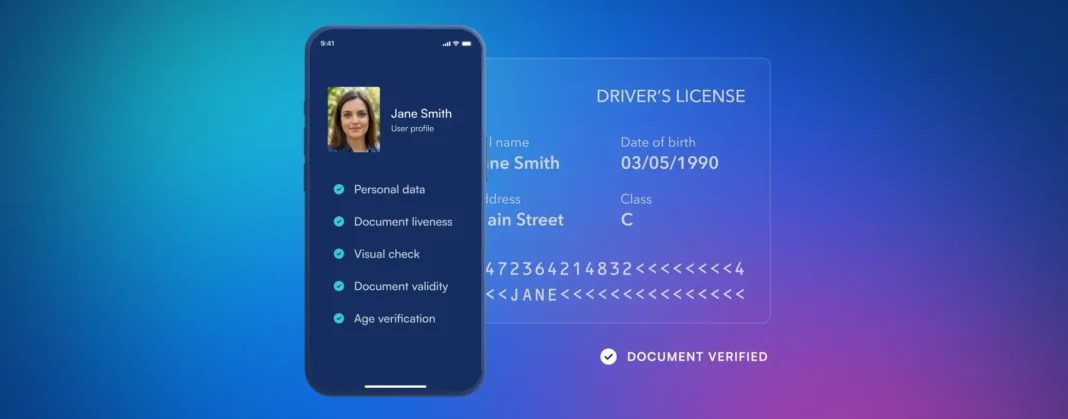
Step 1: Document Submission
The user captures or uploads an image of their government-issued identity document—such as a passport, driver’s license, or national ID card—using a smartphone camera or webcam. Many solutions guide users through this step with real-time feedback to ensure image quality meets processing requirements.
Step 2: OCR and AI-Driven Data Extraction
Optical character recognition (OCR) technology reads and extracts the text and data fields from the document image—name, date of birth, document number, expiration date, and more. AI-powered algorithms then validate the extracted data against expected formats, security feature patterns, and document templates from hundreds of issuing authorities worldwide. This step detects signs of tampering, forgery, or document inconsistencies that would be difficult or impossible to spot with the naked eye.
Step 3: Liveness Detection
Liveness detection confirms that a real, physically present person—not a photograph, video replay, or deepfake—is submitting the identity data. The user is typically prompted to perform a brief action, such as turning their head, blinking, or following an on-screen prompt. The system analyzes the response to distinguish a live human from a spoofing attempt. This step is a critical anti-fraud control and a standard component of any credible digital ID verification solution.
Step 4: Biometric Matching
The system compares the live facial image captured during liveness detection against the photo on the submitted identity document. Advanced facial recognition algorithms calculate a similarity score to confirm the document belongs to the person presenting it.
Step 5: Real-Time Result Delivery
The system delivers a verification outcome—typically within seconds. Results may include a confidence score, a pass/fail decision, or a set of flags indicating specific issues detected during the process.
Step 6: Access Decision or Escalation
Based on the result, the system either grants access, triggers automated onboarding, or escalates the case for manual review. High-risk or ambiguous cases may be routed to a human agent for further assessment, while clear passes proceed automatically.
Types of digital ID verification methods
How you approach identity verification depends on your organization’s needs and risk profile. The following methods are commonly used, often in combination:
- Document verification relies on government-issued identity documents. AI and OCR extract and validate data, and security features are checked for authenticity. This is a strong foundation but must be paired with biometric checks to guard against stolen documents.
- Best for: Financial services onboarding, age verification, regulated industries requiring KYC compliance.
- Biometric verification uses unique physical characteristics—facial recognition, fingerprints, or iris scans—to confirm identity. Liveness detection is a critical component, preventing spoofing attacks using photos or videos.
- Best for: High-security environments, continuous authentication, and use cases where document availability is limited.
- Liveness detection (as a distinct control) confirms that the biometric data is being submitted by a live, present individual rather than a static image or synthetic media. Passive liveness detection requires no user action; active liveness detection prompts a specific gesture or movement.
- Best for: Any scenario where remote biometric verification is used, particularly where deepfake or spoofing risk is elevated.
- Database and credit bureau checks verify identity by cross-referencing submitted information against external data sources—such as credit bureau records, government databases, or utility records. These checks confirm that the identity exists and that the details provided match known records.
- Best for: Financial services and fintech, where corroborating identity data against authoritative external sources is required for KYC or fraud prevention.
- Knowledge-based verification (KBA) involves security questions or personal information that only the legitimate identity holder should know. This adds a layer of security but is vulnerable to data that has been exposed in breaches or is publicly available.
- Best for: Lower-risk scenarios or as a supplementary check alongside stronger primary methods.
- Two-factor authentication (2FA) combines two verification methods—such as a password and a one-time code sent to a registered device. This mitigates credential-based attacks but can increase friction during the verification process.
- Best for: Ongoing authentication after initial identity verification is complete.
- Mobile verification leverages the ubiquity of smartphones for identity verification, using device signals, SIM data, or carrier-based checks. Effectiveness depends on the security of the mobile device and associated network.
- Best for: Supplementary verification in mobile-first onboarding flows.
To find the right combination, weigh security requirements against usability and privacy considerations for your specific user base and regulatory environment.
Common pain points in digital ID verification
Online identity verification, while vital, can cause issues. Most involve user inconvenience, privacy concerns, or increased security risk. Addressing them is crucial to delivering the best customer experience. Here are the most common pain points in the process.
Slow, inconvenient, and manual processes
Lengthy verification times cause frustration and can lead to abandonment—even after a user has begun onboarding. Manual reviews introduce delays, and frequent manual interventions intended to ensure accuracy are exasperating for both customers and institutions. Some organizations may even require physical visits for manual reviews, adding complexity, increasing costs, and driving customer loss. Streamlining the ID verification process is essential to protect customers without inconveniencing them.
Security concerns
Digital ID verification requires users to submit sensitive personal information. Poorly designed verification systems can open the door to identity fraud. If cybercriminals bypass or manipulate the verification process—or obtain stolen ID documents—they can assume someone else’s identity, leading to unauthorized access, financial loss, and reputational damage.
Verification processes must also protect the sensitive data they collect. Neglecting privacy safeguards can result in data breaches, eroding trust and creating legal liability. Strict privacy controls are essential in any digital ID verification system.
AI bias in verification systems
AI-driven verification—particularly facial recognition—can exhibit demographic bias, performing less accurately for certain groups based on skin tone, age, or gender. This is a well-documented risk that organizations must actively address when selecting and auditing verification solutions. Bias in verification systems can result in higher false rejection rates for specific user populations, creating both fairness concerns and regulatory exposure. Organizations should evaluate providers on their bias testing practices, demographic performance data, and ongoing model auditing commitments.
User experience challenges
Complex verification processes overwhelm users, leading to frustration and abandonment. Users who struggle to understand the steps or requirements are less likely to complete verification successfully. Clear guidance, real-time feedback, and minimal required steps are essential to keeping completion rates high.
Technical issues—such as system errors, slow load times, or poor camera handling—can disrupt the user experience and undermine trust. Prioritizing a stable, error-free verification flow is as important as the security controls themselves.
Tips to avoid common pain points
Addressing ID verification problems is mostly a matter of prevention. Here are strategies for avoiding the most common identity verification issues.
Streamlining the verification process
Real-time data verification and API integrations with government-issued ID document databases can significantly reduce verification time. These integrations enable instant validation, ensuring a seamless onboarding experience.
Minimize manual interventions with automated document verification. Intelligent algorithms perform automated checks and assessments to reduce errors and processing time. A good goal is to make manual interventions the exception rather than the rule.
Enhancing security
Multi-factor authentication (MFA) is a powerful tool for enhancing security. By combining something the user knows (password), something the user has (smartphone), and something the user is (biometric data), MFA adds robust layers of protection. This significantly reduces the risk of identity fraud, even if one factor is compromised.
Ensure liveness detection is a core component of any biometric verification step. Without it, facial recognition checks can be defeated with a photograph. Passive liveness detection—which requires no user action—balances strong anti-spoofing protection with minimal friction.
Improving user experience
User-friendly interfaces make a significant difference. Ensure your verification process is straightforward, with clear instructions and minimal steps. Use visual cues and real-time feedback to guide users through each stage, and consider incorporating chat support or a help center where users can get guidance when needed.
Legal and regulatory compliance
Adhering to the General Data Protection Regulation (GDPR) is essential. GDPR ensures the privacy and protection of user data during the verification process. Implement robust data protection measures, secure data storage, and transparency in data handling to remain compliant.
Be aware of other regional and industry-specific regulations governing digital identity verification, including:
- PCI DSS (Payment Card Industry Data Security Standard) for financial services
- HIPAA (Health Insurance Portability and Accountability Act) for healthcare
- Regional KYC and AML frameworks that vary by jurisdiction
Understanding and complying with these regulations is crucial to maintaining trust and adhering to the law.
How to choose a digital ID verification provider
Selecting the right verification provider is a critical decision. When evaluating options, consider the following criteria:
- Document coverage: Does the provider support the identity documents issued in all the countries where your users are located?
- Accuracy and performance data: What are the provider’s verified accuracy rates, and do they publish demographic performance data to demonstrate fairness across user populations?
- Liveness detection capability: Does the solution include passive and/or active liveness detection, and has it been independently tested against spoofing attacks?
- Integration flexibility: Does the provider offer APIs and SDKs that integrate with your existing onboarding and identity stack?
- Regulatory compliance support: Does the solution support the specific compliance frameworks relevant to your industry and geography?
- Bias auditing practices: Does the provider conduct and publish regular audits of AI model performance across demographic groups?
- Scalability and uptime: Can the system handle your verification volume with consistent performance and reliability?
- Transparency and explainability: Does the provider offer clear explanations of verification decisions, including the ability to review flagged cases?
Evaluating providers against these criteria—rather than relying solely on marketing claims—will help you select a solution that is both effective and trustworthy.
Emphasizing the importance of digital ID verification
In an increasingly digital world with a growing array of data points and potential threats, digital ID verification is and will remain crucial. But that doesn’t mean it’s always convenient.
Slow verification, complicated user experiences, added security risks, and the potential for AI bias can make proper verification challenging. That’s why it’s important to create streamlined, intuitive processes that protect user data, perform equitably across all user populations, and meet the regulatory requirements of your industry.
The right combination of document verification, liveness detection, biometric matching, and database checks—implemented with user experience and compliance in mind—gives organizations the foundation they need to verify identity confidently and at scale.