
Bad Actor
A bad actor is any person, group, or automated agent that deliberately abuses a system for gain — financial, informational, or political. In identity verification the term stretches from a single applicant using a stolen driver’s license to an organized ring pushing thousands of fabricated identities through onboarding.
| Also called | Threat actor, malicious actor, adversary, fraudster |
| Scope | Individuals, organized groups, insiders, automated agents and bots |
| Defining trait | Intent — the harm is deliberate, not negligent or accidental |
| Common motives | Financial gain, data theft, disruption, political influence |
| Fields that use it | Fraud and risk, cybersecurity, AML, trust and safety |
| In identity verification | An applicant, account holder, or agent presenting a false, stolen, or fabricated identity |
How the term is actually used
“Bad actor” is deliberately broad. It names the adversary without committing to a method, which is why it survives across teams that share no other vocabulary.
Inside identity verification it resolves into a few recognizable profiles. First-party actors are real people misrepresenting themselves. Third-party actors impersonate someone else using stolen credentials; the victim is real and usually unaware. Synthetic actors are assembled rather than stolen, pairing a valid identifier with fabricated details to produce an identity with no victim to complain. Organized rings run any of the above at volume. Automated agents are the newest category, and the reason the framing has shifted from verifying people to verifying actors.
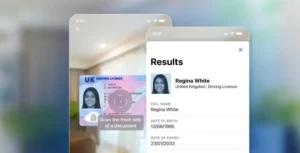
Each demands a different countermeasure. Document authentication catches the impersonator holding a forged card. It does nothing against a first-party applicant whose own real document passes every check.
Why it matters for identity verification
Every verification decision sorts actors before they gain access, in seconds, against an adversary with unlimited attempts. That asymmetry is the problem. A fraud team sees one submission; the actor behind it has probed the flow dozens of times and knows which signals are checked.
Remote channels sharpen the imbalance. In person, a clerk reads hesitation, notices a card that bends wrong, sees a face that does not match. Remotely all of that disappears, and the only evidence is what the actor chose to transmit. Bad actors self-select into remote onboarding for that reason — not because forging a document is easier, but because forging the presentation of one is.
Useful defense treats the label as a starting point. Verifying the document a person presents establishes whether the credential is real; biometric comparison, whether the person presenting it is its owner; device and behavioral signals, whether this attempt resembles a thousand others. No single layer identifies a bad actor. The combination narrows the field enough to act.
Bad actor vs threat actor
| Bad actor | Threat actor | |
|---|---|---|
| Primary field | Fraud, risk, compliance, trust and safety | Cybersecurity and threat intelligence |
| Typical target | An account, an application, a transaction | A network, a system, an organization |
| Usual method | Deception — false or stolen identity | Intrusion — exploitation of a technical weakness |
| Detection surface | Identity signals, documents, behavior, device | Network telemetry, endpoints, logs |
The distinction that matters operationally: a threat actor usually breaks in, a bad actor usually walks in through the front door holding paperwork.
What the label can’t do
It is a description, not a signal. Nothing in a verification stack outputs “bad actor.” Systems output authenticity scores, biometric match confidence, device reputation, velocity anomalies. The label is a human summary applied after those accumulate, so it can never be the thing a rule is built on.
It flattens profiles that need separate handling. Grouping a first-party exaggerator with an organized synthetic-identity operation makes both harder to stop. One is a credit-risk problem with an identity component; the other is an industrialized attack that returns next week with new details and the same infrastructure.
Intent is not observable at onboarding. The defining characteristic — deliberate harm — is precisely what a verification flow cannot measure. Systems observe artifacts, then infer. A first-time applicant with a valid document and a matching face is indistinguishable from a patient fraudster on day one.
It says nothing about scale. One person with a stolen passport and a ring running ten thousand attempts a month both earn the label, and the right response differs by orders of magnitude — a manual review, or a change to the flow itself.
Frequently asked questions
Is a bad actor always a person?
No. It covers automated agents, scripted bots, and AI systems acting on a user’s behalf or their own. This is why identity programs have moved toward verifying actors rather than only people — the entity submitting a request is no longer reliably human.
What is the difference between a bad actor and a fraudster?
Fraudster is narrower. It implies deception for material gain, usually financial. Bad actor also covers disruption, data theft, harassment, and influence operations where no money changes hands.
Can a legitimate customer become a bad actor?
Yes, and this is the case most controls handle worst. First-party fraud starts with a real person passing real verification, then misusing the account. Onboarding checks are structurally blind to it, which is why signals after the account opens matter.
Does document verification identify bad actors?
It identifies bad documents, which is a different set. It catches forged, altered, and expired credentials. It passes a genuine document held by someone who stole it — and a genuine document held by its rightful owner who intends to defraud you.
Related reading
- Fraud ring — how coordinated groups scale a single successful method
- Synthetic identity fraud — the profile with no victim to raise the alarm
- Account takeover — when the bad actor arrives after onboarding
- Fullz — the stolen identity packages that supply third-party attempts