
Biometric Passport
A biometric passport, or ePassport, is a travel document containing a contactless chip that stores the holder’s facial image and the data printed on the identity page, signed by the issuing country. The gold chip symbol on the cover marks it. The chip does not replace the printed page — it makes the printed page verifiable.
| Also called | ePassport, electronic passport, e-passport |
| Governing standard | ICAO Doc 9303 |
| Chip interface | Contactless, ISO/IEC 14443, read at a few centimetres |
| Mandatory biometric | Facial image |
| Optional biometrics | Fingerprints, iris — issuer’s choice, access-restricted |
| Data organization | Logical Data Structure (LDS), divided into data groups |
| DG1 / DG2 | MRZ data / facial image — the two present on every ePassport |
| Access control | BAC or the newer PACE, keyed from the MRZ |
| Authenticity check | Passive Authentication — verifies the issuer’s digital signature |
| Clone detection | Active Authentication or Chip Authentication, where supported |
| Cover marking | Gold ICAO chip symbol |
How it works
The chip holds a copy of what is printed on the identity page, arranged into numbered data groups. DG1 holds the machine-readable zone text; DG2 holds the facial image. Everything else is optional and issuer-dependent.
Reading it requires proving you can already see the document. Basic Access Control derives an encryption key from the machine-readable zone, so a reader must optically scan the printed page before the chip will respond. This is what prevents a passport from being read through a bag or a pocket. PACE, the modern replacement, does the same job with stronger cryptography.
Two distinct checks then run, and conflating them is the most common technical error in this area. Passive Authentication verifies the issuing country’s digital signature over the chip contents, proving the data is genuine and unaltered. It cannot detect copying — a byte-for-byte clone of a legitimate chip carries a valid signature and passes. Active Authentication and Chip Authentication close that gap by requiring the chip to prove it holds a private key that cannot be extracted, which a copy does not have. Not every country implements them.
Fingerprint and iris data, where present, sit behind Extended Access Control and are readable only by systems holding certificates from the issuing state. In practice this restricts them to border control.
Why it matters for identity verification
An ePassport is the strongest identity document in general circulation, and the reason is cryptographic rather than physical. Every other security feature — the watermark, the guilloche, the laminate — attests to the substrate and requires judgment to assess. The chip signature is checkable against a national public key infrastructure and returns a definite answer.
That makes chip verification qualitatively different from document authentication. Confirming a valid issuer signature establishes that the data originated with the issuing state and has not been modified. No amount of print-quality analysis reaches that standard.
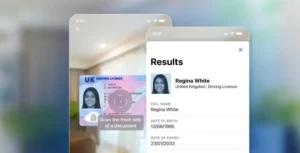
Remote verification is where the constraint appears. Reading the chip needs NFC hardware and physical proximity, which means a phone with NFC held against the document. That works on modern handsets and fails on older ones, so any flow depending on chip reads needs a fallback to optical document authentication for users whose devices cannot do it. Microblink’s identity verification workflow treats the chip read as the strongest available signal rather than a requirement, degrading to visual and MRZ checks when the hardware is not there.
Biometric passport vs traditional passport
| Biometric passport | Traditional passport | |
|---|---|---|
| Chip | Contactless chip storing signed data | None |
| Facial image | Printed and stored digitally in DG2 | Printed only |
| Tamper evidence | Cryptographic signature over chip contents | Physical features only |
| Verification | Machine-checkable against a national PKI | Visual inspection and MRZ parsing |
| Automated border gates | Supported | Not supported |
| Cover marking | Gold ICAO chip symbol | None |
| Clone resistance | Only where Active or Chip Authentication is implemented | Not applicable |
What it can’t do
It cannot prove who is holding it. The chip attests to the document, not the bearer. Establishing that the person presenting the passport is its owner requires comparing their live face to DG2 — a separate check the document cannot perform on its own.
Passive Authentication does not detect cloning. A perfect copy of a genuine chip carries a genuine signature and passes. Only Active Authentication or Chip Authentication distinguishes an original from a copy, and neither is universally implemented.
Most consumer flows cannot read the chip at all. It needs NFC hardware and physical contact. A user on a device without NFC, or on a desktop, is verified optically — which means the chip’s advantages are unavailable in a meaningful share of remote sessions.
A valid chip says nothing about status. The signature proves the passport was validly issued. It does not indicate whether it has since been reported lost or stolen, or whether the holder is subject to any restriction. That requires a database check the document knows nothing about.
Frequently asked questions
How do I know if my passport is biometric?
Look for the gold chip symbol on the front cover — a small rectangle with a circle inside it. Effectively all passports issued by ICAO member states in the past decade are biometric.
What data is stored on a passport chip?
At minimum the machine-readable zone text and the facial image, matching what is printed on the identity page. Fingerprints and iris data are optional, issuer-dependent, and readable only by systems holding certificates from the issuing state.
Can a passport chip be read without my knowledge?
Not in normal use. Access control derives its key from the printed machine-readable zone, so a reader must optically scan the identity page first. That is why the chip cannot be read through a closed passport in a bag.
Is a biometric passport harder to forge?
Substantially, because the chip data is signed by the issuing country and the signature is verifiable against a national public key infrastructure. Forging the printed page is still possible, but a forged page will not match a chip that a forger cannot re-sign.
Related reading
- Passport chip — the component in detail, including the data groups
- Chip authentication — the protocol that distinguishes an original chip from a clone
- Machine-readable zone — the printed text that unlocks the chip
- Global Entry card — a border credential that is not a travel document