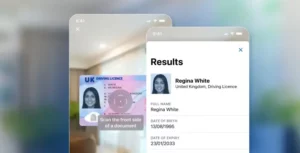

Driver Card
A driver card is the personal smart card a professional driver inserts into a digital tachograph to record driving time, breaks and rest periods. It is both an identity credential and a data carrier: the chip holds who the driver is and what they have done, and the two are bound together so that activity cannot be attributed to anyone else.
| Also called | Tachograph card, driver tachograph card, tacho card |
| Format | Credit-card sized with an embedded microchip |
| Issued by | The national authority of the driver’s country of residence |
| Legal framework | EU tachograph regulation, applied across the EU, EEA and the UK |
| Who needs one | Drivers of goods vehicles above 3.5 tonnes and passenger vehicles carrying more than nine people, within scope of drivers’ hours rules |
| Data held on the card | Driver identity, card and license details, and a rolling record of recent activity |
| Typical validity | Five years |
| Other card types | Company card, workshop card and control card — different holders, different privileges |
Not the same as a driving license
The terms get used loosely and describe different documents with different jobs.
| Driving license | Driver card | |
|---|---|---|
| What it proves | Entitlement to drive a class of vehicle | Who the driver is, for tachograph recording |
| Who needs one | Every driver | Professional drivers within scope of drivers’ hours rules |
| Carries a chip | Sometimes, depending on the issuing state | Always — the chip is the point |
| Records activity | No | Yes — a rolling record of driving, breaks and rest |
| Used for identity verification | Widely, as a general identity document | Rarely — it is a specialist credential |
A driver may hold both and needs both. The license establishes the right to drive; the card establishes whose hours are being recorded.
How it works
The card is inserted at the start of a shift and stays in the tachograph unit while the driver works. From that moment the recording is attributed to that specific driver rather than to the vehicle, which is the whole purpose of the arrangement — drivers’ hours rules apply to people, and vehicles are shared.
Data is written to both the card and the vehicle unit. The card holds a rolling record of recent activity, and the vehicle unit holds a longer one, so an enforcement officer at the roadside can read either and compare them. The card’s chip also performs mutual authentication with the tachograph, which is what prevents a forged card from being accepted or a genuine card from being read by unauthorized equipment.
Three other card types exist in the same system and are frequently confused with this one. A company card lets an operator download and lock data for its own fleet. A workshop card lets an approved fitter calibrate the unit. A control card gives enforcement officers read access. Each carries different privileges, which is why they are separate credentials rather than one card with roles.
Why driver cards matter for identity verification
This is a chip-bearing, cryptographically protected identity credential issued by a national authority — the same family of document as a biometric passport, built for a narrower purpose.
That makes it a relevant document class for anyone verifying professional drivers: gig and freight platforms onboarding operators, fleets checking that a driver is who the paperwork says, and hiring processes for licensed roles. Verifying a driver card is a different exercise from verifying a driving license, because the card proves a narrower fact and carries a different data structure.
The fraud angle is specific and worth naming. Because the card attributes hours to a person, misuse concentrates on attribution — using someone else’s card so that driving time is recorded against a driver who has hours available. That is identity substitution rather than document forgery, and it is not detected by examining the card. What detects it is verifying that the person holding the card is the person it was issued to, which is a biometric question rather than a document one.
For platforms and operators onboarding drivers, identity document verification that covers specialist credential classes alongside ordinary identity documents is the practical requirement, and employee verification is where that check usually belongs in the process.
What a driver card can’t do
It does not authorize driving. That is the license. A driver card without a valid license entitles the holder to nothing.
It does not prove who is holding it. The chip authenticates the card to the tachograph. It does not establish that the person who inserted it is the person named on it.
It is not a general identity document. It is a specialist credential and is not designed or accepted for ordinary identity purposes.
Its record is limited. The card holds a rolling window of recent activity, not an indefinite history, which is why vehicle unit downloads and operator record-keeping matter alongside it.
Frequently asked questions
What is a driver card used for?
It identifies a professional driver to a digital tachograph so that driving time, breaks and rest periods are recorded against that individual rather than against the vehicle. Drivers’ hours rules apply to people, and vehicles are shared, which is why the attribution matters.
Is a driver card the same as a driving license?
No. A driving license proves entitlement to drive a class of vehicle. A driver card identifies the driver to the tachograph and carries a rolling record of their activity. A professional driver needs both, and they are issued and renewed separately.
Who needs a driver card?
Drivers operating vehicles within scope of EU drivers’ hours rules — broadly, goods vehicles above 3.5 tonnes and passenger vehicles carrying more than nine people. The rules apply across the EU and EEA, and the UK operates an equivalent system.
What are the other tachograph card types?
Three besides the driver card. A company card lets an operator download and lock its own fleet’s data; a workshop card lets an approved fitter calibrate the tachograph; a control card gives enforcement officers read access. They carry different privileges and are issued to different holders.
Related reading
- Driver’s license — the entitlement document, and how it differs from this one
- Biometric passport — the same family of chip-bearing credential, built for a wider purpose
- Passport chip — how chip authentication works on a credential like this
- Ghost employee — the workforce identity problem in an adjacent setting