
What is Facial Biometrics?
Facial biometrics is the measurement of a face as data — converting an image into a numerical template that can be compared against another. It underpins both identity verification, where a selfie is matched to a document portrait, and identification, where a face is searched against a database. The two are technically similar and legally very different.
| What it produces | A template — a numerical vector, not a stored image |
| Verification (1:1) | Comparing one face to one claimed identity |
| Identification (1:N) | Searching one face against many records |
| Accuracy metrics | False match rate (FMR) and false non-match rate (FNMR) |
| Threshold effect | Lowering FMR raises FNMR — the two trade off directly |
| Benchmarking | NIST Face Recognition Technology Evaluation (FRTE/FRVT) |
| Template reversibility | Templates are not images, but are not guaranteed irreversible |
| Paired control | Liveness detection — matching alone cannot tell a face from a photo of one |
| Regulatory context | Biometric data is a special category under GDPR; several U.S. states impose consent regimes |
How it works
A face is detected in the frame, normalized for pose and lighting, and passed through a model that outputs a template — typically a few hundred floating-point numbers encoding the geometry and texture the model learned to find discriminative. Comparison is a distance calculation between two templates, producing a similarity score.
The threshold on that score is the whole policy decision, and it is not a technical one. Set it high and few impostors get through while more genuine users are rejected. Set it low and the reverse. There is no setting that avoids both errors, which is why false match rate and false non-match rate are always quoted as a pair — a vendor citing one without the other has told you nothing.
Modern accuracy is high and unevenly distributed. NIST’s evaluations have repeatedly found performance varying by demographic group, with error rates differing across age, sex and skin tone depending on the algorithm and the training data. The gaps have narrowed substantially in leading systems and have not closed, which makes demographic performance a question worth asking a vendor directly rather than assuming.
The other thing worth knowing: a template is not an image, but it is not automatically irreversible either. Research has shown reconstructing recognizable faces from templates is possible under some conditions, so templates deserve protection as biometric data rather than being treated as anonymized derivatives.
Why it matters for identity verification
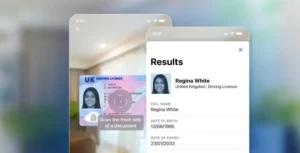
Facial biometrics is what connects a document to a person. Document authentication establishes that a passport is genuine and unaltered; the face match establishes that the person holding it is the person it was issued to. Without that second step, a stolen document passes every check the first step performs.
In remote onboarding this is a 1:1 verification problem, which is the easier and less legally fraught of the two modes. The system is not searching a database or asking who someone is — it is testing a claim the user made, against a portrait from a document they presented. That distinction matters for privacy posture and for how the processing is justified under data protection law.
Face matching is inseparable from liveness detection in practice. A match proves two images show the same person; it cannot tell whether one of them was a photograph held up to a camera. Deploying matching without liveness in a remote channel is close to deploying nothing. Microblink’s biometric matching runs the two together, and the verification workflow ties both to the authenticated document.
Verification vs identification
| Verification (1:1) | Identification (1:N) | |
|---|---|---|
| Question | Is this the person they claim to be? | Who is this person? |
| Comparison | One template against one | One template against a gallery |
| Typical use | Onboarding, unlocking, step-up checks | Watchlist search, deduplication, investigation |
| Error behavior | Stable — one comparison | False matches accumulate with gallery size |
| Data held | Usually transient | A persistent database of templates |
| Regulatory exposure | Lower — the user makes a claim and consents | Substantially higher |
Conflating the two is the most common error in public discussion of face recognition. Matching a selfie to the passport someone just photographed is a categorically different activity from searching a face against a database of people who never consented, even though the underlying model may be identical.
What it can’t do
It cannot tell a face from an image of a face. Matching compares templates. A photograph of the right person produces a legitimate match, which is why liveness detection is not an enhancement but a prerequisite in any remote flow.
It cannot promise uniform accuracy across demographics. Published evaluations continue to find performance variation by age, sex and skin tone. Leading systems have narrowed it considerably; none has eliminated it, and a deployment that does not measure its own demographic performance will not notice its own.
It cannot make a threshold decision for you. Where to sit on the FMR-FNMR curve is a business and risk judgment. A system presented as fully automatic has made that choice on your behalf, and you should know what it chose.
It cannot un-leak a face. A compromised password is replaced; a compromised face is not. That permanence is the argument for storing templates rather than images, protecting templates as biometric data, and retaining them only as long as there is a reason to.
Frequently asked questions
What is the difference between facial recognition and facial biometrics?
Facial biometrics is the measurement — turning a face into a comparable template. Facial recognition usually refers to identification, searching a face against a database. Identity verification uses one-to-one matching, which is a narrower and less privacy-invasive application.
Are facial biometric templates the same as photographs?
No. A template is a numerical vector, not an image, and cannot be viewed as a face. It is not guaranteed irreversible either — research has reconstructed recognizable faces from templates — so templates should be protected as biometric data.
How accurate is facial biometric matching?
Leading algorithms achieve very low error rates in NIST evaluations under good conditions. Real-world accuracy depends on image quality, threshold settings, and demographic composition, and the false match and false non-match rates always trade off against each other.
Does facial biometrics work if someone changes their appearance?
Generally yes for glasses, facial hair, weight change and ageing over a few years, since the features models rely on are structural. Substantial ageing, significant surgery, or heavy occlusion degrade matching and may require re-enrolment.
Related reading
- Liveness detection — the check that makes face matching meaningful remotely
- Biometric passport — where the reference portrait comes from
- Identity document verification — how the document and the face fit together
- Biometric KYC in practice — how the pieces combine in a compliant onboarding flow