Fraud Investigation
A fraud investigation is the process of establishing what happened after fraud is suspected — gathering evidence, reconstructing the sequence, identifying who was involved, and producing a record that supports recovery, reporting, or prosecution. It starts where detection ends.
| Trigger | An alert, a customer dispute, a chargeback, or a pattern surfaced in review |
| First priority | Contain the loss — freeze, block, preserve |
| Evidence sources | Transaction logs, device and session data, identity artifacts, communications, linked accounts |
| Typical outputs | Loss classification, recovery action, SAR filing, control change, referral |
| Evidentiary constraint | Chain of custody and reproducibility, if the file may support prosecution |
| Regulatory link | Findings feed suspicious activity reporting obligations |
| Most valuable output | The control change that stops the next one |
| Structural limitation | Investigation reconstructs; it does not prevent |
How it works
Investigation runs in a rough order, and the order matters because evidence degrades.
Containment comes first. Freeze the account, block the card, halt the transfer if it has not settled. Every hour of delay reduces recoverable funds, particularly where money has moved to a bank drop and onward.
Preservation is the step most often done badly. Session logs, device fingerprints, the images submitted at onboarding, IP and geolocation records — these expire on retention schedules set for other purposes. An investigation opened sixty days after the event frequently finds the most useful evidence already gone.
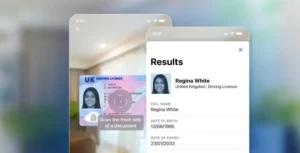
Reconstruction assembles the sequence: how access was obtained, what changed and when, where value went. This is where identity artifacts earn their keep. The document submitted at account opening, the biometric captured, the device that enrolled it — these are fixed points in a timeline where almost everything else is inference.
Linkage is what converts a single case into something worth the effort. One compromised account is a loss. The same device across forty accounts, or one identity document behind several applications, is an organized operation — and finding it depends entirely on whether the institution stored identity attributes in a form that can be matched across accounts.
Why it matters for identity verification
Investigation quality is determined months earlier, by what was captured at onboarding.
An account opened with a verified document and a biometric leaves an investigator something concrete: an authenticated credential, a face, a device, a timestamp. An account opened with a self-asserted name and an email leaves almost nothing. The investigation still happens; it produces less, more slowly, and rarely supports a referral.
The linkage point is where the real gain sits. Fraud rings are found by connecting accounts, and the strength of the connection depends on what can be matched. Device and IP are useful and cheaply defeated by a competent operator. Verified identity attributes — the same document, the same face, the same date of birth across supposedly unrelated applicants — are much harder to vary at scale. Retaining and linking those attributes is what makes network investigation possible, and Microblink’s stolen and synthetic identity detection surfaces the connections while the accounts are still active rather than afterwards.
Investigation vs detection
| Fraud detection | Fraud investigation | |
|---|---|---|
| Timing | During or immediately after the event | After the event, often much later |
| Question | Is this transaction fraudulent? | What happened, and who did it? |
| Decision speed | Milliseconds | Days to weeks |
| Output | Approve, decline, or escalate | A documented case file |
| Automation | Almost entirely automated | Analyst-led, tool-assisted |
| Success measure | Losses prevented | Losses recovered, and controls improved |
The last row is where investigation justifies itself. Recovery rates are usually poor. The durable return is the control change — understanding how the fraud worked well enough to close the route.
What it can’t do
It cannot recover most losses. By the time an investigation opens, funds have typically moved through several accounts and often across borders. Recovery is the exception, and programs justified on recovery rates tend to disappoint.
It cannot reconstruct what was not retained. Evidence that expired on a retention schedule is gone. This is the single most common practical constraint, and it is set by policy long before any investigation begins.
It cannot establish intent from data alone. Transaction records show what happened, not why. Distinguishing deliberate first-party fraud from a genuine dispute usually requires evidence the institution does not hold.
It does not scale with fraud volume. Investigation is analyst-led and expensive. An institution investigating its way out of a fraud problem is losing — the resolution is a control change upstream, which is why the finding matters more than the file.
Frequently asked questions
What is the difference between fraud detection and fraud investigation?
Detection decides in milliseconds whether to allow a transaction. Investigation happens afterwards and reconstructs what occurred, who was involved, and how. Detection prevents; investigation explains and informs the control change.
What evidence matters most in a fraud investigation?
Whatever ties activity to a person: the identity document submitted at onboarding, biometric captures, device fingerprints, session and IP records. These are fixed points in a timeline that is otherwise largely inference — and they are also the first to expire on retention schedules.
How are fraud rings identified?
By linking accounts on shared attributes. Device and IP links are useful and easily defeated. Verified identity attributes — the same document or face appearing across supposedly unrelated applicants — are far harder to vary at volume.
Does a fraud investigation lead to a SAR filing?
Often. Where an investigation establishes reasonable suspicion of money laundering or other financial crime, the institution files a suspicious activity report and cannot inform the customer. The two processes run alongside each other.
Related reading
- Fraud detection — the layer investigation picks up from
- Fraud ring — what linkage analysis is looking for
- Suspicious activity report — the filing an investigation can trigger
- Bank drop — where funds go before recovery becomes impossible