
Identity Document Verification
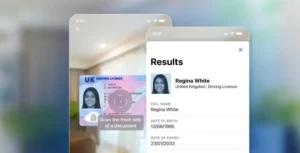
Identity document verification is the process of confirming that a government-issued ID is authentic, unaltered, and belongs to the person presenting it. Also called electronic identity verification, eIDV, or document verification, it combines authenticity checks on the document with a biometric comparison against its holder.
| Also called | Electronic identity verification, eIDV, ID verification, document verification |
| What it checks | Document authenticity, data consistency, and whether the bearer is the owner |
| Document types | Passports, driver’s licenses, national ID cards, residence permits |
| Core techniques | Optical authentication, MRZ and barcode parsing, chip reads, facial comparison, liveness |
| Typical duration | Seconds, when automated |
| Regulatory context | Customer Identification Program rules under the Bank Secrecy Act; KYC and AML regimes internationally |
| Primary failure mode | Verifying a genuine document held by someone who is not its owner |
| Remote constraint | A single flat image conveys less than a document in the hand |
How it works
Verification answers two separate questions, and the most common design error is treating them as one. The first is whether the document is real. The second is whether the person holding it is its owner. A system can be excellent at one and useless at the other.
Document authenticity starts with classification — identifying which of several thousand document types is present, because the checks that follow depend on the answer. Then the substrate and print are assessed for the security features that type should carry, and the encoded data is compared against the printed data. That cross-check is the most reliable single signal available: a machine-readable zone or barcode duplicates what is printed on the front, so any mismatch exposes tampering immediately. Where the document has a chip, reading it raises the standard again, because the contents are signed by the issuing state and verifiable against a national public key infrastructure.
Bearer verification compares a live capture of the person’s face against the portrait on the document, with liveness detection establishing that the capture came from a present human rather than a photograph, a screen, or generated media. Without that second half, a stolen passport passes every check the first half performs.
Risk-based flows vary the depth. A low-risk transaction may need only document authentication; a high-value one adds chip reads, stronger liveness, and cross-checks against independent data sources.
Why it matters
Almost every regulated onboarding obligation reduces to establishing who is opening an account. Customer Identification Program rules require an institution to verify identity and document how it did so. KYC and AML regimes elsewhere impose the same substance in different words.
The commercial argument is usually stronger than the compliance one. Verification sits at the point of highest drop-off in any onboarding funnel, so its speed and failure rate determine conversion as much as its accuracy determines fraud loss. A check that adds ninety seconds and rejects one legitimate applicant in twenty costs more in abandoned signups than it saves in prevented fraud.
Remote channels are where this gets difficult. In person, a document can be tilted, felt, and held to the light. Remotely, everything must be inferred from images the applicant chose to transmit — which is why injection attacks, where synthetic imagery is fed directly into the capture pipeline rather than shown to a camera, have become the more serious threat. Microblink’s document verification pairs authenticity analysis with biometric and liveness checks in a single automated workflow, and the identity verification platform applies risk-based thresholds so the depth of the check follows the value of the transaction.
Document verification vs identity verification
| Document verification | Identity verification | |
|---|---|---|
| Question answered | Is this document genuine and unaltered? | Is this person who they claim to be? |
| Inputs | Images of the document, encoded data, chip | The document plus a live biometric capture |
| Catches | Forgeries, alterations, expired credentials | Impersonation using a genuine document |
| Misses | A genuine document presented by someone else | Little, when both halves run together |
| Sufficient alone | No | Depends on the document check beneath it |
The terms are used interchangeably and the distinction is not pedantic. A programme that authenticates documents thoroughly and never compares a face has an impersonation gap that no improvement in document analysis will close.
What it can’t do
It cannot confirm the data is true, only that it is consistent. A genuine passport issued on the basis of a fraudulent birth certificate authenticates perfectly. Verification establishes the integrity of the credential and its chain of issuance, not the truth of the underlying claim.
It cannot see status changes. A document valid on its face may have been reported lost or stolen an hour ago. That requires a database check the document knows nothing about.
It is a moment, not a state. Verification establishes identity at one point in time. Everything after that — a session hijacked, credentials sold, an account taken over — is outside its scope, which is why ongoing signals matter after onboarding completes.
Remote capture loses information that a physical inspection has. Optically variable features, substrate feel, and the way a laminate reacts to angle do not survive a single flat photograph. Good systems compensate with motion capture and multiple frames; none fully recover what an in-person check sees.
Frequently asked questions
What is the difference between eIDV and identity document verification?
They describe the same process. Electronic identity verification, eIDV, and identity document verification all refer to confirming a government-issued ID is authentic and belongs to its bearer. Regional and vendor preference drives which term gets used.
How long does identity document verification take?
Seconds when automated. The delay users experience is usually capture — getting an image sharp and complete enough to analyze — rather than the analysis itself, which is why capture guidance affects completion rates more than model accuracy does.
Can identity document verification be done entirely remotely?
Yes, and most now is. The constraint is that a flat image conveys less than a document in the hand, so remote flows lean harder on the machine-readable data, the chip where present, and liveness detection to establish the person is physically there.
Does identity document verification prevent synthetic identity fraud?
Partly. It catches fabricated documents and detects a face that does not match the portrait. It does not catch a genuine document lawfully issued to a synthetic identity that was constructed before the document was applied for, which is why document checks pair with data and behavioral signals.
Related reading
- Machine-readable zone — the encoded cross-check that exposes tampering
- Biometric passport — the strongest document class, and why
- Liveness detection — establishing the person is physically present
- Choosing ID verification software — what to compare when evaluating providers