
VAMP Before and After: What Merchants Need to Know About Visa’s New Chargeback Program and Fraud Compliance


The payments landscape is always evolving, and merchants must continually adapt to changing rules and standards. One of the most notable recent changes is Visa’s new chargeback program, known as Visa Automated Monitoring Program (VAMP). Designed to streamline the chargeback process and reduce fraud, VAMP brings both opportunities and challenges for merchants. Understanding the program’s nuances is essential to minimizing risk, avoiding penalties, and maintaining strong customer relationships.
Here are five key things merchants need to know about VAMP before and after its rollout, providing clear guidance on what to expect and how to prepare.
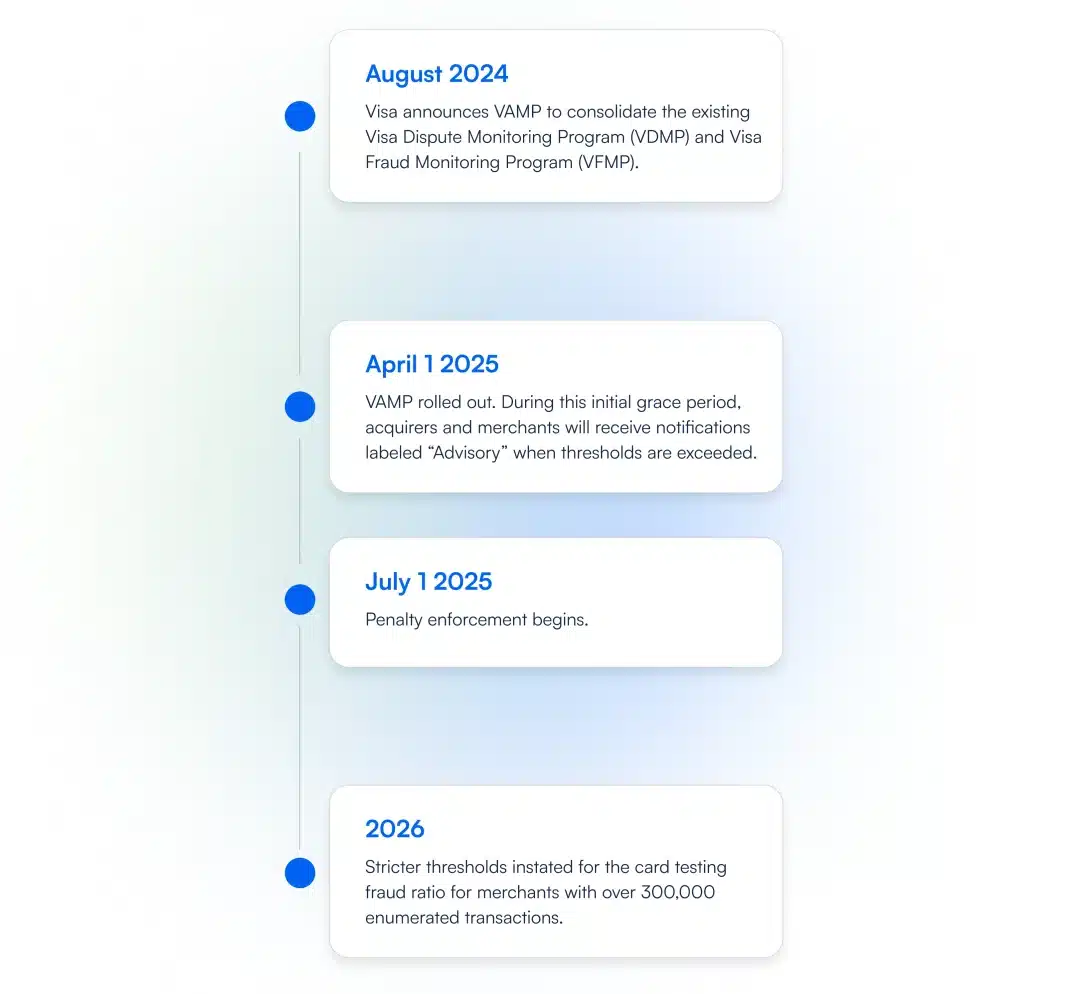
What is VAMP? Visa’s New Chargeback Program Explained
Visa introduced the Visa Automated Monitoring Program (VAMP) as part of its broader strategy to combat fraud and abuse in the chargeback process. Chargebacks occur when cardholders dispute transactions, resulting in the reversal of funds from the merchant back to the customer. While chargebacks are meant to protect consumers, they have also become a significant source of financial strain for merchants, especially in cases of friendly fraud or repeat disputes.
Before VAMP:
Merchants faced an often manual and fragmented system for tracking and disputing chargebacks. Fraudulent disputes could slip through the cracks, and inconsistent enforcement of rules across the payment ecosystem created confusion.
After VAMP:
The program introduces more automation and stricter monitoring to identify merchants with high levels of chargebacks and fraud. VAMP aims to:
- Streamline the dispute process through better tracking and data-sharing.
- Protect cardholders by reducing illegitimate charges.
- Encourage merchants to proactively address chargeback issues and improve their dispute resolution processes.
Merchants now need to pay closer attention to their chargeback ratios and overall fraud levels to stay compliant with Visa’s guidelines.
Visa VAMP Thresholds: How Chargeback Monitoring Criteria Have Changed
One of the most significant changes under VAMP is how Visa measures chargeback thresholds and identifies merchants who exceed acceptable levels. Merchants who fail to meet these criteria can face penalties or even restrictions.
Before VAMP:
Visa primarily tracked chargeback thresholds based on the dispute-to-transaction ratio (DTR), calculated as the number of chargebacks divided by the total number of monthly transactions. However, tracking methodologies often lacked granularity and varied regionally.
After VAMP:
The thresholds have been updated and are now more specific and automated. Merchants are monitored based on:
- Dispute Count: The total number of chargebacks filed within a specific period.
- Dispute Ratio: The percentage of transactions resulting in disputes (similar to the DTR but applied more rigorously).
- Fraud Ratio: A metric specifically targeting fraud-related disputes.
Merchants exceeding the thresholds will automatically trigger Visa’s monitoring program, prompting additional scrutiny and potential fines. It’s crucial for merchants to regularly monitor their dispute and fraud ratios to avoid penalties.
Key Takeaway:
Merchants need to adopt better tools and strategies to track chargeback and fraud data in real-time. Proactive monitoring will help them stay below Visa’s thresholds and avoid triggering VAMP enforcement.
Visa VAMP’s New Dispute Prevention Rules: What Merchants Must Do
Under VAMP, Visa emphasizes the importance of merchants actively preventing and resolving disputes before they escalate to chargebacks. While dispute prevention has always been a priority, the new program raises the stakes for non-compliance.
Before VAMP:
Many merchants relied on reactive approaches to chargeback management, often responding to disputes only after they were initiated. This approach not only increased costs but also left merchants vulnerable to penalties.
After VAMP:
Merchants are now required to demonstrate clear, proactive measures for preventing disputes. Some of these requirements include:
- Clear communication with customers about billing terms, refunds, and policies.
- Enhanced fraud detection tools to identify suspicious transactions before they are processed.
- Real-time dispute resolution tools that allow merchants to resolve disputes directly with cardholders before a formal chargeback occurs.
Visa’s focus on automation means that merchants must invest in better technology to prevent disputes from escalating. Implementing tools such as real-time notifications, automated dispute resolution platforms, and fraud detection systems will be critical.
Key Takeaway:
Proactive prevention is no longer optional under VAMP—it’s a requirement. Merchants should assess their current chargeback management processes and invest in tools that prioritize prevention and resolution.
VAMP Non-Compliance Penalties: What Merchants Risk Under Visa’s New Rules
Visa’s new program comes with a more structured and transparent penalty framework. Non-compliance with VAMP guidelines can lead to financial consequences and even restrictions on payment processing.
Before VAMP:
Penalties for chargeback issues were often inconsistent and varied depending on the acquirer or region. Many merchants were unaware of the risks until they faced substantial fines.
After VAMP:
Visa has formalized penalties for merchants who exceed chargeback thresholds or fail to comply with dispute resolution requirements. The penalties include:
- Fines: Merchants exceeding acceptable chargeback or fraud levels will face escalating fines.
- Monitoring Fees: Merchants placed into Visa’s monitoring program must pay additional fees until their ratios are reduced.
- Processing Restrictions: In extreme cases, Visa may suspend or restrict a merchant’s ability to process Visa transactions.
These penalties create a stronger incentive for merchants to prioritize dispute prevention, fraud detection, and customer satisfaction.
Key Takeaway:
Merchants should treat compliance with VAMP as a top priority. Avoiding penalties requires proactive management of chargeback and fraud rates, as well as clear communication with acquiring banks.
Best Practices for Merchants: Navigating Visa VAMP Chargeback Guidelines
Adapting to Visa’s VAMP program requires a combination of proactive strategies, robust tools, and a commitment to transparency. Merchants who approach VAMP strategically can not only avoid penalties but also improve their customer relationships and reduce fraud.
Best Practices to Follow:
- Monitor Chargeback Ratios in Real-Time: Use analytics tools to track your dispute and fraud ratios closely. Set up alerts for any spikes or anomalies that may trigger Visa’s thresholds.
- Implement Advanced Fraud Detection: Leverage machine learning-based fraud detection tools to identify and block high-risk transactions before they are processed.
- Enhance Communication and Transparency: Clearly communicate billing terms, refund policies, and purchase details to customers to prevent misunderstandings that lead to disputes.
- Adopt Real-Time Dispute Resolution Tools: Utilize platforms that enable merchants to resolve disputes directly with customers before they escalate to formal chargebacks.
- Work Closely with Your Acquirer: Collaborate with your acquiring bank to ensure you understand VAMP requirements and have a clear plan for maintaining compliance.
- Educate Your Team: Ensure your internal teams understand the importance of dispute prevention and resolution under VAMP. Provide training on tools, processes, and customer communication strategies.
Key Takeaway:
Merchants who prioritize technology, proactive dispute management, and customer satisfaction will thrive under the new VAMP guidelines. Compliance isn’t just about avoiding penalties—it’s about creating a stronger, fraud-resistant business.
When Visa’s VAMP Program Doesn’t Apply: Key Exceptions for Merchants
While VAMP is comprehensive, there are scenarios where it doesn’t apply. For example, transactions authenticated via 3D Secure (3Ds) or where the merchant can prove that the credit card was physically present often shift liability away from the merchant.
- 3D Secure (3Ds): If a transaction passes 3D Secure verification, the liability for fraudulent disputes typically falls on the card issuer rather than the merchant. This is particularly useful for eCommerce merchants looking to reduce fraud-related chargebacks.
- Card-Present Transactions: If a merchant can prove the card was physically present (e.g., EMV chip transactions), Visa generally assigns liability to the issuer.
VAMP ratio calculations exclude disputes resolved through Visa’s Rapid Dispute Resolution (RDR) tool and Verifi’s Cardholder Dispute Resolution Network (CDRN). In addition to disputes resolved via these two programs, the exclusion also applies to disputes which are rejected through Compelling Evidence 3.
Merchants with fewer than 1,000 applicable fraudulent or disputed transactions will be excluded.
How Merchants Can Adjust Chargeback Ratios to Comply with VAMP
- Increase Legitimate Transaction Volume: Encouraging lower-risk, high-volume transactions can dilute the impact of chargebacks on overall ratios.
- Leverage 3Ds Authentication: Implementing 3D Secure reduces fraud liability and adds confidence to online sales.
Split Transactions: Where applicable, merchants can break large orders into smaller transactions to minimize chargeback impact.
BlinkCard Helps Merchants Reduce Card-Not-Present Fraud Under VAMP
Replace manual credit card data entry with BlinkCard to scan and extract data in under 3 seconds. The liveness check confirms that the card is present at the time of the transaction.
Visa VAMP vs. Mastercard ECP: Chargeback Program Comparison for Merchants
Visa isn’t alone in tightening chargeback management—Mastercard has its own program, Excessive Chargeback Program (ECP). Here’s how the two compare:
- Thresholds: While Visa uses automated monitoring, Mastercard sets specific thresholds based on dispute count and ratio (e.g., 1.5% dispute ratio for high-risk merchants).
- Penalties: Both Visa and Mastercard impose fines, but Mastercard’s penalties escalate faster for merchants exceeding thresholds.
- Resolution Tools: Mastercard encourages merchants to use real-time resolution tools like Visa does, but implementation guidelines can differ.
Key Takeaway: While both programs target fraud and chargebacks, merchants need to track the nuances between Visa and Mastercard to stay compliant with both systems.
Visa VAMP: Final Tips for Merchants Navigating Chargeback Compliance
Visa’s VAMP program marks a significant shift in the chargeback landscape. While the program introduces new challenges for merchants, it also offers an opportunity to strengthen fraud prevention and improve customer satisfaction. By understanding the key changes, tracking chargeback and fraud data proactively, and investing in tools for dispute prevention, merchants can navigate VAMP successfully.
Chargebacks and disputes will always be part of doing business, but with the right strategies in place, merchants can minimize their impact, avoid penalties, and build a more transparent and trustworthy relationship with their customers.
As the payments ecosystem continues to evolve, staying informed and agile is the key to success. By embracing the changes introduced by VAMP, merchants can position themselves for a more secure and sustainable future.