
Best Identity Fraud Prevention Software in 2026: 10 Tools for Businesses


Search for identity fraud prevention software and most results are consumer identity theft protection, such as Aura or LifeLock. Those services watch your own credit and personal data. This guide is for the other side of the problem: businesses that need to stop criminals from opening or taking over customer accounts with fake, stolen or synthetic identities.
That problem is growing. Javelin’s 2026 Identity Fraud Study found new account fraud hit 5.4 million U.S. victims in 2025, up 31%, while account takeover remained the costliest fraud type at more than $15 billion.
This guide compares ten tools: Microblink, Socure, Persona, Prove, Sift, SEON, Alloy, Sardine, Sumsub and Jumio. To see how Microblink catches fake and AI-generated identities, start with its AI-powered identity fraud detection page.
Key takeaways
- Microblink is our pick for stopping fake, stolen and AI-generated identities at signup. It was the only system to meet every threshold in the DHS RIVR evaluation, and it scored 100% on the IDNet deepfake benchmark.
- Most businesses need two layers: a check that the identity is real at signup and a tool that watches logins and payments afterward.
The four kinds of identity fraud, and what stops each one
Identity fraud isn’t one problem, so no single tool is best at all of it. Start with the type that costs you most:
Type 1
Synthetic identities
Real and made-up details mixed together, used to build credit and then disappear
Tools that stop it
- Microblink
- Socure
- Prove
- Alloy
- Persona
- SEON
Type 2
Stolen identities
A real person’s details used to open an account in their name
Tools that stop it
- Microblink
- Persona
- Jumio
- Sumsub
- Socure
- Alloy
Type 3
Fake documents and deepfakes
AI-generated IDs, edited photos and fake selfie videos made to pass checks
Tools that stop it
- Microblink
- Sumsub
- Persona
- Jumio
- Socure
Type 4
Account takeover
Criminals log in to real accounts with stolen credentials and change the details
Tools that stop it
- Microblink
- Sift
- Sardine
- SEON
- Prove
For a deeper look at the first two, see our guide to synthetic identity fraud.
How we ranked these tools
We weighed five criteria, in this order: independently tested accuracy against fake documents and false rejects; coverage of the four identity fraud types; defense against deepfakes and injection attacks; how quickly a team can go live; and whether pricing is published.
That order favors catching fake identities at signup, because every later check trusts that first decision. On account takeover alone, Sift or Sardine would rank higher, so every review lists its gaps.
How to choose identity fraud prevention software
Match the tool to where fraud gets in, then test it on your own cases:
- If fake or AI-generated IDs are opening accounts, ask for independent results on fake documents and how the vendor detects deepfakes and injection attacks.
- If synthetic identities are the problem in U.S. lending or banking, compare Socure and Prove, and pair either with a document check.
- If criminals are taking over existing accounts, compare Sift, Sardine and SEON on login and device signals.
- If you run many checks across vendors, Alloy keeps the rules and audit trail in one place.
Before you sign, run each shortlisted tool on confirmed fraud and on good customers you know you rejected. Compare fraud caught, false rejects and manual review volume.
| Tool | Best for | Identity fraud it targets | Starting price |
|---|---|---|---|
| Microblink | Fake, stolen and AI-generated identities at signup | Stolen identities, fake documents, deepfakes | BlinkID from $210 a month |
| Socure | U.S. banks and lenders | Synthetic and stolen identities | $0.80 per document check |
| Persona | Configurable checks and fraud rings | Stolen identities, fraud rings | From $250 a month |
| Prove | Low-friction U.S. phone checks | Synthetic identities, account takeover | Quote |
| Sift | Online businesses | Account takeover, fake accounts | Quote |
| SEON | Growing teams on a budget | Made-up identities, repeat signups | $699 a month |
| Alloy | Banks using many data vendors | Synthetic and stolen identities | Quote |
| Sardine | Fintechs that want fraud and AML together | Account takeover, scams | Quote |
| Sumsub | Fintechs and crypto platforms | Fake documents, deepfakes | $1.35 per verification |
| Jumio | Global brands | Stolen identities, fake documents | Quote |
Swipe to see more →
Want to see how Microblink handles your hardest fake IDs? Book a Microblink demo.
1. Microblink

Best for: Stopping fake, stolen and AI-generated identities before they become accounts.
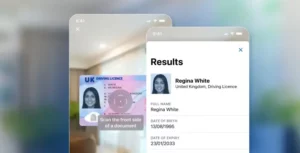
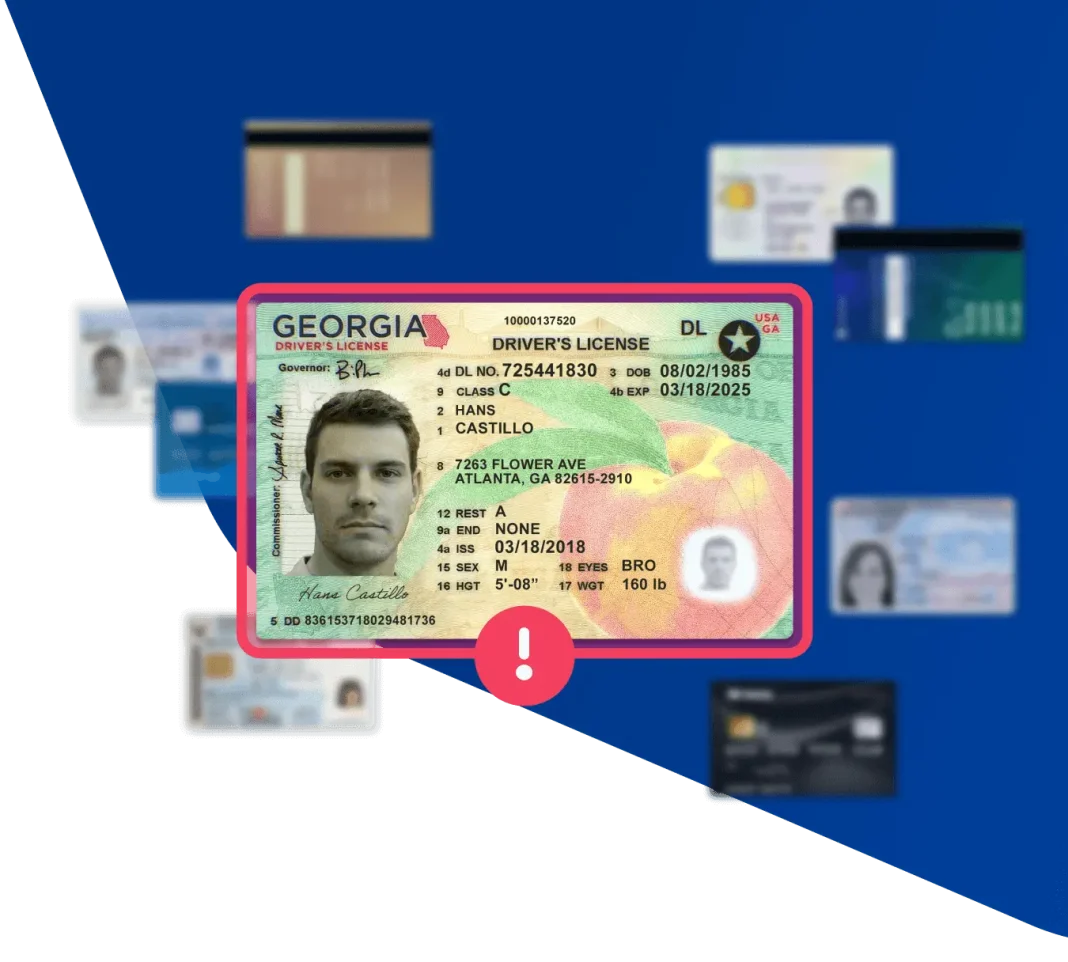
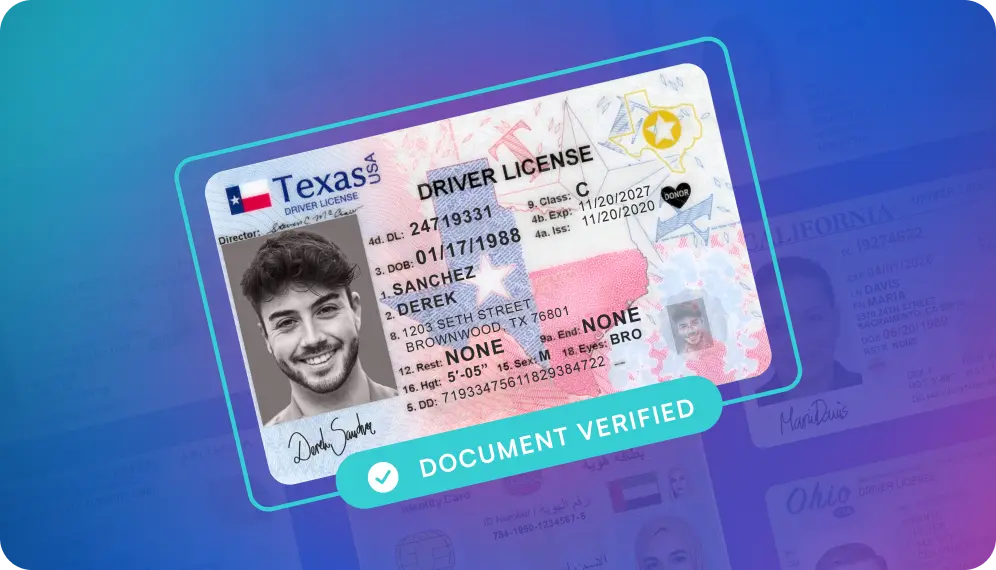
Microblink stops identity fraud where it starts, at the ID and the face. BlinkID Verify checks that a document is genuine across 2,500+ ID types, catches IDs shown on a screen or photocopied, and matches the ID to a live face. The Microblink Platform rolls every signal into a 0–100 trust score with a full audit trail. Microblink processed 2.9 billion identities in 2025.
It ranks first because of independent proof. In the U.S. Department of Homeland Security’s Remote Identity Validation Rally (RIVR), Microblink was the only one of seven document systems to meet every threshold, with a 0.88% false accept rate and a 3.15% false reject rate (announced by Microblink in March 2026; DHS does not endorse vendors). It catches fakes without turning away real customers.
It is built for AI-generated fraud. Its deepfake detection scored 100% on the IDNet benchmark, and its Fraud Lab creates more than 100,000 fraudulent images a month to train and test its models against new attack types. Microblink’s identity checks are used by 2 of the 5 biggest crypto exchanges, where AI-generated faces are a constant threat.
Fraud checks only work if real customers still get through. BlinkID returns results in under 3 seconds and, according to Microblink, gets 40% more successful ID captures than traditional approaches. Binance reported a 40% increase in capture success after moving to its adaptive interface, and LatinID, which serves automotive lenders in Mexico, reports a 98% success rate with Microblink’s ID verification.
What it does well
- Synthetic and stolen identity detection at signup, with injection attack detection that spots fake camera feeds.
- An Identity Graph that links signals across customers and events, so a face or document reused in another application gets flagged.
- Payment card checks that confirm the physical card is present, for step-up checks when a card is added or a risky change is made.
Watch out for
- It doesn’t watch logins or transactions after signup, so most teams pair it with Sift, Sardine or SEON for account takeover.
- Business verification isn’t part of its product line.
Where it fits: the identity layer at signup and at high-risk moments such as account recovery, for banks, fintechs, crypto exchanges and marketplaces. Checks can run on the customer’s device or in the cloud, and The Benefit Company in Bahrain uses it to secure digital onboarding. Its Know Your Actor approach also extends verification to AI agents acting for a verified customer.
Stop identity fraud at signup
Catch fake, stolen and AI-generated identities
Microblink checks the ID and the face in one flow and scored 100% on the IDNet deepfake benchmark. Run your hardest identity fraud cases through it and see what gets caught.
Self-serve BlinkID plans start at $210 a month for 350 scans, and Platform pricing is by quote. To test it on your own fraud cases, book a demo.
2. Socure

Best for: U.S. banks and lenders fighting synthetic identity fraud.
Socure scores identity fraud risk using a large U.S. identity graph and runs decisions on its RiskOS platform. It says 19 of the top 20 U.S. banks use it, and its Sigma models score both third-party identity theft and synthetic identities at account opening.
It grew quickly in 2026, raising money at a $5.2 billion valuation in September and buying Fravity to add AI agents to RiskOS. Its document check covers 6,000 document types in 190 countries, and watchlist screening draws on 25,000+ sources.
What it does well
- Synthetic identity scores that catch made-up identities a document check alone can miss.
- A self-serve Launch plan with $1,000 in free monthly credits, rare for an enterprise-grade tool.
Watch out for
- Sigma scores rely on U.S. data such as Social Security numbers, so they don’t apply outside the U.S.
- Socure describes its liveness as Level 2 but names no testing lab.
Where it fits: identity fraud scoring at account opening for U.S. lenders, banks and fintechs. Outside the U.S., pair it with a document check, since its data scores don’t reach there. On the Launch plan, a document check costs $0.80.
3. Persona

Best for: Teams that want configurable identity checks and fraud ring detection.
Persona verifies people and businesses through no-code Workflows and Dynamic Flow, covering 200+ countries and territories. In the U.S. it can check Social Security records through eCBSV, driver’s license records through AAMVA and taxpayer IDs through the IRS, which helps catch synthetic identities.
Its summer 2026 release added checks for AI-generated documents, mobile driver’s licenses and EU digital identity wallets. Its liveness check holds iBeta Level 2 letters from 2023.
What it does well
- Graph, which links accounts that share devices, IP addresses or other details to expose fraud rings.
- Watchlist screening and business verification in the same platform.
Watch out for
- There is no login or transaction monitoring, so account takeover needs another tool.
- The Essential plan needs a 12-month contract, and higher plans aren’t priced publicly.
Where it fits: identity checks and fraud ring detection for fintechs, marketplaces and platforms that change flows often. Graph is most useful once you have enough volume to see patterns across accounts. The Essential plan starts at $250 a month, and start-ups can apply for a year of free services.
4. Prove

Best for: Verifying U.S. customers through their phone number with little friction.
Prove ties identity to the phone a person carries. Its checks use phone ownership and carrier signals to confirm the applicant is who they claim to be, and Pre-Fill fills in verified details so customers type less. Prove says 19 of the top 20 U.S. banks use it, and its CEO says it covers 90% of the world’s digitally active adults.
It launched its Identity Platform in April 2026, which watches phone number, device and carrier changes over time and adds an agentic suite that ties AI agent actions to a verified person. BetMGM uses Pre-Fill and Unified Authentication for onboarding and login.
What it does well
- Low-friction checks at signup and login, often with no document or selfie needed.
- Alerts when a phone number or carrier changes, a common step in account takeover.
Watch out for
- Its signals depend on phone and carrier data, which is strongest in the U.S.
- It doesn’t authenticate ID documents itself, and pricing is by quote.
Where it fits: low-friction identity checks for U.S. banks, lenders and gaming operators, with a document check as backup.
5. Sift

Best for: Online businesses fighting account takeover and fake accounts.
Sift scores logins, new accounts and payments in real time using its Global Data Network, which it says draws on more than 1 trillion events a year from 34,000 sites and apps. It serves more than 700 brands, including Patreon, Yelp and Hertz.
Its Q1 2026 Digital Trust Index found fraud shifting from payments to identity, with about 21% of consumers hit by account takeover in 2025. In October 2026 it launched the Fraud Attack Defense Suite, AI agents that detect, investigate and respond to attacks, with the detection agent generally available first.
What it does well
- Account Defense, which spots takeovers from login behavior and device signals.
- Fake account detection at signup, with case review tools for fraud teams.
Watch out for
- It doesn’t verify ID documents or faces, so stolen and fake identities at signup need a separate check.
- Pricing is by quote.
Where it fits: account takeover and fake account prevention for e-commerce, marketplaces, SaaS, travel and gaming. Patreon reports a 99% new user acceptance rate with Sift, ChowNow an average fraud rate below 0.03%, and Tutory 83% less manual review.
6. SEON
Best for: Growing teams that want published pricing and a fast start.
SEON checks identity risk from more than 1,100 first-party signals, including device, email, phone and IP data. Its digital footprint check looks at whether an email or phone number is tied to real online accounts, which helps expose made-up identities. It says the average customer goes live in 14 days.
It raised an $80 million Series C in September 2025 and has since added identity verification and an AI investigations edition. Customers include Revolut, Plaid and Entain, and its gaming customers use it against bonus abuse, where one person opens many accounts.
What it does well
- Fast, low-cost identity risk checks without asking the customer for a document.
- Device intelligence and custom rules that catch repeat signups and bonus abuse.
Watch out for
- Its identity verification is newer than its signal-based scoring, so test document checks on your hardest cases.
- Case management and AML need the custom-priced Premium plan.
Where it fits: signup and login risk for fintech, gaming and e-commerce teams. Starter costs $699 a month for 2,500 checks and 10 users, and a free trial is available.
7. Alloy

Best for: Banks and fintechs that combine many identity and fraud data sources.
Alloy is an identity and fraud decisioning platform. It routes each applicant through hundreds of data partners, applies your rules and returns one decision with an audit trail. Alloy says more than 900 financial institutions and fintechs use it, and its 2026 State of Fraud Report found 91% of fraud leaders seeing more crime committed with help from AI.
It added Plaid’s fraud and identity tools to its network in April 2026 and launched an AI assistant for fraud and compliance investigations in the first half of the year.
What it does well
- Testing a new identity data source against your current one before you switch.
- Ongoing monitoring after onboarding, including transaction monitoring and perpetual KYC.
Watch out for
- It has no document or liveness engine of its own, so accuracy depends on the partners you contract.
- Each data partner is usually its own line item, and its G2 rating rests on only four reviews.
Where it fits: the decision layer for banks, credit unions and fintechs that use several identity vendors. Alloy says Suncoast Credit Union, Florida’s largest, cut fraud losses by over 35% from 2023 to 2024. Pricing is by quote.
8. Sardine

Best for: Fintechs that want identity, fraud and AML signals in one platform.
Sardine combines device intelligence, behavior biometrics, transaction monitoring and AML compliance. It checks the device and how an applicant behaves at signup, then keeps scoring the customer after the account opens. Customers include FIS, Intuit, Nubank and GoDaddy.
National Bank of Canada deployed Sardine across its retail, commercial and wealth businesses in May 2026 and led a $25 million funding round, and Forrester named Sardine a Leader in its Q3 2026 Wave for financial crime management. Its 4.8 G2 rating is the highest here.
What it does well
- Device and behavior signals from a consortium covering more than 6 billion devices, 800 million consumers and 3 million businesses.
- Account takeover and scam detection that continues after signup.
Watch out for
- Its strength is behavior and transaction risk, so test its document checks on your hardest cases.
- Its breadth suits teams with dedicated fraud and compliance staff, and pricing is by quote.
Where it fits: identity and fraud risk across signup, logins and payments for fintechs, banks and crypto platforms. Its AML tools also include AI agents that draft suspicious activity reports.
9. Sumsub

Best for: Fintechs and crypto platforms that want identity checks, AML and deepfake defense in one product.
Sumsub covers ID verification and liveness, AML screening, business verification, transaction monitoring and Travel Rule messaging for crypto. It says it supports 14,000+ document types in 220+ countries and territories.
It has leaned into AI-driven fraud in 2026, adding AI agent verification in January and an adaptive deepfake detector in June. Its liveness check holds an iBeta Level 3 letter dated September 2026, the top level of iBeta’s liveness testing. We compare ten alternatives to Sumsub in a separate guide.
What it does well
- A no-code workflow builder that sets checks by country, product and risk level.
- Verification without a document through database checks, where the law allows it.
Watch out for
- Business verification, transaction monitoring and database checks sit on the Custom plan, priced by quote.
- Its AML screening runs on ComplyAdvantage data, so you’re buying two vendors’ work through one contract.
Where it fits: identity checks and AML for fintechs, crypto exchanges and payment companies. Basic costs $1.35 per verification with a $149 monthly minimum, Compliance adds AML screening at $1.85 with a $299 minimum, and a 14-day trial includes 50 checks.
10. Jumio

Best for: Global brands that want identity checks and ongoing risk monitoring.
Jumio is an identity verification provider used by banks, lenders, payment companies and gaming operators. It says it covers more than 5,000 ID types across 200 countries and territories, and its iOS liveness SDK holds an iBeta Level 2 letter from September 2025.
Its 2026 releases focus on fraud after signup. Jumio Watch, launched in April, reassesses customers’ risk after they’re onboarded, and since June Jumio accepts digital IDs from 60+ countries. It also screens customers against sanctions, PEP and adverse media lists, and its selfie-based authentication lets returning customers re-verify with a face match before risky changes.
What it does well
- Government database and address checks alongside document verification.
- Data centers in the U.S., the EU and Singapore for data residency.
Watch out for
- Its 4.1 G2 rating is the lowest here, so ask for references from companies your size.
- We found no business verification product, and pricing isn’t published.
Where it fits: global identity checks for enterprises that already run decisioning elsewhere, and for lenders and gaming operators that need to re-check customers over time with Jumio Watch. Pricing is by quote.
Which identity fraud prevention software should you choose?
Pick the tool that stops the fraud type costing you most. For synthetic identities in U.S. lending, Socure and Prove lead. For account takeover, Sift and Sardine go deepest. Persona suits teams that want to build their own flows, SEON is the quickest start on a published budget, and Alloy ties many vendors together.
If fake, stolen or AI-generated identities are getting through at signup, start with Microblink. It was the only system to meet every DHS RIVR threshold, so the tools that watch logins and payments later start from a verified person.
Book a Microblink demo and run your hardest identity fraud cases through it.
Frequently asked questions
What is identity fraud prevention software?
Identity fraud prevention software helps businesses stop criminals from using fake, stolen or synthetic identities to open accounts, borrow money or take over existing accounts. It checks ID documents and faces, scores identity data and watches devices and behavior. Our glossary entry explains how detection and prevention work together.
What is the best identity fraud prevention software for businesses?
It depends on the fraud type. Microblink leads for fake, stolen and AI-generated identities at signup, Socure and Prove for synthetic identities in the U.S., Sift and Sardine for account takeover, and Persona and Sumsub for configurable identity checks. Most businesses combine a signup check with a tool that watches logins.
How is it different from identity theft protection like Aura or LifeLock?
Identity theft protection services such as Aura and LifeLock protect an individual. They monitor your credit and personal data and help you recover after theft. Identity fraud prevention software protects a business and its customers by stopping fake or stolen identities from opening or taking over accounts. For personal protection, a free credit freeze with all three bureaus is a strong first step.
How do you detect synthetic identity fraud?
Synthetic identities pass simple data checks because parts of them are real. Catch them by combining a data-led score, such as Socure’s or Prove’s, with a document and live selfie check that proves a real person is present. Watching for the same face or document across applications also helps.
How do you prevent account takeover?
Watch logins for unusual devices, locations and behavior with a tool such as Sift, Sardine or SEON, and add multi-factor authentication. For risky changes, such as a new phone number or payout account, ask for a fresh identity check, like a selfie matched to the ID on file.
Can identity fraud prevention software stop deepfakes?
The best tools can. Look for deepfake detection with independent results, liveness checks tested by a lab such as iBeta, and injection attack detection that spots fake camera feeds. Microblink scored 100% on the IDNet deepfake benchmark, and Sumsub holds an iBeta Level 3 liveness letter.
How much does identity fraud prevention software cost?
Identity checks start around $0.80 per verification at Socure and $1.35 at Sumsub, Persona’s Essential plan starts at $250 a month, and SEON’s Starter plan costs $699 a month. Microblink’s self-serve BlinkID plans start at $210 a month. Enterprise platforms are priced by quote, so compare the total cost of fraud losses and manual review, not just the license.
To price Microblink for your volume, talk to the Microblink team.