
Artificial Intelligence (AI)
Artificial intelligence is the broad field concerned with building systems that perform tasks normally requiring human judgment — perception, classification, inference, generation. In fraud prevention and identity verification it is not a future capability. It is the thing already doing the work: reading documents, matching faces, ranking risk, and increasingly, producing the attacks.
That last part is what makes the topic awkward to write about. AI is simultaneously the principal defense and the principal reason the defense had to change.
| Relationship to machine learning | ML is the subset doing nearly all practical work |
| In document verification | Classification, extraction, authenticity assessment |
| In biometrics | Face matching and liveness |
| In fraud decisioning | Risk scoring, behavioral modeling, network analysis |
| On the attack side | Deepfakes, synthetic documents, scaled social engineering |
| Main practical limit | Label quality and explainability, not model capability |
What AI actually does in this field
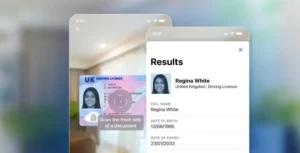
Perception tasks that cannot be written as rules. Identifying which of thousands of document types is being presented, locating and reading fields under real-world lighting, assessing whether security features are present and consistent, matching a face to a portrait, judging whether a face is physically present. None of these can be specified procedurally, which is why rule-based approaches never worked well and AI did.
Weak-signal combination. Fraud signals are individually unremarkable — a new device, an odd hour, an address mismatch. The combination may be strongly predictive, and nobody would have written that rule because the interaction is not visible to inspection.
Network and link analysis. Finding that apparently unrelated applications share a device, an address or a resolved identity is what exposes organized fraud, and it is a graph problem rather than a rule.
AI as the attack surface
The same capabilities are available to the other side, and three consequences are already visible.
Face spoofing got cheap. Generating a convincing synthetic face or animating a stolen photograph once required skill and time. It now requires neither, which changed liveness detection from a refinement into a requirement.
Document forgery got cheap in the same way, and the harder shift is that synthetic documents no longer contain the physical inconsistencies forensic checks were built to find.
Social engineering scaled. The economics of advance fee and romance fraud used to be limited by how many conversations a human could sustain. Generated text removes that ceiling, and voice cloning does the same for vishing.
The defensive conclusion is specific rather than general: controls that depend on an attacker lacking skill or time are now weak, and controls that depend on the attacker lacking access to a real person are not. A generated face is not a person. That distinction is what liveness and injection detection exist to test, and it does not erode as generation improves.
Why it matters for identity verification
Identity verification is unusual in that AI does both the perception and the decisioning, and the thing that limits it is neither.
Model quality matters, and beyond a point the binding constraint is what the model is given to reason about. A fraud model scoring self-asserted application data is reasoning about claims the applicant chose to make. The same model given a verified name, date of birth and document number extracted from an authenticated document is reasoning about facts. It also becomes able to resolve records to the same real person — which is what network features require, and what fabricated identities are specifically designed to prevent.
There is a second reason this matters more than model architecture. Fraud labels are systematically wrong in a known direction: declined applications have no outcome, so the model never learns whether those declines were correct, and undetected fraud sits in training data labeled legitimate. A more capable model trained on that data reproduces past decisions more confidently. Better inputs address the problem; better architecture does not.
Where AI claims are oversold
Four things are worth checking whenever AI is claimed as a capability.
- “AI-powered” describes implementation, not performance. It says nothing about accuracy, and nearly every product in this category qualifies. Ask for measured results on an independent benchmark instead.
- Accuracy figures without a base rate are meaningless. At a 0.1% fraud rate, approving everything is 99.9% accurate. Ask for detection rate at a stated false positive rate.
- Self-reported benchmarks are self-selected. A vendor’s own evaluation runs on data the vendor chose. Independent evaluation is a different class of evidence.
- “Adapts automatically” can mean retraining on its own decisions, which reinforces existing patterns rather than correcting them.
What AI cannot do here
It cannot establish identity. A model concludes that a case resembles fraud. Determining who someone is requires evidence, and evidence is a different kind of thing from inference.
It cannot explain itself without deliberate effort. Where a regime requires an adverse decision to be explained to the person affected, a score does not satisfy that and explainability has to be built.
It cannot be made fair by dropping attributes. Models learn proxies — geography, device cost, name patterns — and removing the explicit field leaves the correlation. Fairness is measured in outcomes across groups, not in the absence of a column.
It does not stay good unattended. Fraud adapts and populations shift. An unmonitored model degrades quietly while continuing to emit confident numbers.
Frequently asked questions
How is AI used in fraud detection?
For risk scoring that weighs many weak signals at once, behavioral modeling against learned patterns, and network analysis that finds connections between accounts no rule expresses. In identity verification it also does document classification and extraction, face matching and liveness detection.
Is AI making fraud worse?
It has made several attacks much cheaper — synthetic faces, forged documents and scaled social engineering all used to be limited by attacker skill and time. It has also improved the defenses. The controls that held up are the ones testing for physical presence rather than plausibility.
What should I ask a vendor claiming AI capability?
For measured performance on an independent benchmark, stated as a detection rate at a specific false positive rate rather than as an accuracy percentage. Also ask specifically how injection attacks are handled — an answer describing image quality analysis is answering a different question.
Can AI replace identity verification?
No, because they do different things. A model infers risk from patterns; verification establishes who someone is from evidence. Inference is cheap and available on every transaction, evidence is expensive and conclusive, and the useful design uses the first to decide where to spend the second.
Related reading
- Machine learning — the subset doing nearly all the practical work
- Deepfake — the attack capability AI created
- Liveness detection — the control that holds up against generation
- Fraud score — what these models output