
Contactless Chip
A contactless chip is an integrated circuit that communicates over a short-range radio field instead of physical contacts, drawing its operating power from the reader rather than a battery. It is the general category. The chip in an ePassport, a tap-to-pay card, and a transit pass are all contactless chips built to the same radio standard.
| Operating frequency | 13.56 MHz for identity and payment applications |
| Primary standard | ISO/IEC 14443 (proximity, ~10 cm) |
| Related standard | ISO/IEC 15693 (vicinity, ~1 m, lower data rate) |
| Power | Inductively coupled from the reader field |
| Terminology | The chip is a PICC; the reader is a PCD |
| Found in | ePassports, national eID cards, payment cards, transit passes, access badges |
| Interface types | Contactless only, or dual-interface with contact pads |
How a contactless chip works
The reader generates an alternating magnetic field. A chip entering that field induces a current in its own antenna, which is enough to power the silicon and drive two-way communication. No battery, no pairing, no configuration.
Range falls off sharply with distance, which is the whole point. At the proximity distances defined by ISO/IEC 14443, a card has to be deliberately presented. That physical constraint is doing security work: it means a credential cannot be interrogated from across a room the way a warehouse RFID tag can.
Multiple chips in the field at once are handled by anticollision, a negotiation that lets the reader isolate and talk to exactly one card. It is the reason tapping a wallet containing three contactless cards usually produces an error rather than a random charge.
Why contactless chips matter for identity verification
The important distinction is not contactless versus contact. It is whether the chip merely stores data or actively proves something.
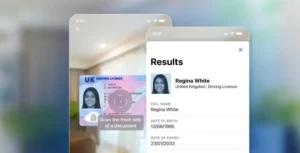
A basic contactless tag returns a fixed identifier to anyone who asks. A contactless chip in an identity document does the opposite: it refuses to respond until the reader derives a key from the printed machine-readable zone, then returns data signed by the issuing authority. Same radio layer, completely different trust model.
For verification, this means the phrase “it has a chip” carries no information on its own. What matters is which protocols the chip supports and what it can be made to prove. A capture and identity document verification flow has to know the difference.
Contact vs contactless vs dual-interface
| Contact | Contactless | Dual-interface | |
|---|---|---|---|
| Standard | ISO/IEC 7816 | ISO/IEC 14443 | Both |
| Connection | Physical gold pads | 13.56 MHz radio field | Either, one chip |
| Wear | Pads degrade with use | No physical wear | Contactless preferred |
| Speed of use | Insert and wait | Tap | Tap or insert |
| Typical use | SIM cards, older bank cards | Passports, transit, tap-to-pay | Modern payment cards |
What contactless chips can’t do
The interface guarantees nothing. Contactless describes how data moves, not whether the data is trustworthy. A cloned transit card and an ePassport use the same radio layer.
They still need line of sight to the printed document. In identity applications the key material comes from the printed page, so reading the chip in isolation is not possible.
They prove possession, not identity. A successful read means someone is holding the document. Establishing that they are its owner requires biometric matching against the image stored on the chip.
Coverage is inconsistent. Assuming a contactless chip exists is one of the most common integration mistakes, particularly outside passports.
Frequently asked questions
Is a contactless chip the same as NFC?
Closely related but not identical. NFC is a specific standard that operates at the same 13.56 MHz frequency and can read ISO/IEC 14443 chips, which is why a phone can read an ePassport. Contactless chip describes the card side; NFC usually describes the reader side and the peer-to-peer capabilities layered on top.
Can contactless chips be read without the holder knowing?
In principle a reader within a few centimeters can energize a chip. In practice, identity chips will not release data without key material derived from the printed page, and payment chips generate a per-transaction cryptogram rather than exposing reusable data.
Why do contactless cards work through a wallet?
The magnetic field passes through most non-metallic materials. Metal shields it, which is why metal card holders block the read entirely and why several cards in one wallet trigger anticollision rather than a clean tap.
Do contactless chips wear out?
The chip itself has no contacts to degrade, so it usually outlasts the card body. Failures are typically antenna breaks from bending, or delamination, rather than electrical wear.