
Protect every payment channel with adaptive, multi-layered fraud detection that stops chargebacks, synthetic identities, and emerging threats—without sacrificing user experience. Instantly verify identities, detect deepfakes, and maintain compliance with seamless API integration and privacy-by-design architecture. Stay ahead of evolving fraud with a platform trusted by industry leaders.








IDs processed every month
countries supported for verifying identities
to capture and extract data

Protect your payment transactions and minimize financial losses with Microblink’s advanced AI-driven fraud prevention. Our proprietary adaptive AI infrastructure detects and neutralizes emerging threats like synthetic identity fraud and deepfakes in real-time, significantly reducing chargebacks and financial exposure.
Ensure seamless user experiences while staying ahead of evolving fraud schemes and regulatory demands. Leverage multi-layered verification, behavioral signals, and privacy-by-design architecture to maintain trust and compliance across all payment channels.


Microblink’s BlinkCard and BlinkID Verify enable instant, on-device authentication of payment cards and IDs, proactively detecting deepfakes and synthetic identities at the point of transaction.
This multi-layered approach significantly reduces chargebacks by up to 25% and cuts financial losses from card-not-present fraud.
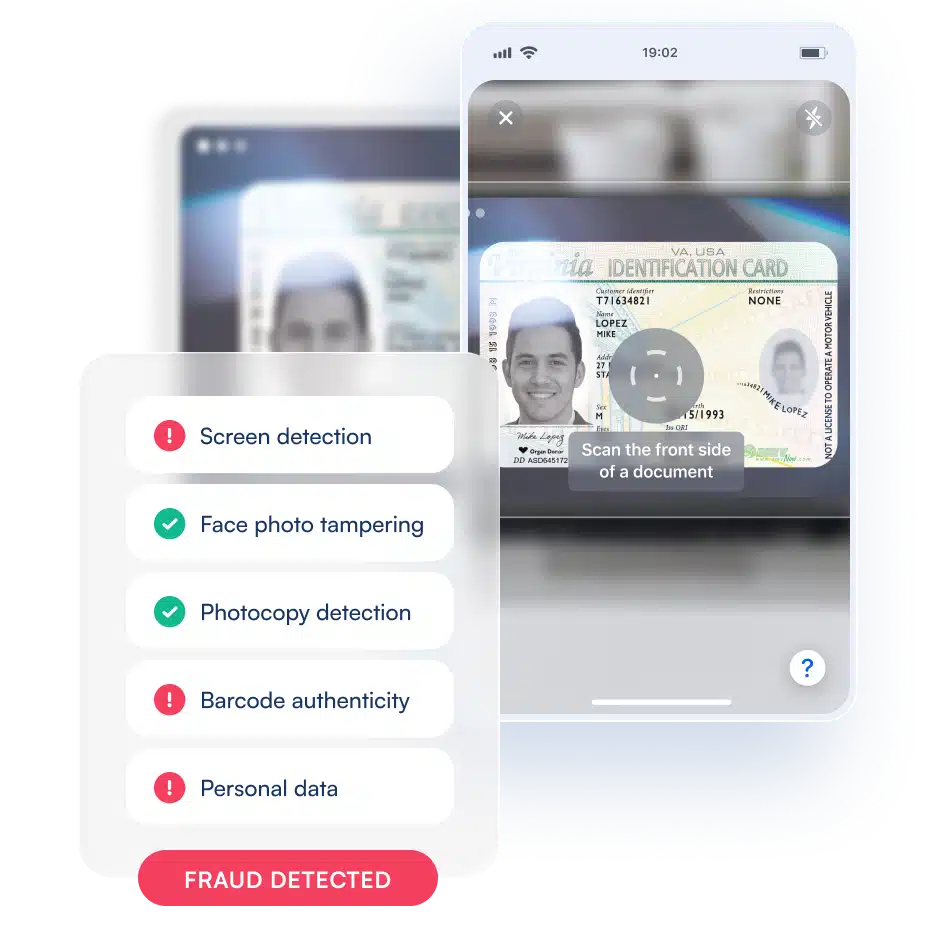
Streamline new user acquisition for payment services with Microblink’s SDKs, offering rapid and accurate on-device capture and verification of IDs and payment cards.
This frictionless process boosts conversion rates by up to 15% while effectively preventing synthetic identity fraud from entering your ecosystem.
Microblink’s proprietary adaptive AI infrastructure continuously learns and evolves, delivering dynamic protection against emerging payment fraud vectors like AI-generated deepfakes.
This ensures your fraud prevention system remains resilient and effective against new threats, significantly reducing investigative and remediation costs.

First Abu Dhabi Bank partners with Microblink to accelerate ID scanning during KYC verification.

Discover how Attain is transforming the consumer-permissioned future with BlinkReceipt.

Discover how BlinkID revolutionized Jurat’s user experience and contributed to their success in the digital notary industry.

Quick and accurate ID verification, ensuring a seamless and secure registration process

Meet regulatory requirements with ID document verification and non-documentary signals


Verify identity and prevent unauthorized transactions through secure document scanning

Detect stolen or synthetic identities with precision and verify IDs to prevent fraudulent account creation and transactions

Ensure compliance and prevent underage access by instantly verifying customer ages through secure ID scanning

With 12 years of expertise in computer vision R&D, Microblink has been at the forefront of AI-driven identity verification, continuously innovating to deliver fast and accurate solutions.

We pioneered AI-driven identity verification, setting the standard for fast, secure, and accurate ID scanning solutions.

We develop our AI in-house, using proprietary data and a dedicated team of machine learning specialists to ensure unmatched accuracy and performance in identity verification.
With 12 years of expertise in computer vision R&D, Microblink has been at the forefront of AI-driven identity verification, continuously innovating to deliver fast and accurate solutions.
We pioneered AI-driven identity verification, setting the standard for fast, secure, and accurate ID scanning solutions.
We develop our AI in-house, using proprietary data and a dedicated team of machine learning specialists to ensure unmatched accuracy and performance in identity verification.
The most prevalent payment fraud vectors include card-not-present (CNP) fraud, account takeover (ATO), synthetic identity fraud, chargeback abuse, and merchant fraud. Proactive detection requires a layered approach: real-time identity verification (ID document and biometric checks), device fingerprinting, behavioral analytics, and AI/ML-driven transaction monitoring. Integrating these tools enables early detection of anomalies and emerging fraud patterns before financial losses occur.
Implement adaptive, risk-based authentication (RBA) that dynamically adjusts verification steps based on transaction risk. For low-risk transactions, streamline with passive checks (device and behavioral signals); for higher-risk scenarios, escalate to biometric or document verification. Use AI-powered fraud scoring to minimize false positives and leverage real-time data enrichment to validate identities quickly, ensuring a seamless experience for genuine users while effectively blocking fraudsters.
Prioritize solutions with advanced liveness detection, deepfake detection, and multi-modal biometric verification. Ensure the platform uses adaptive AI trained on evolving fraud patterns and supports real-time document and facial analysis. Look for vendors who regularly update their models and provide transparent reporting on detection rates for new fraud techniques like AI-generated synthetic IDs.
Choose solutions with built-in compliance frameworks, automated AML screening, and robust audit trails. Ensure the provider holds certifications such as SOC 2 and ISO 27001, and supports specific data residency requirements. Opt for platforms offering privacy-by-design (e.g., zero data access, on-device processing) and clear documentation to simplify regulatory audits.
Select platforms with flexible APIs, SDKs, and no/low-code options for rapid deployment. Ensure compatibility with your payment gateway, CRM, and onboarding systems. Prioritize solutions offering real-time decisioning, customizable workflows, and detailed integration guides. It is best practice to pilot integrations in sandbox environments and leverage vendor support for technical troubleshooting during the rollout.
Track key metrics such as the reduction in chargebacks, fraud loss rates, false positive/negative rates, and onboarding conversion rates. Use vendor-provided analytics dashboards to monitor trends and generate performance reports. Calculate cost savings from prevented fraud and operational efficiencies (e.g., reduced manual reviews) and benchmark these against industry averages to demonstrate clear ROI to stakeholders.

AI didn't just make fraud faster. It made it a system. We analyzed millions of identity interactions to map how identity attacks are evolving across regions, attack types, and sophistication levels — and what organizations need to rethink to keep pace.
See the Data