
Polycarbonate ID Card
A polycarbonate ID card is built from multiple layers of polycarbonate fused under heat and pressure into a single solid block, then personalized by laser engraving inside the material rather than printing on it. The result has no laminate to lift and no printed layer to alter, which is why it has become the standard for high-security documents.
| Material | Polycarbonate, in multiple fused layers |
| Construction | Monolithic — laminated under heat and pressure into one block |
| Personalization | Laser engraving, which carbonizes the material |
| Engraved data | Portrait, name, document number, dates |
| Card format | ID-1, the standard card size |
| Also used for | Passport data pages |
| Typical lifespan | Ten years or more |
Why the material matters more than the features
Most discussion of document security focuses on features — holograms, microprinting, optically variable ink. Polycarbonate is different in kind, because it changes what an attacker can physically do.
A traditional card is a printed substrate with a protective laminate over it. Every attack against it follows from that structure: separate the layers, alter what is underneath, reseal. Delamination is the enabling step for photo substitution and data alteration alike.
A polycarbonate card has no layers to separate. Fusion under heat and pressure produces a single block with no practical seam. Attempting to open it deforms and clouds the material irreversibly, and the damage is obvious to a person holding it.
Laser engraving compounds this. Rather than depositing ink on a surface, the laser carbonizes a small volume inside the material, turning it from clear to black. The image is not on the card, it is in the card. It cannot be scratched off, dissolved, or lifted, because removing it means removing material.
Why polycarbonate matters for identity verification
It shifts the dominant threat.
Against laminated documents, alteration of a genuine card is the cheap, common attack. Against polycarbonate, alteration is impractical, so attackers move to full counterfeits or to attacking the issuance process itself. Different attack, different detection strategy.
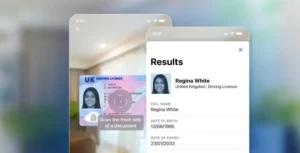
It also creates checkable properties that printing cannot. Laser engraving produces genuine tactile relief you can feel. It supports features that only work in a monolithic material — ghost images at depth, tactile microtext, and angle-dependent images formed inside the substrate. Assessing those is part of what a full identity document verification check does beyond reading text.
For remote verification specifically, engraved features behave differently under a phone camera than printed ones, which is useful signal — and a reminder that capture quality determines how much of it survives to the analysis stage.
Polycarbonate vs laminated cards
| Polycarbonate | PVC or paper with laminate | |
|---|---|---|
| Structure | Fused monolithic block | Substrate plus separate overlay |
| Personalization | Laser engraved inside | Printed on the surface |
| Delamination attack | Destroys the card | The classic attack path |
| Tactile feel | Engraved relief | Smooth |
| Durability | Ten years or more | Wears, yellows, peels |
| Cost | Higher | Lower |
What polycarbonate can’t do
It does not stop counterfeiting. Blank polycarbonate stock and laser engravers are commercially available. What it stops is cheap alteration of genuine documents, which pushes attackers toward more expensive full fabrication.
It does not verify the person. The hardest-to-forge card in the world proves nothing about who is holding it. That still requires biometric matching and liveness detection.
It cannot fix bad issuance. A polycarbonate card issued against fraudulent breeder documents is a genuine card containing a fabricated identity, and every physical check passes.
Engraving is monochrome. Laser carbonization produces grayscale, so color portraits and color security elements require additional printed layers — which reintroduces a printed component, in a limited way.
Frequently asked questions
Why are polycarbonate cards harder to forge?
They are fused into a single block with no separable layers, and the data is carbonized inside the material rather than printed on it. The delamination attack that enables most alteration of laminated documents destroys a polycarbonate card instead.
How can you tell a polycarbonate card by hand?
Laser-engraved data has genuine tactile relief you can feel with a fingertip. The card is also more rigid than PVC, produces a distinct sound when tapped, and shows no laminate edge at the border.
Are all passports polycarbonate now?
No. Many countries have moved their data page to polycarbonate, but laminated paper data pages remain in circulation worldwide, and documents issued years ago stay valid for their full term.
Can polycarbonate cards contain a chip?
Yes. The chip and antenna are placed between layers before fusing, which protects them mechanically and makes extraction destructive.