
Top Account Takeover Protection Software in 2026

Account takeover (ATO) attacks have reached a new level of sophistication in 2026. Generative AI, deepfakes, automated botnets, leaked credentials, and session hijacking techniques have made traditional defenses like static passwords and one-time MFA checks less reliable on their own. For compliance officers, risk managers, heads of security, CFOs, and other fraud decision-makers, that creates a difficult balancing act: reduce unauthorized access without slowing down legitimate users or creating audit and operational headaches.
The strongest ATO protection strategies now combine identity verification, behavioral analytics, bot mitigation, and risk-based step-up authentication. Some platforms are strongest at stopping fake users and synthetic identities at onboarding, while others focus on credential stuffing, email compromise, post-login anomaly detection, or the financial damage that follows a takeover. Below is a 2026 comparison of the leading account takeover protection software options, starting with Microblink.
Competitor Comparison Table
| Product | Compliance Features | Industry Focus | AI Capabilities | User Experience | Developer Experience |
| Microblink | KYC/AML-ready identity verification, document capture, and reliable data extraction for regulated onboarding. | Fintech, banking, insurance, telecom, and digital platforms that need secure onboarding. | Document AI, OCR/data extraction, and biometric facial verification for strong identity checks. | Fast, low-friction onboarding experience; quality can depend on end-user device cameras. | SDK and API integration is flexible, but embedding into onboarding and auth flows requires development effort. |
| DataDome | Supports fraud prevention controls across web, mobile, and APIs, though it is not a dedicated compliance suite. | E-commerce, marketplaces, travel, media, and other high-traffic consumer platforms. | Intent-based bot detection, edge-side mitigation, and full-session ATO monitoring. | Low-latency protection with minimal friction for most users; stricter policies may challenge legitimate traffic. | Strong CDN, edge, and API integrations, but advanced policy tuning can require specialized expertise. |
| Imperva | Policy-driven protection, compromised credential detection, and strong visibility for audit and security teams. | Large enterprises in finance, retail, SaaS, and other digital businesses. | Zero-day leaked credential detection, user behavior anomaly detection, and attack analytics. | Protects login flows with low added latency and provides clear dashboards for investigation. | Out-of-the-box policies help, but enterprise deployment and customization can be complex. |
| Barracuda | Email security controls, phishing defense, and awareness training support governance and risk reduction. | Organizations prioritizing email security, business email compromise prevention, and web application protection. | AI-powered impersonation detection and communication-pattern analysis across email environments. | Strong protection for email users; training improves readiness but adds participation overhead. | Email deployment is relatively approachable, while WAF tuning requires more hands-on expertise. |
| Lookout | Supports zero trust, data protection, and access governance across cloud and mobile environments. | Mobile-first, remote/hybrid, and cloud-centric enterprises. | UEBA and machine learning for anomaly detection across users, devices, and data access. | Unified experience for distributed workforces; endpoint agent requirements can add rollout friction. | Cloud-native platform with broad coverage, but SSE implementation can involve a steeper learning curve. |
| Check Point | Strong policy enforcement, account isolation, segmentation, and monitoring across email, collaboration, APIs, and apps. | Security-mature enterprises seeking consolidated protection across multiple channels. | ML-driven anomaly detection across 100+ indicators and automated threat response workflows. | Comprehensive protection with guided remediation, though administration can feel heavy for smaller teams. | Feature-rich and extensible, but licensing and advanced configuration increase operational complexity. |
| Trustmi | Strengthens payment governance by validating vendor and banking changes inside financial workflows. | B2B payments, finance, AP, procurement, and ERP-driven enterprises. | Behavioral AI for payment anomalies and AI-assisted fraud investigation. | Fits naturally into payment approval processes and helps stop fraud without broad end-user disruption. | Deep ERP and finance-system integrations are valuable, but implementation can be involved. |
1. Microblink
Platform summary
Name: Microblink
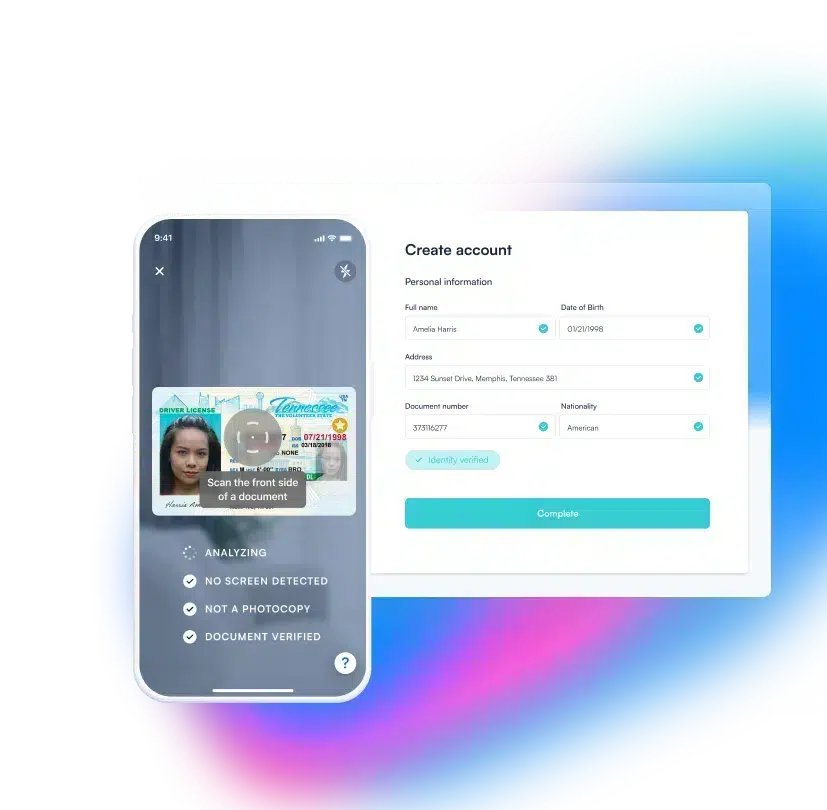
Description: Microblink provides an identity-centric approach to account takeover protection built around its “Know Your Actor” framework. Instead of treating authentication as a single checkpoint, the platform continuously helps enterprises distinguish between legitimate users, approved AI delegates, and malicious actors across the customer journey.
Target audience: Compliance, fraud, risk, and security teams at medium-sized businesses and enterprises that need strong identity assurance, low-friction onboarding, and support for regulated environments.
Key benefits
- Reduces ATO risk by verifying that the person behind an account action is the legitimate account holder.
- Supports continuous identity assurance rather than relying only on point-in-time KYC or one-time login checks.
- Balances fraud prevention with customer experience through contextual, risk-based step-up verification.
- Helps regulated businesses maintain KYC/AML, privacy, and audit-readiness requirements across global markets.
Core features
- Continuous “Know Your Actor” classification: Evaluates session-level signals to classify whether an actor is a human, a delegated AI agent, or a malicious bot.
- Contextual step-up verification: Triggers progressive verification only when risk is elevated, such as biometric re-verification before sensitive actions.
- Advanced deepfake and liveness detection: Uses proprietary machine learning models to stop injected video, generated faces, and synthetic identity attacks.
- On-device processing: Captures and processes identity documents and biometric data directly on the user’s device in under a second.
- Document AI and data extraction: Scans and extracts data from a wide range of identity documents for faster onboarding and stronger identity checks.
- Flexible deployment: Supports cloud, on-premise, and hybrid deployment models to align with enterprise security and data residency requirements.
Primary use cases
- Securing high-risk account modifications: Adds biometric or document-based re-verification when users reset passwords, change MFA settings, or update profile details.
- Protecting high-value transactions and withdrawals: Forces step-up verification before irreversible actions like large transfers, crypto withdrawals, or payout changes.
- Safe delegation for AI agents: Enables organizations to permit low-risk AI-driven tasks while blocking sensitive actions until explicit user consent and re-authentication are provided.
- Secure customer onboarding: Prevents fake and synthetic accounts from entering the ecosystem during sign-up.
- Compliance and KYC/AML workflows: Automates identity data capture and verification for regulated onboarding and periodic checks.
Recent updates
- Rebranded BlinkReceipt under the new name Actual.
- Released the Mapping the Rise of AI-Powered Identity Fraud report based on millions of identity interactions.
- Reported 100% deepfake detection accuracy and a 0.00% system error rate on the U.S. Department of Homeland Security’s RIVR benchmark.
- Hosted and published learnings from the FREUID Challenge, focused on advancing fraud and document forgery detection.
- Expanded document recognition and improved AI performance for global identity verification use cases.
Limitations
- Microblink is strongest on identity assurance and step-up verification, so some organizations may still pair it with dedicated bot management or broader network-layer defenses.
- Integration into existing onboarding, authentication, and transaction flows requires implementation work from engineering teams.
- Biometric and document capture quality can still be influenced by end-user hardware and camera conditions.
Pros
- Highly accurate AI-driven identity verification.
- Fast document scanning improves onboarding speed and lowers manual review burden.
- Biometric liveness and deepfake detection add a strong layer of protection against spoofing.
- Risk-based verification helps reduce unnecessary friction for legitimate users.
Cons
- Not a standalone replacement for every bot mitigation or edge security use case.
- Custom workflow integration can require development resources.
- Performance at capture can vary on older or low-quality mobile devices.
2. DataDome
Platform summary
Name: DataDome
Description: DataDome is a bot and online fraud protection platform designed to stop account takeover at the edge. Its intent-based detection models analyze traffic in real time to identify credential stuffing, reconnaissance, fake account creation, and post-login abuse.
Target audience: Security and fraud teams at high-traffic digital businesses, especially those operating consumer-facing web, mobile, and API environments.
Core features
- Intent-based detection: Uses behavioral AI to identify malicious automation that signature-based controls often miss.
- Real-time mitigation at the edge: Blocks malicious requests before they hit application infrastructure.
- Continuous session detection: Monitors risk across the full user session, not just at login.
- Cross-channel protection: Covers websites, mobile apps, and APIs from the same control plane.
Primary use cases
- Preventing credential stuffing against customer login flows.
- Stopping fake account creation and promo abuse.
- Mitigating loyalty abuse and post-login account manipulation.
- Reducing login friction while maintaining high-volume attack protection.
Recent updates
- Introduced Agent Trust to allow verified AI agents while blocking malicious or suspicious automated activity.
Limitations
- Advanced rule configuration can be complex for smaller teams.
- Aggressive policies may occasionally challenge legitimate users or tools.
- Pricing is not publicly transparent.
Pros
- Real-time detection and mitigation at the edge.
- Monitors activity across the full session, not just login.
- Strong bot and credential stuffing protection with low friction.
Cons
- Advanced configuration can be complex.
- Aggressive policies may occasionally affect legitimate users.
- Pricing details are not publicly transparent.
3. Imperva
Platform summary
Name: Imperva
Description: Imperva Account Takeover Protection focuses on compromised credential detection, anomalous behavior monitoring, and visibility into attack trends. It is particularly useful for organizations that want ATO controls tightly connected to a larger WAAP and application security stack.
Target audience: Large enterprises in finance, retail, SaaS, and other digital sectors with mature security programs and a need for investigation-grade visibility.
Core features
- Zero-day leaked credentials detection: Flags login attempts involving credentials exposed in third-party breaches.
- User behavior anomaly detection: Identifies suspicious shifts in login patterns, device usage, or policy violations.
- Login behavior visualization: Provides dashboards to help teams track trends, compromised users, and attack activity over time.
- Out-of-the-box policies: Helps organizations get started quickly while still supporting more advanced tuning.
Primary use cases
- Protecting login endpoints from credential stuffing and brute force attacks.
- Identifying compromised users and initiating password reset workflows.
- Giving audit, fraud, and security teams better visibility into account abuse patterns.
- Distinguishing legitimate aggregators from malicious automation in financial ecosystems.
Recent updates
- Recognized as a leader in the SecureIQLab WAAP report with top security efficacy.
- Expanded API security capabilities to improve protection for mobile backends and digital application environments.
Limitations
- Best suited to large enterprises and may be costly for smaller organizations.
- Deployment and customization can be resource-intensive.
- Some users report inconsistent support responsiveness depending on issue complexity.
Pros
- Proactively detects leaked or compromised credentials.
- Advanced anomaly detection helps identify suspicious account behavior.
- Strong dashboards and visibility support investigation and response.
Cons
- Best suited to large enterprises and may be costly for smaller teams.
- Deployment and customization can be resource-intensive.
- Support responsiveness may vary by issue complexity.
4. Barracuda
Platform summary
Name: Barracuda
Description: Barracuda approaches account takeover from an email-first perspective, focusing on impersonation, phishing, and business email compromise. It combines AI-driven account and message analysis with security awareness training and WAF-based protection against web-layer abuse.
Target audience: Organizations that view email as a primary attack surface and want to reduce both technical and human-driven account takeover risk.
Core features
- AI-powered impersonation protection: Detects subtle signs that an account is compromised or being used for social engineering.
- Security awareness training: Helps employees identify phishing, account takeover cues, and credential theft attempts.
- WAF configuration for ATO: Extends protection to web applications through detection of botnet probing and credential stuffing.
- Communication-pattern analysis: Learns normal behavior to spot abnormal internal email activity.
Primary use cases
- Preventing business email compromise and fraudulent wire transfer requests.
- Blocking credential stuffing against employee and customer-facing portals.
- Reducing the success rate of phishing campaigns and internal impersonation attacks.
- Protecting sensitive departments such as finance, HR, IT, and executive teams.
Recent updates
- Acquired Evo Security, adding identity and MFA-related capabilities to strengthen protection against modern, AI-driven threats.
Limitations
- Strongest in email security, not full-spectrum ATO protection across every digital channel.
- Training effectiveness depends on sustained employee participation.
- WAF tuning for ATO scenarios requires specialized expertise.
Pros
- Strong AI-powered protection against impersonation and email compromise.
- Security awareness training addresses the human side of ATO risk.
- WAF capabilities help reduce automated login abuse.
Cons
- Primary strength is email security rather than full-channel ATO protection.
- Training outcomes depend on employee participation and retention.
- WAF policy tuning requires expertise and ongoing maintenance.
5. Lookout
Platform summary
Name: Lookout
Description: Lookout offers a data-centric Security Service Edge platform that limits the damage of a compromised account by continuously evaluating user behavior, device posture, and data access patterns. It is particularly strong in mobile-first, remote, and hybrid work environments.
Target audience: Cloud-centric enterprises that need to protect distributed workforces, mobile endpoints, and sensitive data under a zero trust model.
Core features
- Data-centric SSE platform: Combines cloud and on-premises data security controls into a unified environment.
- User and Entity Behavior Analytics (UEBA): Learns normal behavior and flags anomalies that may indicate takeover or misuse.
- Zero trust architecture support: Continuously verifies access and limits permissions to reduce blast radius.
- Mobile threat protection: Helps secure smartphones and tablets used for corporate access and MFA.
Primary use cases
- Securing hybrid and remote workforces.
- Detecting suspicious post-login activity and potential insider-like misuse.
- Protecting mobile devices from smishing, malicious apps, and other takeover-adjacent threats.
- Limiting data exposure after a credential compromise.
Recent updates
- Expanded platform messaging and capabilities around Shadow AI governance, helping organizations monitor risk tied to employee use of generative AI tools.
Limitations
- Broad SSE scope can make deployment and administration complex.
- Full functionality may require endpoint agents.
- The platform is more focused on data and access security than initial identity verification.
Pros
- Unified platform for protecting data across cloud and mobile environments.
- UEBA helps detect suspicious post-login behavior.
- Strong fit for mobile-first and remote-work security strategies.
Cons
- Broad SSE scope can make deployment and administration complex.
- Full functionality may require endpoint agents.
- Less focused on identity verification than some specialized ATO tools.
6. Check Point
Platform summary
Name: Check Point
Description: Check Point includes account takeover protection within a wider security architecture spanning email, collaboration, APIs, and applications. Its strength is in detection, containment, and automated response once suspicious behavior is identified.
Target audience: Security-mature enterprises that want consolidated controls across multiple communication and application surfaces.
Core features
- Workspace security and email collaboration: Monitors email and collaboration tools for signs of compromise.
- Account isolation and sandboxing: Restricts permissions on suspicious accounts to prevent lateral movement.
- Automated threat response workflows: Provides guided remediation and reduces noise for analysts.
- ML-driven anomaly detection: Watches 100+ indicators across channels to identify suspicious behavior faster.
Primary use cases
- Preventing email-based ATO and internal phishing spread.
- Detecting suspicious mailbox changes, MFA changes, or mass internal email activity.
- Securing APIs and web applications against password spraying and credential stuffing.
- Reducing the blast radius of a compromised account through rapid isolation.
Recent updates
- Released updates tied to Frontier AI Security, focused on hardening defenses against AI-generated phishing and automated hijacking techniques.
Limitations
- Can be resource-intensive to operate.
- Licensing may be difficult to navigate.
- Advanced configuration creates a steeper learning curve for teams without deep security specialization.
Pros
- Broad protection across email, collaboration, APIs, and applications.
- Account isolation and segmentation reduce blast radius after compromise.
- Automated response workflows improve remediation speed.
Cons
- Can be resource-intensive to operate.
- Licensing can be difficult to navigate.
- Advanced configuration comes with a steep learning curve.
7. Trustmi
Platform summary
Name: Trustmi
Description: Trustmi focuses on the financial impact of account takeover rather than the initial breach itself. Its Behavioral AI analyzes payment workflows, vendor changes, and transaction context to stop fraudulent transfers that can occur after a trusted account is compromised.
Target audience: CFOs, AP leaders, procurement teams, fraud managers, and enterprise finance organizations with complex B2B payment workflows.
Core features
- Behavioral AI for payment security: Learns normal payment behavior and vendor communication patterns.
- Financial context awareness: Detects abnormal changes in payment details, banking information, and request context.
- Real-time payment protection: Validates transactions before money moves.
- AI-assisted investigation: Reconstructs suspected fraud events to reduce manual forensic work.
Primary use cases
- Stopping post-ATO payment fraud after a finance or procurement account is compromised.
- Preventing vendor compromise and fraudulent banking detail changes.
- Strengthening payment approval controls and finance governance.
- Automating fraud investigation in ERP-driven environments.
Recent updates
- Introduced its AI Investigation Agent to automate forensic analysis.
- Reported a 5x surge in payment fraud activity, reinforcing demand for payment-specific controls after account compromise.
Limitations
- Does not prevent the initial account compromise.
- Integration with ERP and financial systems can be complex.
- Primarily designed for B2B payment environments rather than consumer-facing ATO scenarios.
Pros
- Directly addresses the financial damage that can follow an account takeover.
- Behavioral AI is well suited to detecting abnormal payment requests.
- Deep integration with ERP and payment workflows increases control.
Cons
- Does not prevent the initial account compromise itself.
- Financial-system integration can be complex.
- Primarily designed for B2B payment environments rather than consumer ATO scenarios.
What is Account Takeover Protection Software?
[Account takeover](https://microblink.com/resources/glossary/account-takeover/) (ATO) protection software is a specialized [fraud prevention solution](https://microblink.com/resources/blog/top-fraud-prevention-solutions/) designed to detect, block, and mitigate unauthorized access to user accounts. By leveraging advanced machine learning, behavioral biometrics, and device fingerprinting, these platforms continuously monitor login attempts and post-login user sessions in real-time. Instead of relying solely on traditional authentication methods, ATO software analyzes hundreds of risk signals to accurately distinguish between your legitimate customers and malicious actors attempting to exploit stolen credentials.
Why is it important?
Implementing robust ATO protection is critical because compromised accounts lead directly to devastating financial losses, regulatory compliance violations, and severe reputational damage. When fraudsters successfully breach an account, they can drain funds, steal sensitive personal data, or use the compromised identity to launch further attacks on your ecosystem. For B2B and enterprise organizations, safeguarding user accounts is not just about stopping fraud; it is a foundational requirement for maintaining customer trust and ensuring compliance with strict data privacy regulations like GDPR, CCPA, and PSD2.
How to choose the best software provider
Selecting the right ATO protection partner requires a strategic methodology focused on detection accuracy, seamless integration, and user experience. Start by evaluating a provider’s detection capabilities—look for solutions that offer a multi-layered defense mechanism, combining behavioral analytics and global threat intelligence to ensure high catch rates with minimal false positives. Additionally, assess the software’s ability to integrate smoothly with your existing identity and access management (IAM) stack via APIs without adding friction to the legitimate user’s journey. Finally, prioritize vendors that offer scalable infrastructure, comprehensive compliance reporting, and dedicated support teams to help you stay ahead of evolving fraud vectors.
What is account takeover protection software, and how is it different from traditional authentication tools?
Account takeover protection software is a category of security and fraud prevention technology designed to detect, prevent, and respond to unauthorized access to user or employee accounts. Unlike traditional authentication tools, which usually focus on verifying a user at a single point in time, ATO protection software looks at risk across the full account lifecycle.
Traditional controls such as passwords, SMS codes, or one-time MFA prompts are still important, but they are no longer enough on their own. Attackers now use credential stuffing, phishing kits, session hijacking, MFA fatigue, deepfakes, and AI-powered social engineering to bypass static defenses. ATO protection software helps fill those gaps by combining signals such as:
- Identity verification at onboarding or re-authentication
- Behavioral analytics and anomaly detection
- Bot and automation detection
- Device, network, and session risk monitoring
- Risk-based step-up authentication for sensitive actions
For fraud decision-makers, the key difference is that ATO protection software is not just about access control. It is about reducing fraud losses, limiting operational disruption, improving auditability, and protecting customers and internal users without introducing unnecessary friction.
How do I choose the right account takeover protection software for my organization?
The right platform depends on where your takeover risk is highest and what business outcomes matter most. For some organizations, the biggest issue is fake or synthetic users entering the ecosystem during onboarding. For others, the main problem is credential stuffing, phishing-driven compromise, or fraudulent payments after a trusted account has already been hijacked.
A practical evaluation should include:
- Attack surface: Are you mainly protecting customer logins, employee email accounts, mobile apps, APIs, payment workflows, or all of the above?
- Risk stage: Do you need stronger onboarding identity assurance, login protection, post-login anomaly detection, or transaction-level verification?
- Compliance needs: If you operate in regulated industries, evaluate support for KYC, AML, audit trails, privacy controls, data residency, and evidence collection.
- User experience: Strong security should not create excessive abandonment, help desk volume, or login friction for legitimate users.
- Integration complexity: Consider how easily the platform connects to your onboarding flows, authentication systems, fraud stack, case management tools, SIEM, ERP, or payment systems.
- Deployment model: Some teams require cloud deployment, while others need on-premise or hybrid support for security and governance reasons.
- Operational model: Assess how much tuning, staffing, and specialized expertise the platform requires after go-live.
For many medium-sized businesses and enterprises, the best approach is not one tool that does everything, but a layered stack. For example, identity-centric protection can help verify the real person behind sensitive actions, while bot mitigation and UEBA tools can handle automated attacks and post-login anomalies.
Why is identity verification important for preventing account takeover in 2026?
Identity verification has become more important because attackers are no longer just guessing passwords. They are exploiting weak recovery flows, hijacking sessions, impersonating real users with deepfakes, and using stolen credentials that already passed basic authentication checks.
That means an organization may need to answer a more advanced question than “Did the right password and code get entered?” The better question is “Is the person or actor behind this action really the legitimate account holder?”
Identity verification helps by adding stronger assurance at high-risk moments, such as:
- Password resets
- MFA resets or device changes
- Profile and contact detail changes
- Large withdrawals or payout changes
- Vendor banking updates
- Access to sensitive records or privileged workflows
For fraud decision-makers, this is especially valuable because it supports both fraud reduction and defensibility. A strong identity-centric approach can reduce false positives, create clearer audit records, and lower the chance that a compromised but properly credentialed attacker can complete a sensitive action. In practice, identity verification is often most effective when used as a risk-based step-up control rather than as a blanket requirement for every session.
Can account takeover protection software help with compliance and audit readiness?
Yes. For regulated and risk-sensitive organizations, ATO protection software can support compliance efforts by improving how identity, access, fraud controls, and investigation records are documented and enforced.
Depending on the platform, compliance-related benefits may include:
- Identity verification workflows aligned to KYC and AML processes
- Evidence logs for onboarding, re-verification, and sensitive transactions
- Policy-based escalation for higher-risk account actions
- Monitoring for suspicious access behavior and credential compromise
- Segmentation of duties between fraud, security, and compliance teams
- Support for data governance, privacy, and retention requirements
This matters because account takeover incidents often create more than direct fraud losses. They can also trigger customer complaints, remediation costs, reporting obligations, internal control concerns, and auditor scrutiny. A platform that helps teams show when a user was verified, why a step-up challenge was triggered, what risk signals were present, and how the case was resolved can materially improve audit readiness.
That said, most ATO tools are not complete compliance systems on their own. Fraud decision-makers should still confirm whether the vendor’s controls and reporting features align with their specific regulatory obligations, internal policies, and third-party review requirements.
Is a single ATO protection tool enough, or do most organizations need a layered approach?
Most organizations need a layered approach because account takeover is not a single attack type. It is a chain of risks that can start with fake accounts, leaked credentials, phishing, bots, session theft, social engineering, or insider-like misuse after login.
A single product may be very strong in one area but weaker in others. For example:
- Identity verification platforms are strong at onboarding assurance and high-risk step-up checks
- Bot management tools are strong at blocking credential stuffing and automated abuse
- UEBA and SSE platforms are strong at detecting suspicious post-login behavior
- Email security platforms are strong at preventing phishing and business email compromise
- Payment fraud controls are strong at stopping financial loss after compromise
For fraud decision-makers, the goal should not be buying the most tools possible. It should be building the right control layers around the highest-risk points in the user journey. A practical layered model often includes:
- Strong identity proofing at account creation
- Bot and credential attack defenses at login
- Risk-based step-up verification for sensitive changes and transactions
- Behavioral monitoring for post-login misuse
- Incident response and audit visibility for investigation and reporting
In other words, the best ATO strategy is usually a coordinated architecture, not a standalone point solution.