
Top Agentic IDV Solutions for Streamlined Onboarding and Fraud Prevention in 2026

Intro
As autonomous AI agents proliferate across enterprise environments in 2026, traditional identity and access management frameworks are no longer enough to contain fraud, prove compliance, and preserve operational speed. Fraud Decision-Makers now have to think beyond one-time customer verification and address a broader identity challenge: how to trust human users, delegated AI agents, and non-human identities across the full lifecycle.
That shift is why agentic IDV has become a more strategic buying category. The strongest platforms now blend identity proofing, adaptive risk controls, behavioral analysis, runtime enforcement, and audit-ready reporting to help enterprises reduce fraud without creating unnecessary friction.
For compliance officers, risk managers, heads of security, and CFOs, the best choice depends on the problem you are trying to solve first. Some solutions focus on digital onboarding and KYC, while others are better suited to shadow AI governance, runtime security, autonomous SOC workflows, or just-in-time access management for AI agents.
Competitor Comparison Table
| Theme | Microblink | Token Security | Stellar Cyber | NeuralTrust | Apono |
|---|---|---|---|---|---|
| Compliance Features | KYC and AML automation, age verification, and privacy-first on-device processing support strong identity compliance requirements. | OWASP-aligned agent lifecycle governance, auditable discovery, and least-privilege enforcement strengthen control over non-human identities. | Identity threat detection, investigation context, and unified security telemetry help support incident response and audit readiness. | Built for EU AI Act, GDPR, and ISO 42001 alignment with runtime controls, audit trails, and on-premises deployment options. | Just-in-time access approvals, detailed action logs, and immutable audit trails support strict access governance and compliance reviews. |
| Industry Focus | Best suited for fintech, banking, digital marketplaces, and businesses with age-restricted or regulated onboarding flows. | Focused on large enterprises managing shadow AI, custom GPTs, and complex fleets of autonomous agents. | Well matched to mid-market SOCs and security teams that need broad detection and response coverage without many point tools. | Designed for highly regulated enterprises that require private cloud or on-premises AI security controls. | Strong fit for cloud-native engineering, DevOps, and platform teams deploying copilots, automations, and AI agents in production. |
| AI Capabilities | Uses document AI, biometric liveness checks, and synthetic identity fraud detection to verify users quickly and accurately. | Delivers continuous agent discovery, behavioral baselining, and automated least-privilege policy enforcement for machine identities. | Combines autonomous phishing triage, anomaly detection, correlation AI, and response workflows for SOC automation. | Inspects prompts, memory changes, and tool calls in real time while mapping agent posture across the AI stack. | Applies intent-based access control, ephemeral permissions, and human-in-the-loop approvals to govern agent actions. |
| User Experience | Offers a fast and low-friction onboarding flow that can improve conversion, though performance may vary on weaker devices. | Provides strong visibility for security teams, but the platform can feel specialized and complex during early adoption. | Reduces analyst workload with automation, although the interface can feel dense for less experienced users. | Gives security teams proactive control, but deep runtime inspection can introduce latency into user-facing AI experiences. | Fits neatly into common approval workflows like Slack and CLI, though extra reviews can slow fully automated processes. |
| Developer Experience | SDK-based deployment gives teams flexibility and privacy benefits, but implementation typically requires dedicated mobile engineering effort. | Enterprise rollout demands extensive policy design, asset mapping, and cross-functional coordination before value is fully realized. | Open APIs and hundreds of connectors ease integration, though setup and tuning still require meaningful time and expertise. | Deep control across models, tools, and MCP servers is powerful, but deployment is infrastructure-heavy and integration intensive. | Developer-friendly integrations reduce process friction, but writing granular intent-based policies still takes careful planning. |
1. Microblink
Platform summary
Microblink is an AI-powered identity verification platform built for enterprises that need faster onboarding, stronger fraud prevention, and tighter compliance controls without compromising user experience. Its evolving Know Your Actor (KYA) approach extends beyond point-in-time KYC by helping organizations distinguish between legitimate human users, delegated AI agents, and malicious synthetic activity throughout the digital journey.
Best for: Banks, fintechs, digital marketplaces, travel platforms, and other regulated enterprises with high-volume onboarding and fraud exposure.
Unique selling point: Continuous identity intelligence paired with privacy-first, on-device processing and dynamic risk orchestration.
Key benefits
- Continuous identity assurance across the lifecycle. Microblink moves beyond static onboarding checks and supports ongoing trust decisions as risk changes. That matters for FDMs who need to secure not just account creation, but also password resets, payout changes, and high-risk transactions.
- Lower synthetic fraud and deepfake exposure. Its combination of liveness detection, behavioral biometrics, and document intelligence is designed to catch increasingly sophisticated AI-generated fraud. This helps enterprises protect approval rates without absorbing excessive manual review costs.
- Higher conversion through adaptive friction. Microblink can step up verification only when risk rises, instead of forcing every user through the same heavy workflow. That balance is especially valuable for teams measured on both compliance outcomes and revenue conversion.
- Stronger compliance and defensibility. Explainable AI, audit trails, and automated reporting make decisions easier to justify during internal reviews and external audits. For regulated organizations, that improves confidence in KYC, AML, privacy, and governance controls.
Core features
- Know Your Actor (KYA) framework. This framework classifies actor types in real time so organizations can distinguish between real users, approved AI delegates, and hostile automation. It reframes identity verification as a continuous trust problem instead of a one-time onboarding event.
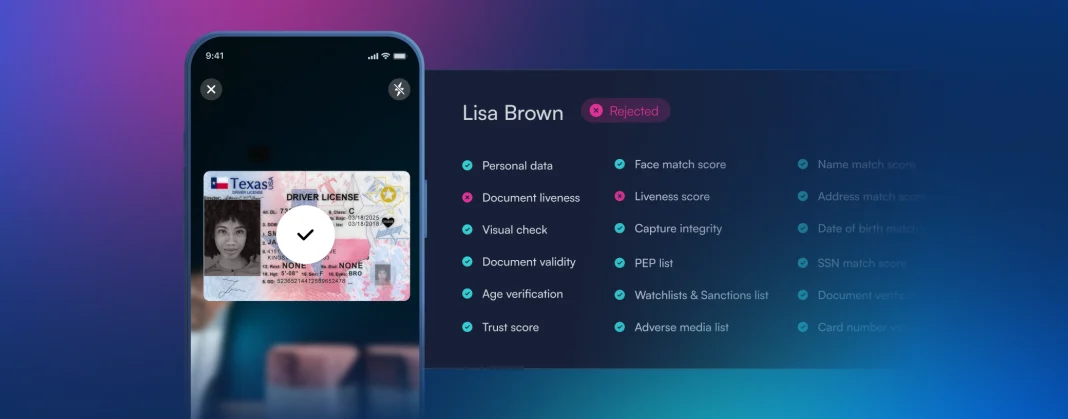
- On-device document verification. Microblink’s edge-first architecture processes identity data directly on the user’s device rather than routing sensitive data through external servers. This supports lower latency, stronger privacy, and easier alignment with data protection requirements.
- Autonomous deepfake and synthetic identity defense. The platform uses liveness checks, behavioral signals, and cross-channel fraud analysis to detect manipulated documents and AI-assisted impersonation. That makes it particularly relevant as fraud rings scale their attacks with generative AI.
- Decision Command Center with explainable AI. Microblink can orchestrate step-up checks based on changing risk while preserving transparent decision logic and auditability. That helps compliance and fraud teams apply controls proportionally instead of relying on blunt, static rules.
Primary use cases
- Accelerated digital banking onboarding. Financial institutions can automate identity and document verification in under a second and reduce onboarding times by up to 80%. That can materially improve approval speed while cutting manual review workloads.
- Agentic travel identity control. Travel businesses can carry a trusted identity state across booking, check-in, and border-related workflows. This helps reduce account takeover and loyalty fraud in multi-stage customer journeys.
- High-risk transaction step-up verification. Microblink can trigger contextual re-verification for sensitive events such as large withdrawals, payout changes, or password resets from unfamiliar environments. That lets teams apply friction where it protects value most.
Recent updates
- Enhanced synthetic identity fraud detection. Microblink has improved its AI models to better identify pixel-level inconsistencies and other indicators of manipulated identity documents. That strengthens its position against rapidly evolving AI-enabled fraud tactics.
- Expanded global document coverage. The platform continues to broaden its support for thousands of document types across 140+ countries. This is important for enterprises that need consistent onboarding controls across multiple regions.
- New market and product momentum. Microblink rebranded BlinkReceipt to Actual and released its Mapping the Rise of AI-Powered Identity Fraud report. Together, those updates signal continued product investment and a stronger enterprise narrative around fraud intelligence.
Limitations
- Integration complexity. Microblink’s SDK-led model gives enterprises flexibility, but it can require meaningful mobile and product engineering time to deploy well. Organizations without strong internal development support may need a more phased rollout plan.
- Device performance variability. Because processing happens on the user’s device, results can vary based on camera quality, processor speed, and user environment. Older or lower-end devices may introduce more friction than premium smartphones.
- Custom pricing and procurement effort. Microblink’s pricing is enterprise-oriented and not publicly listed. That can make early-stage budgeting and vendor comparison harder for smaller teams.
Pros
- Excellent onboarding experience. The scanning flow is fast and tolerant of imperfect lighting or camera angles. That can directly improve conversion at a stage where drop-off is costly.
- Strong privacy posture. Keeping sensitive identity data on-device reduces exposure to unnecessary data transfer and storage risks. This is especially compelling for organizations navigating GDPR, data residency, or internal privacy mandates.
- Broad enterprise applicability. Microblink supports global document verification, age checks, KYC workflows, and step-up authentication. That makes it useful well beyond basic account opening.
Cons
- Implementation is not plug-and-play. Teams often need dedicated engineering resources to integrate, test, and optimize the user journey. This can extend time to value compared with lighter SaaS tools.
- Performance is partly hardware-dependent. Even strong software can be constrained by weak end-user devices. Enterprises serving broad consumer populations need to account for that variance.
- Pricing transparency is limited. A custom pricing model may fit complex enterprise buying processes, but it slows quick commercial evaluation. That can be frustrating for mid-market buyers trying to shortlist vendors efficiently.
2. Token Security
Platform summary
Token Security is an identity-first platform focused on discovering, governing, and monitoring AI agents and other non-human identities inside the enterprise. It is better suited to internal AI identity governance than customer-facing onboarding, making it a strong option for FDMs concerned about shadow AI, machine accountability, and least-privilege enforcement.
Best for: Large enterprises managing custom GPTs, service accounts, and complex autonomous agent environments.
Unique selling point: End-to-end AI agent identity lifecycle management, from discovery through retirement.
Core features
- Continuous discovery and inventory. Token Security identifies AI agents, custom GPTs, and shadow AI activity across enterprise environments. It creates a live inventory of ownership, permissions, and activity so unmanaged machine identities do not go unnoticed.
- Least-privilege access enforcement. The platform evaluates agent permissions and rightsizes access based on operational need. This reduces the blast radius if an agent, token, or workflow is compromised.
- Behavioral baselining and monitoring. Token Security establishes expected behavior patterns for each agent and flags deviations in real time. That gives security teams earlier visibility into rogue behavior or privilege misuse.
Primary use cases
- Shadow AI mitigation. Enterprises use the platform to surface unmanaged AI workflows operating outside approved governance channels. This is especially useful for security leaders trying to regain visibility across fast-moving business units.
- Multi-agent traceability. Token Security helps teams audit complex chains of actions across interconnected agents. That improves accountability and supports post-incident investigation.
- Automated lifecycle governance. Organizations can use it to deprovision dormant or orphaned machine identities before they become risk exposures. This is particularly valuable where service-account sprawl has already become a control problem.
Recent updates
- OWASP-aligned lifecycle management. Token Security introduced AI Agent Identity Lifecycle Management aligned with the OWASP Top 10 for Agentic Applications. That gives buyers a clearer framework for evaluating modern AI identity risks.
Limitations
- Narrower scope than full IAM or onboarding IDV. Token Security is purpose-built for machine identities rather than human KYC or broad employee IAM. Most organizations will still need adjacent tools for customer onboarding and workforce access.
- Rollout complexity. Creating a reliable inventory of agents and defining least-privilege boundaries takes time and cross-functional coordination. Large organizations should expect involvement from security, platform, application, and governance teams.
- Best fit for large enterprises. The value is strongest in environments with significant autonomous-agent sprawl. Smaller businesses with limited AI deployment may find the platform too specialized for current needs.
Pros
- Identity-first architecture. Treating agents as managed identities closes accountability gaps that legacy access models often miss. That is strategically useful for enterprises moving from experimentation to operational AI at scale.
- Strong lifecycle control. The platform spans discovery, active governance, and retirement of AI identities. This helps reduce permission creep and orphaned accounts over time.
- Relevant security alignment. Its OWASP-based positioning makes it easier for risk teams to map technical controls to recognized AI security concerns. That improves the quality of internal governance discussions.
Cons
- Steep learning curve. Machine-first identity governance requires a different mental model than traditional employee access management. Teams may need training before they can operationalize the platform consistently.
- Complex initial implementation. Building policies for dynamic, distributed agents is rarely quick. Organizations with fragmented ownership structures may struggle to move fast.
- Limited appeal for lighter environments. If an enterprise has only a few internal AI use cases, the platform may feel overbuilt. Budget-conscious buyers may prefer a narrower control set.
3. Stellar Cyber
Platform summary
Stellar Cyber is an Open XDR platform that uses agentic AI to automate detection, triage, and response across the security operations stack. It is not a traditional onboarding IDV tool, but it is highly relevant for FDMs who view identity threats, phishing, and incident response as part of a broader fraud and risk management program.
Best for: Mid-market SOCs and enterprise security teams seeking autonomous detection and response with strong identity-threat context.
Unique selling point: A human-augmented autonomous SOC model that amplifies analysts instead of replacing them.
Core features
- Autonomous phishing triage. Stellar Cyber can process reported phishing emails, inspect links and attachments, and trigger containment actions rapidly. This reduces analyst workload while helping teams react faster to common entry points.
- Multi-layer AI architecture. The platform combines detection, correlation, and response agents across endpoints, networks, and cloud environments. That broader telemetry view helps uncover attack chains that siloed point tools can miss.
- Identity threat detection. It correlates behavior such as geographic anomalies, unusual queries, and suspicious data movement. This supports earlier detection of compromised accounts and lateral movement.
Primary use cases
- Alert fatigue reduction. Mid-market teams use Stellar Cyber to automate repetitive triage and correlation tasks. That allows scarce analysts to focus on higher-value investigation work.
- Insider threat mitigation. The platform can surface anomalies tied to privilege escalation or unusual data access. This is useful in environments where malicious insiders and compromised legitimate accounts look similar at first.
- Rapid incident containment. Automated response workflows can compress response windows from days to minutes. For FDMs, that reduction can translate directly into lower breach costs and less operational disruption.
Recent updates
- Version 6.1 enhancements. Stellar Cyber added automatic phishing triage and AI-generated case summaries. Those updates improve both speed to action and the quality of analyst handoffs.
Limitations
- Heavy data volume. The platform ingests broad telemetry, which can be powerful but overwhelming at first. Teams without strong operational discipline may struggle to separate signal from noise early on.
- Tuning requirements. Unsupervised models need time to learn what normal looks like in a new environment. During the ramp-up period, false positives can increase and trust can take time to build.
- Dense user experience. Combining SIEM, XDR, NDR, and UEBA in one interface creates a lot of depth. Less experienced analysts may need structured enablement before they can work efficiently.
Pros
- Balanced automation model. Stellar Cyber automates repetitive SOC work without removing humans from high-impact decisions. That balance is attractive for organizations that want speed without surrendering control.
- Large integration ecosystem. Open APIs and extensive connectors help organizations extend existing security investments. That can reduce rip-and-replace costs and lower adoption friction.
- Predictable licensing approach. A single-license model can simplify budgeting relative to multiple point products. This is especially helpful for mid-market buyers under cost-consolidation pressure.
Cons
- Initial setup can be substantial. Broad telemetry ingestion and tuning often require vendor support or internal expertise. Buyers should plan for operational effort, not just software activation.
- Training investment is necessary. Teams that do not learn the investigation model may underuse the platform’s value. That weakens ROI, especially in smaller SOCs.
- Over-correlation risk exists. If tuning is weak, unrelated events can be grouped together. That can complicate root-cause analysis until baselines mature.
4. NeuralTrust
Platform summary
NeuralTrust is a specialized runtime security platform for enterprises deploying AI agents in regulated environments. It is more focused on governing agent behavior, model interactions, and prompt-level risk than on customer onboarding, making it well suited for organizations concerned with AI governance, data sovereignty, and real-time enforcement.
Best for: Highly regulated enterprises in finance, healthcare, and other sectors with strict AI control requirements.
Unique selling point: Split-plane architecture that enables runtime policy enforcement while keeping sensitive data on-premises or in private cloud environments.
Core features
- TrustGuard runtime protection. NeuralTrust monitors prompts, memory changes, and tool calls in real time. It can block unsafe actions before execution, which is critical in high-risk AI environments.
- TrustGate access centralization. The platform applies identity-aware permissions across models, tools, and MCP server calls. This creates more consistent policy enforcement across fragmented AI stacks.
- TrustLens posture management. NeuralTrust discovers AI agents and maps their connected models, data sources, and identities. That visibility helps security and compliance teams understand where AI risk actually sits.
Primary use cases
- Regulatory compliance assurance. Enterprises use NeuralTrust to support alignment with the EU AI Act, GDPR, and ISO 42001. The audit trails and policy evidence are useful in formal reviews and external audits.
- MCP server protection. The platform helps defend against tool poisoning and unauthorized access in the Model Context Protocol layer. This is increasingly relevant as agent ecosystems become more modular and interconnected.
- Multi-agent workflow enforcement. NeuralTrust can monitor trust boundaries across agents that share tasks and context. That helps contain the impact of a compromised agent before it spreads.
Recent updates
- Funding and deployment expansion. NeuralTrust recently raised $20M and expanded its split-plane architecture for private cloud and on-premises deployment models. That signals continued investment in enterprise-grade, regulated use cases.
Limitations
- Runtime latency risk. Deep inspection of prompts and tool calls can introduce delay. In user-facing AI applications, even modest latency can affect customer experience and business adoption.
- Infrastructure-heavy deployment. Split-plane architecture offers control, but it also demands advanced implementation capabilities. Organizations should expect meaningful involvement from infrastructure and security engineering teams.
- Premium enterprise positioning. NeuralTrust is designed for complex, high-regulation environments rather than lightweight AI programs. Mid-sized businesses may find the pricing and deployment model too heavy for near-term needs.
Pros
- Proactive real-time blocking. NeuralTrust can stop unsafe actions before they happen rather than just logging them afterward. That is a major advantage when policy violations could trigger material compliance exposure.
- Strong compliance orientation. The platform is designed with AI governance and privacy frameworks in mind. This makes it easier for risk teams to collect evidence and defend control design.
- Data sovereignty flexibility. Keeping sensitive information on-premises while still applying runtime controls is valuable for regulated enterprises. It also reduces resistance from internal privacy and legal stakeholders.
Cons
- Performance overhead is a real consideration. Deep inspection requires compute and careful tuning. Enterprises must weigh protection depth against production responsiveness.
- Integration burden can be high. NeuralTrust touches multiple layers of the AI stack, including models, tools, and MCP infrastructure. That raises complexity compared with lighter monitoring tools.
- Specialized expertise is often needed. Intent-aware AI security is still a niche discipline. Traditional security teams may need outside support or dedicated specialists.
5. Apono
Platform summary
Apono is a just-in-time access governance platform that has expanded into agentic identity and copilot security. It is not built for front-end document verification, but it is highly relevant for FDMs who need to control what autonomous agents can access, how long they can access it, and how those actions are approved and audited.
Best for: Cloud-native engineering, platform, DevOps, and security teams deploying AI agents and copilots into production workflows.
Unique selling point: Zero Standing Privilege for AI agents, backed by intent-based access controls and human-in-the-loop approval flows.
Core features
- Zero Standing Privilege enforcement. Apono grants AI agents task-scoped access only when needed. This sharply limits the blast radius of compromised credentials or abused automations.
- Intent-based access control. The platform compares what an agent says it intends to do with the action it is actually attempting. If those two things do not align, it can block the request.
- Human-in-the-loop approvals. Sensitive actions can be routed to human reviewers for approval inside tools like Slack or the CLI. This preserves oversight without forcing teams into disconnected workflows.
Primary use cases
- Non-human identity sprawl management. Apono helps teams discover and govern growing populations of agentic identities and tokens. This improves ownership and reduces unmanaged access risk.
- Secure copilot deployment. Engineering teams can let coding assistants work productively without giving them broad, persistent access to source code or production systems. That supports innovation without abandoning guardrails.
- Audit and compliance tracking. The platform records every request, approval, and downstream action. That creates strong evidence for incident response and compliance reviews.
Recent updates
- Acquisition and category expansion. Apono was acquired by 1Password and also raised a $34M Series B to expand secure access governance for the AI era. That strengthens its strategic relevance in the access-management market.
Limitations
- Approval workflow friction. Human review adds a valuable control, but it can also slow automation if policies are too strict. Teams need to tune approvals carefully to avoid creating operational bottlenecks.
- Cloud-native bias. Apono is strongest in modern SaaS and cloud infrastructure environments. Organizations with heavy on-premises or legacy environments may face gaps in coverage or integration.
- Policy design complexity. Writing granular intent-based policies for many different agents takes planning and context. That work is manageable, but it is not trivial.
Pros
- Strong blast-radius reduction. Replacing persistent privileges with just-in-time access significantly limits what a compromised agent can do. This is one of the clearest, most practical controls for agentic risk.
- Developer-friendly workflow fit. By integrating into tools teams already use, Apono lowers resistance to secure approval processes. That can improve adoption compared with more isolated access products.
- Detailed auditability. Every access event is tied to intent and approval context. This makes investigations and compliance evidence collection far easier.
Cons
- Approval bottlenecks are possible. If too many actions require review, autonomous workflows lose much of their speed advantage. Policy tuning becomes essential to preserve business value.
- Weaker fit for on-prem-heavy enterprises. Organizations with legacy infrastructure may not get the same breadth of value as cloud-native teams. That limits its universality across enterprise environments.
- Does not deeply inspect prompt content. Apono governs access well, but it is not a full runtime prompt-security solution. Many teams will need a complementary tool if prompt injection is a high-priority concern.
What is Agentic IDV?
Agentic Identity Verification (IDV) represents the next evolution in compliance and fraud prevention, shifting from static, rules-based checks to dynamic, AI-driven autonomous systems. Instead of simply processing documents against a rigid checklist, agentic IDV utilizes autonomous AI agents that can reason, adapt, and make real-time decisions during the user onboarding process. These intelligent systems dynamically adjust friction, orchestrate multiple data sources, and interact with users to resolve discrepancies instantly, effectively mimicking the critical thinking of a human compliance officer but at machine speed and scale.
Why is it important?
As cybercriminals increasingly weaponize generative AI to create hyper-realistic deepfakes and synthetic identities, traditional verification methods are no longer sufficient to protect your business. Agentic IDV is critical because it fights AI with AI, providing a proactive defense mechanism that stays ahead of sophisticated fraud vectors while eliminating the operational bottleneck of manual reviews. By autonomously and accurately assessing risk in real-time, these solutions drastically reduce false positives, lower customer acquisition costs, and ensure a frictionless onboarding experience for legitimate users without compromising on strict KYC and AML compliance.
How to choose the best software provider
Selecting the right agentic IDV partner requires a rigorous methodology focused on technological sophistication, integration capabilities, and proven efficacy. Begin by evaluating a provider’s core AI architecture—specifically their ability to detect advanced spoofing and deepfakes through continuous learning models rather than static algorithms. Next, assess their orchestration capabilities to ensure the software can seamlessly integrate with your existing tech stack via robust APIs and autonomously adapt to varying global regulatory requirements. Finally, demand transparent performance metrics, prioritizing vendors that can demonstrate low false-reject and false-accept rates, alongside highly customizable workflows that align with your specific risk appetite.
What is agentic IDV, and how is it different from traditional identity verification?
Agentic IDV is a broader approach to identity trust that goes beyond verifying a person once during onboarding. Traditional identity verification usually focuses on checking a government ID, matching a selfie, and passing KYC or AML requirements at account opening. That is still important, but it is no longer enough in environments where AI agents, bots, delegated automations, and synthetic identities can interact with systems after the initial verification step.
Agentic IDV adds continuous trust and risk evaluation across the full lifecycle. That can include:
- Verifying whether the actor is a real human, an approved AI agent, or malicious automation
- Monitoring behavior after onboarding for signs of account takeover, synthetic fraud, or misuse
- Applying step-up verification when risk changes, such as during password resets, payout changes, or large transactions
- Enforcing access and permissions for non-human identities and autonomous systems
- Preserving audit trails that support compliance, investigations, and internal governance
For Fraud Decision-Makers, the practical difference is that traditional IDV answers, “Was this person verified at the start?” while agentic IDV asks, “Can this actor be trusted right now, in this context, for this action?”
How should Fraud Decision-Makers evaluate agentic IDV solutions in 2026?
The best evaluation starts with the primary risk you need to reduce first. “Agentic IDV” now spans several adjacent categories, so not every platform in this market solves the same problem. Some tools are strongest in customer onboarding and KYC, while others focus on internal AI governance, SOC automation, runtime protection, or just-in-time access controls.
A practical evaluation framework includes:
- Coverage of your identity problem: Determine whether you need customer onboarding verification, non-human identity governance, runtime AI security, or access control for agents. Many enterprises need more than one layer.
- Fraud prevention depth: Assess liveness detection, synthetic identity detection, behavioral analytics, anomaly detection, and step-up orchestration.
- User experience and conversion impact: Review how much friction the platform introduces, especially for mobile onboarding, account recovery, and high-risk transaction checks.
- Compliance readiness: Look for support for KYC, AML, GDPR, audit trails, explainability, policy evidence, and reporting.
- Operational fit: Consider whether your team has the engineering, security, and governance resources required for rollout and tuning.
- Deployment model: Confirm whether you need on-device processing, SaaS, private cloud, or on-premises deployment for privacy and data residency reasons.
- Integration complexity: Review SDKs, APIs, connectors, workflow compatibility, and the effort required to integrate with fraud, IAM, and case management systems.
- Lifecycle visibility: Stronger platforms support not just onboarding, but also monitoring, re-verification, policy enforcement, and auditability over time.
For teams focused on onboarding conversion and customer fraud prevention, solutions built around document verification, biometrics, and adaptive trust controls will usually be more relevant than platforms focused primarily on internal AI agent governance.
Do companies need one platform for customer onboarding and another for internal AI agent governance?
In many cases, yes. Customer-facing identity proofing and internal AI identity governance are related, but they solve different control problems.
Customer onboarding platforms are designed to answer questions such as:
- Is this a real person?
- Is their identity document valid?
- Are they passing KYC, AML, or age-gating requirements?
- Is this session showing signs of spoofing, deepfakes, or synthetic fraud?
Internal AI governance and non-human identity tools are designed to answer different questions, such as:
- What AI agents exist across the enterprise?
- What systems, tools, tokens, and data can they access?
- Are their actions aligned with approved intent and least-privilege policy?
- Can we trace, approve, revoke, and audit their activity?
For Fraud Decision-Makers, this means a single platform may not cover every requirement end to end. If your top priority is streamlined onboarding and fraud prevention, start with a solution that is strong in identity proofing, adaptive risk, and customer journey optimization. If your exposure is growing inside the enterprise through shadow AI, autonomous workflows, or agent sprawl, you may also need a complementary governance or access platform.
The right architecture often combines:
– A customer identity verification layer
– A fraud decisioning and monitoring layer
– A non-human identity or agent governance layer
– Audit and reporting workflows for compliance and investigation
What compliance and audit requirements should an agentic IDV solution help support?
The exact requirements vary by industry and region, but most medium-sized businesses and enterprises will expect an agentic IDV solution to support a mix of identity, fraud, privacy, and governance obligations.
Common requirements include:
- KYC and AML controls: Especially in banking, fintech, marketplaces, and regulated digital services
- Age verification: Important for age-restricted products and services
- Privacy and data protection: Including GDPR, data minimization, lawful processing, and data residency concerns
- Auditability: Clear logs showing what was checked, what risk signals were evaluated, what decision was made, and why
- Explainability: The ability to justify decisions during internal reviews, regulator requests, or customer disputes
- Access governance: For organizations deploying AI agents internally, least-privilege enforcement and approval records may also be necessary
- AI governance alignment: In some cases, controls may need to support emerging frameworks such as the EU AI Act or internal AI risk policies
From a buying perspective, FDMs should look for:
– Transparent decision logic rather than opaque black-box outcomes
– Automated reporting that reduces manual compliance effort
– Evidence retention policies that fit legal and audit requirements
– Flexible deployment options that align with privacy expectations
– Controls that can adapt over time as fraud patterns and regulations change
A strong platform should help your team do more than pass an audit. It should also make fraud controls easier to defend, easier to operate, and less disruptive to legitimate users.
What makes a strong agentic IDV solution for reducing fraud without hurting onboarding conversion?
The strongest solutions reduce fraud by applying the right level of verification at the right time, instead of forcing every user through maximum friction. That balance matters because overly aggressive controls can reduce approval rates, increase abandonment, and create unnecessary manual review costs.
Key capabilities to prioritize include:
- Fast and accurate document verification: Users should be able to complete onboarding quickly without repeated scans or failed captures
- Liveness and spoof detection: Protection against selfie spoofing, deepfakes, and impersonation attacks is increasingly important
- Synthetic identity detection: The platform should identify signs of manipulated documents, fabricated identities, and suspicious behavior patterns
- Adaptive risk orchestration: Low-risk users should move quickly, while high-risk cases trigger step-up verification
- Behavioral and contextual signals: Device signals, session behavior, geography, and transaction context improve decision quality beyond static ID checks
- Continuous trust assessment: Fraud often appears after onboarding, so re-verification and ongoing monitoring are valuable
- Privacy-conscious deployment: On-device or edge-first approaches can reduce exposure of sensitive data while improving speed
- Strong reporting and explainability: Compliance and fraud teams need defensible decisions, not just pass/fail outputs
For enterprises where onboarding speed and fraud prevention are both strategic priorities, the strongest fit is usually a platform that combines identity proofing with ongoing trust evaluation. That is especially relevant when the business must verify real customers quickly while also distinguishing them from bots, synthetic identities, and AI-assisted fraud attempts.