
Bank Account Verification: Stop Fraud While Keeping Customers Happy

Bank account verification is no longer just a compliance checkbox. For product teams, it represents one of the most sensitive moments in the customer journey—where security, compliance, and user experience collide. Businesses are expected to stop fraud, meet KYC/AML requirements, and deliver a fast onboarding experience all at once. When this balance fails, the consequences are immediate: either fraud slips through, or legitimate users abandon the process before converting. In today’s environment of synthetic identities, deepfakes, and AI-driven fraud, the margin for error is shrinking fast.
Bank account verification is the process of confirming that a bank account exists, that it belongs to the person attempting to use it, and that it can be trusted for financial transactions. It plays a critical role in onboarding across industries such as financial services, fintech, marketplaces, and subscription platforms. However, modern verification goes beyond validating account details alone. It requires understanding and confirming the identity behind the account, ensuring that both the account and the user are legitimate.
The fraud landscape has fundamentally changed. What was once limited to stolen credentials or simple account misuse has evolved into more sophisticated attacks. Fraudsters now use synthetic identities, combining real and fabricated data to create entirely new personas. Stolen bank account information is reused across platforms, while AI-generated documents and deepfake technologies enable attackers to bypass traditional verification systems. At the same time, user expectations have shifted toward instant onboarding and seamless digital experiences. This creates a critical tension: how can organizations verify accounts thoroughly without introducing friction that drives users away?
Common Bank Account Verification Methods
Organizations typically rely on a mix of approaches to verify bank accounts, each with its own trade-offs:
- Micro-deposits: Small test deposits sent to the user’s account for confirmation, which are reliable but slow and prone to abandonment
- Instant bank verification (open banking): Real-time verification through bank login, offering speed and accuracy but sometimes introducing trust and regional limitations
- Document-based verification: Uploading bank statements or proof of account ownership, which supports compliance but is increasingly vulnerable to AI-generated fraud
- Identity-based verification: Linking bank accounts to verified identities using documents, biometrics, and behavioral signals, providing stronger fraud protection when implemented correctly
The Problem: Verification in Isolation Doesn’t Work
Most systems treat bank account verification as a standalone step, disconnected from broader identity checks. This creates exploitable gaps. Fraud does not operate in isolation—it thrives on inconsistencies between systems. A real bank account can be paired with a fake identity, or a legitimate identity can be linked to a stolen account. Synthetic identities, in particular, are designed to pass basic checks while masking underlying fraud. When verification methods are siloed, these connections are missed, allowing fraud to slip through undetected.
How to Prevent Fraud Without Increasing Friction
Preventing fraud while maintaining a seamless user experience requires a shift toward connected, intelligent verification systems. Instead of validating individual elements in isolation, organizations need to evaluate identity and financial data together, in context, and in real time.
| Approach | What It Does | Business Impact |
|---|---|---|
| Identity + account linking | Connects verified identity to bank account | Detects mismatches and synthetic identities |
| Real-time risk scoring | Evaluates behavior, device, and session signals | Reduces fraud while minimizing friction |
| Automated decisioning | Eliminates reliance on manual review | Faster onboarding and lower operational costs |
| Adaptive verification | Applies stronger checks only when needed | Improves conversion rates and user experience |
How to Catch Synthetic Identities Early
Synthetic identities are particularly challenging because they are designed to appear legitimate across multiple checks. They often use valid-looking bank accounts and pass basic verification steps, making them difficult to detect without a broader view of identity signals. Detecting these threats requires combining document verification, biometric authentication, and behavioral analysis to uncover inconsistencies that wouldn’t be visible in isolation. By correlating multiple signals, organizations can identify patterns that indicate fraud before accounts are fully onboarded.
Red Flags to Watch For
Fraudulent activity often reveals itself through subtle inconsistencies rather than obvious errors. Common warning signs include mismatches between identity and account ownership, repeated use of the same bank details across multiple accounts, unusual onboarding behavior, or documents that appear overly perfect—potentially indicating AI generation. Suspicious timing patterns or irregular transaction behavior can also signal risk. While each of these indicators may seem minor on its own, together they form a clearer picture of potential fraud.
How Microblink Supports Bank Account Verification
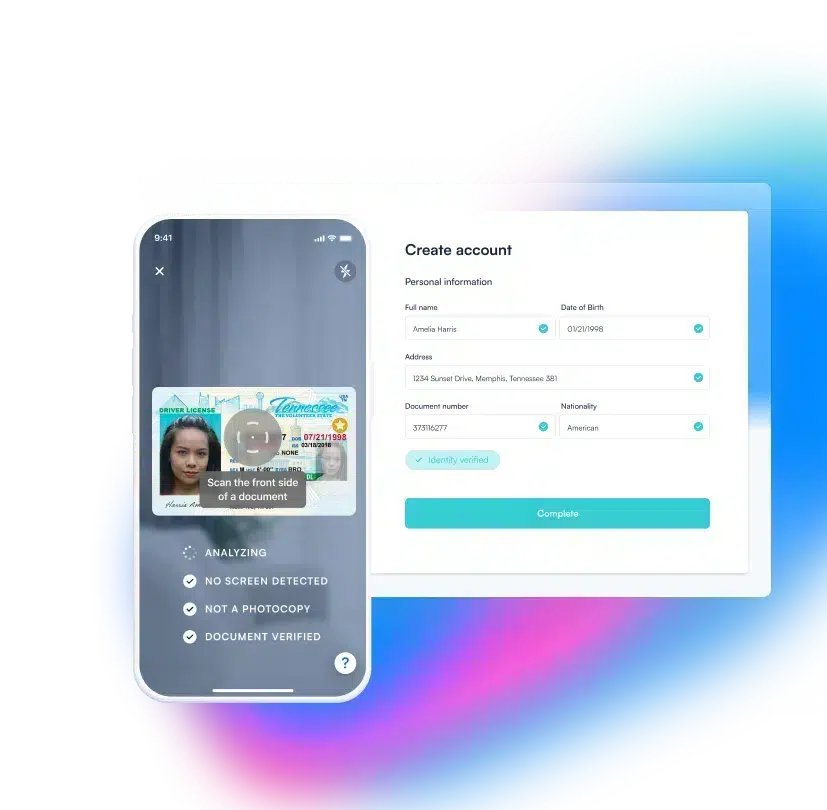
Microblink approaches bank account verification as part of a broader identity intelligence system rather than a standalone process. By combining document verification, biometric authentication, and real-time risk signals, Microblink enables organizations to verify both the account and the individual behind it in a unified workflow. This approach helps detect synthetic identities and AI-driven fraud while minimizing friction for legitimate users. The result is a system that strengthens compliance, improves accuracy, and supports faster onboarding without sacrificing security.