
Selfie Verification: How It Works, Accuracy, and KYC Best Practices

Selfie verification has become a common part of digital identity verification because it answers an important question that document verification alone cannot: is the person presenting an identity document actually the person it belongs to?
The basic concept is straightforward. A user captures an identity document and a selfie, and facial recognition technology compares the live image with the portrait on the document. But effective selfie verification involves more than simply comparing two faces. Image quality, liveness detection, document authenticity, spoof detection, processing speed, privacy, and false-positive rates can all affect whether a verification workflow successfully stops fraud without creating unnecessary friction for legitimate customers.
For product teams building digital onboarding, understanding how those components work together is essential to choosing the right approach.
What is selfie verification?
Selfie verification is a biometric identity verification method that compares an image of a person captured during an interaction with a trusted reference image, often the portrait on a government-issued identity document.
In a typical KYC selfie workflow, the customer first captures an ID such as a driver’s license or passport. The system extracts relevant identity information and evaluates the document before asking the customer to take a selfie. Facial matching technology then determines whether the two images appear to represent the same person.
That comparison provides another layer of evidence connecting a physical person with the identity being presented digitally.
However, facial similarity alone isn’t enough. A fraudster could potentially present a photograph, manipulated video, mask, screen replay, or AI-generated face. That’s why modern selfie verification also relies on liveness and anti-spoofing technology.
How does selfie-to-ID verification work?
Although implementations differ, selfie-to-ID verification generally involves several interconnected steps.
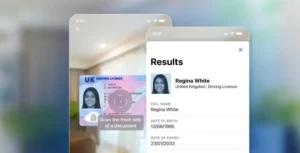
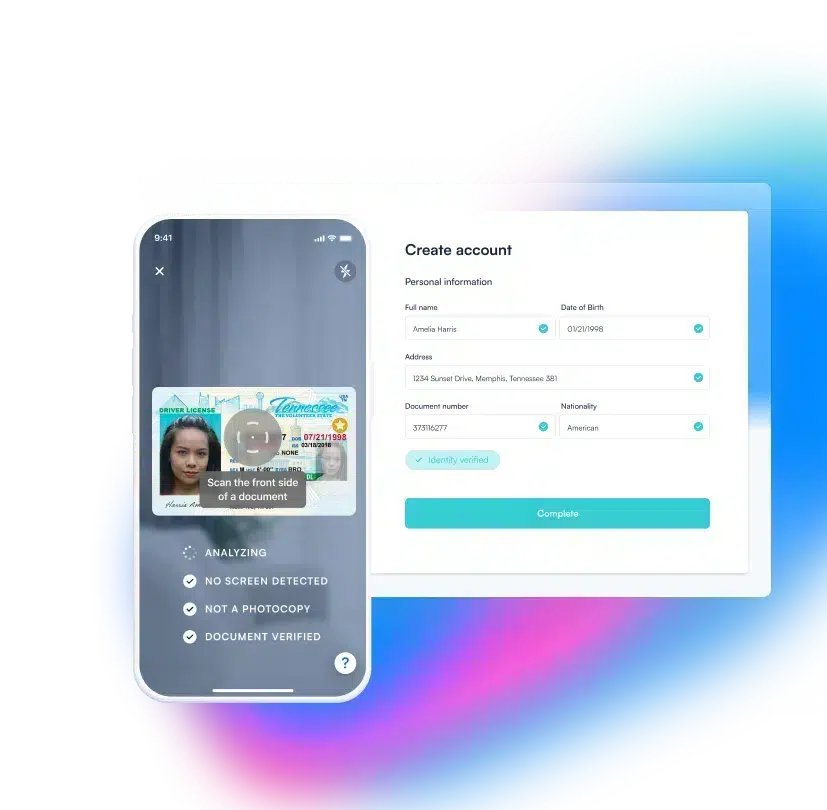
First, the user captures an identity document. Guided capture can help position the document correctly and identify issues such as blur, glare, poor lighting, or incomplete framing before they result in a failed verification.
The document is then analyzed and its portrait extracted. Automated document verification can also evaluate the credential for signs of manipulation or fraud rather than assuming that every submitted ID is genuine.
Next, the user captures a live selfie. Image-quality controls can again help ensure that the system receives usable biometric evidence.
Facial matching technology compares characteristics of the selfie with the portrait extracted from the ID and produces a similarity assessment. At the same time, liveness technology helps determine whether the system is interacting with a real person rather than a presentation or digital spoof.
The results can then be evaluated according to the organization’s risk policies. A high-confidence verification might proceed automatically, while an inconclusive result could trigger a retry, additional verification, or manual review.
How accurate is selfie verification?
There isn’t one meaningful universal number for selfie-to-ID verification accuracy. Performance depends on the algorithms being used, image quality, document quality, demographics represented in testing data, operating thresholds, environmental conditions, and the types of attacks the system encounters.
For product teams, this means evaluating more than a vendor’s headline accuracy claim.
False acceptance rates indicate how frequently an unauthorized person may incorrectly pass a comparison, while false rejection rates indicate how often legitimate users may be rejected. Product teams should also examine successful completion rates, the percentage of cases requiring manual review, and performance across different devices, demographics, document types, and operating conditions.
Independent testing and transparent methodology are particularly valuable. Our guide to benchmarking and explainability in identity verification explores why buyers should understand what a performance number actually measures before comparing providers.
The practical question isn’t simply, “How accurate is your face matching?” It’s whether the entire verification system delivers acceptable fraud detection and customer completion rates under conditions that resemble your production environment.
Why liveness detection matters
Selfie verification establishes much less confidence if the system cannot determine whether the face being presented is genuinely present.
Liveness detection is designed to identify presentation and spoofing attempts involving techniques such as photographs, screens, masks, prerecorded videos, and increasingly sophisticated digital manipulation. As deepfake and face-swap technology improves, this layer has become increasingly important.
Some systems use active liveness, which requires the user to perform an action such as moving their head or following an instruction. Passive liveness can evaluate the capture without requiring these additional actions, helping reduce friction while still looking for evidence of spoofing.
Product teams evaluating liveness detection software should consider both security performance and its effect on the user journey. A powerful fraud control that causes legitimate customers to abandon onboarding creates a different kind of business problem.
How fast should selfie verification be?
Automated selfie verification can operate quickly, but the time required for the complete customer journey depends on much more than API response time.
Document capture problems, poor selfie quality, network conditions, repeated attempts, additional verification requirements, and manual review can all increase the actual time between starting verification and receiving a decision.
That’s why product teams should measure end-to-end performance rather than focusing exclusively on processing speed. Time to completion, first-attempt capture success, retry rates, abandonment, and manual review rates provide a better picture of how selfie verification performs for customers in production.
Guided capture can be particularly important here. Preventing a poor-quality image from entering the workflow is generally preferable to processing it, rejecting it, and forcing the customer to start again.
Selfie verification in a KYC workflow
Selfie verification can provide valuable biometric evidence within KYC, but it should not be confused with the entire KYC process.
A broader remote identity verification workflow may include document capture and authenticity checks, identity-data extraction, biometric comparison, liveness detection, database or watchlist screening, and additional risk signals depending on regulatory requirements and the organization’s policies.
Selfie verification helps establish that the person presenting an identity credential is associated with that credential. Other controls establish whether the document itself is trustworthy, whether relevant identity information can be corroborated, and whether additional compliance or fraud concerns exist.
Organizations should also maintain appropriate records of verification outcomes and escalation decisions according to their applicable regulatory and privacy requirements.
Reducing selfie verification friction without weakening fraud defenses
Stronger verification doesn’t necessarily require putting every customer through a more difficult process.
Product teams can use guided capture to prevent avoidable failures, passive liveness to minimize unnecessary actions, and retry logic to give legitimate customers an opportunity to correct simple capture problems. Risk-based workflows can reserve additional verification for situations where the available evidence warrants it.
The handling of failures matters too. A failed face match isn’t automatically evidence of fraud. Poor lighting, an outdated ID portrait, image quality, or other legitimate factors can produce uncertainty. Well-designed workflows distinguish between an obvious attack, an inconclusive result, and a correctable capture problem.
Choosing an ID verification API should therefore involve examining both fraud performance and the flexibility to build these different outcomes into the customer journey.
Building better selfie verification
Effective selfie verification isn’t simply a face-matching problem. Product teams need to establish that the ID is trustworthy, determine whether the selfie belongs to the person pictured on it, verify that a live person is actually present, and make a decision quickly enough to keep legitimate customers moving.
Those requirements become even more important as synthetic identities, deepfakes, face swaps, and other AI-assisted attacks become easier to produce.
The strongest selfie verification workflows bring document analysis, facial matching, liveness detection, image-quality controls, and risk-based decisioning together. For product leaders, the goal isn’t to maximize friction in the name of security or minimize it at any cost. It’s to collect enough reliable evidence to make the right decision while asking legitimate customers to do as little unnecessary work as possible.