
AAMVA (American Association of Motor Vehicle Administrators)
AAMVA is the American Association of Motor Vehicle Administrators, and in a verification context the name is usually shorthand for something narrower: the DL/ID Card Design Standard it publishes, which defines what North American driver licenses and state ID cards encode in the barcode on the back.
| Stands for | American Association of Motor Vehicle Administrators |
| What it is | A nonprofit representing motor vehicle agencies in the US and Canada |
| Relevant output | The DL/ID Card Design Standard |
| Barcode symbology | PDF417, on the reverse of the card |
| Geographic scope | United States and Canada |
| Data structure | Header, subfile designators, then three-letter element IDs |
| Equivalent role | What ICAO Doc 9303 is to passports, AAMVA is to North American licenses |
How the AAMVA barcode is structured
An AAMVA-compliant barcode is a structured text file, not an image of the card. Read it and you get a string that begins with a header identifying it as an AAMVA file, followed by an Issuer Identification Number naming the issuing jurisdiction and a version code telling the parser which revision of the standard to apply.
After the header come subfiles. The primary one is designated DL and carries the license data itself. Inside it, every value is prefixed by a three-letter element identifier — the family name, given name, date of birth, expiry date, license number, address, and physical descriptors each have their own code.
The version code matters more than it looks. Element definitions have changed across revisions, so a parser that assumes one version will misread cards issued under another. This is the most common source of silent errors in license parsing.
Why AAMVA matters for identity verification
Most of the world’s automated identity checking assumes a machine-readable zone. North America largely does not have one.
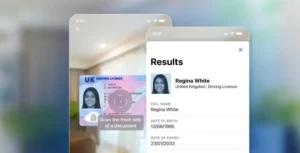
US and Canadian driver licenses are not machine readable travel documents. They carry no MRZ, no OCR-B line, and in most cases no chip. What they carry is a PDF417 barcode built to the AAMVA standard, and that barcode is the only structured, machine-readable data on the card.
For any verification flow operating in North America, this is the practical center of gravity. A stack that reads MRZs and chips but cannot parse AAMVA will fail on the single most common identity document on the continent. It also gives you the same cross-check the MRZ gives elsewhere: the barcode data and the printed front of the card should agree, and disagreement is a strong signal that one of them has been altered. That comparison is a core function of identity document verification.
AAMVA vs ICAO Doc 9303
| AAMVA | ICAO Doc 9303 | |
|---|---|---|
| Covers | Driver licenses and state ID cards | Passports, visas, travel ID cards |
| Scope | United States and Canada | Global |
| Machine-readable carrier | PDF417 barcode | MRZ, plus a contactless chip |
| Cryptographic signature | None in the barcode | Signed Document Security Object on the chip |
| Proves issuance | No | Yes, where a chip is present |
That fourth row is the important one, and it is where most misunderstanding of AAMVA data begins.
What AAMVA can’t do
The barcode is not signed. There is no cryptographic proof of issuance in an AAMVA barcode. Anyone can generate a compliant one — free tools exist for exactly that purpose — and it will parse cleanly. Structural validity says the data is well-formed, not that a DMV produced it.
Compliance varies by jurisdiction. Fifty-plus issuing authorities implement the standard with local variation, and older cards remain in circulation under older revisions for years.
It says nothing about the person. Parsing the barcode gives you what the card claims. Confirming the holder is that person requires biometric matching and liveness detection.
Front and back can disagree by design of the forger. Sophisticated fakes now produce a technically flawless barcode, which is precisely why a perfect barcode has become its own tell.
Frequently asked questions
Is AAMVA a government agency?
No. It is a nonprofit association representing motor vehicle administrators across US states and Canadian provinces. It publishes standards and coordinates between jurisdictions, but it does not issue documents or enforce compliance.
Can an AAMVA barcode be faked?
Yes, straightforwardly. The format is published and unsigned, and generators are freely available. A counterfeit barcode parses exactly like a genuine one, which is why barcode data has to be cross-checked against the printed card and the physical security features rather than trusted alone.
Do all US driver licenses use the AAMVA standard?
The overwhelming majority do, but implementation varies by jurisdiction and by the revision in force when the card was issued. Older cards in circulation may follow earlier versions with different element definitions.
What is the difference between AAMVA and PDF417?
PDF417 is the barcode symbology — the physical encoding that stores data as a pattern. AAMVA defines what data goes inside it and how it is structured. PDF417 is the container; AAMVA is the contents.