
6 Best Digital Onboarding Fraud Prevention Software in 2026

In the digital-first economy, the first minute of a customer’s journey is often the most vulnerable. As enterprises push for faster, lower-friction digital onboarding solutions, fraudsters are using synthetic identities, forged documents, screen-replay attacks, and AI-generated deepfakes to exploit gaps in identity verification.
For Fraud Decision-Makers, the challenge is no longer just speeding up onboarding. It’s doing so without increasing fraud exposure, compliance risk, or review costs. The right fraud prevention solutions should help your team verify real users quickly, detect sophisticated fraud in real time, and maintain audit readiness across jurisdictions.
This guide reviews six leading digital onboarding fraud prevention platforms for 2026. We focused on the criteria that matter most to compliance officers, risk managers, security leaders, and finance executives: identity assurance, fraud detection depth, compliance support, user friction, and implementation complexity.
Best Digital Onboarding Fraud Prevention Software
| Product | Compliance Features | Industry Focus | AI Capabilities | User Experience | Developer Experience |
|---|---|---|---|---|---|
| Microblink | Privacy-first on-device processing; supports KYC/AML workflows; GDPR and CCPA aligned | Mobile-first identity verification for banks, fintechs, and global enterprises | Proprietary AI vision for ID scanning, selfie matching, liveness, deepfake, and synthetic identity detection | Very fast, low-friction onboarding with strong scan accuracy; can reduce abandonment and speed account opening | Requires SDK integration and engineering resources; best as a verification engine, not full orchestration |
| Resistant AI | Document forensics layer that strengthens KYC controls and auditability | Document-heavy onboarding in lending, property management, and merchant onboarding | Advanced document forensics across 500+ forgery vectors; detects reused templates and AI-generated docs | Minimal added friction because it overlays existing workflows; performance depends on upload quality | Easy to layer onto existing stacks, but requires an existing KYC/onboarding system to be useful |
| Sardine | Unified fraud, KYC, and AML capabilities for regulated onboarding | High-risk fintech, neobanks, payments, and crypto platforms | Behavioral biometrics, device intelligence, ML risk scoring, and social engineering detection | Strong protection against remote access scams and suspicious intent with a unified investigation view | Deep integration needed to unlock full value; premium platform with higher implementation complexity |
| Sumsub | Full-cycle KYC/KYB orchestration, Travel Rule support, age verification, and strong global compliance coverage | Global marketplaces, fintech, crypto, gambling, and cross-border platforms | Biometric verification, 3D liveness, deepfake detection, and non-doc verification in supported markets | Highly customizable onboarding flows with strong international coverage; some web SDK branding limits | Drag-and-drop workflow builder lowers technical burden, though costs and support can vary by scale and tier |
| Feedzai | Enterprise RiskOps for fraud and AML with explainable models for regulatory reporting | Tier-1 banks, payment processors, and large financial institutions | Whitebox AI, dynamic TrustScore, real-time anomaly detection, and cross-channel behavioral analysis | Optimized for high-volume, real-time decisions rather than lightweight onboarding simplicity | Long, resource-intensive implementation; requires sophisticated internal teams and significant budget |
| Unit21 | Compliance operations orchestration, alert management, and case review across KYC/AML data sources | Fintech operations teams, marketplaces, and crypto compliance programs | No-code rules engine, shadow mode testing, link analysis, and signal orchestration | Strong operational visibility and flexible rule tuning, but alert fatigue is possible if rules are poorly configured | No-code experience empowers risk teams, but relies heavily on third-party integrations and has a learning curve |
1. Microblink
Platform summary
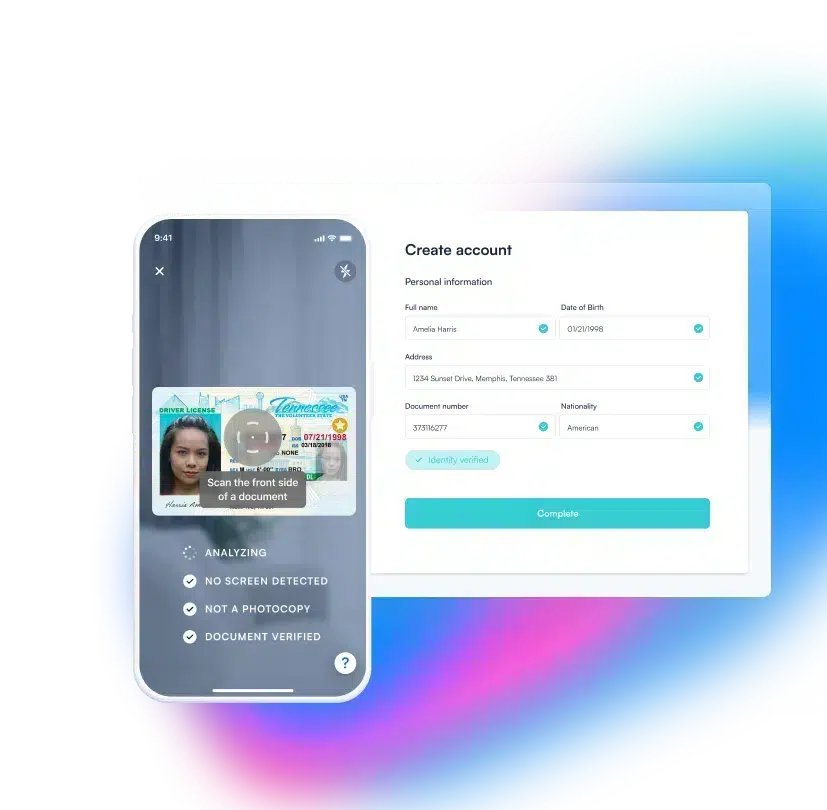
Microblink is an AI-powered digital onboarding and fraud prevention platform built for enterprises that need to balance security, conversion, and compliance. It is trusted by global organizations to process more than 10 million identity documents every month across 140+ countries.
Its core strength is mobile-first identity verification powered by proprietary computer vision and machine learning, paving the way for modern agentic IDV solutions. For Fraud Decision-Makers, Microblink stands out for combining sub-second document capture, strong biometric verification, privacy-first architecture, and advanced protection against deepfakes and synthetic identities.
Key benefits
- Reduces onboarding friction with very fast document capture and data extraction.
- Helps lower abandonment rates while accelerating account opening and verification flows.
- Strengthens fraud defenses against document tampering, facial spoofing, deepfakes, and synthetic identities.
- Supports enterprise compliance and privacy goals with on-device processing and secure data handling.
Core features
- AI-powered document and biometric verification: Uses advanced facial recognition, 3D liveness detection software, and sub-second ID scanning to validate users quickly and accurately.
- Proactive deepfake and synthetic identity detection: Applies adaptive AI/ML models to detect document fraud, facial spoofing, and AI-generated identities in real time.
- On-device processing and privacy-by-design: Extracts and verifies data directly on the user’s device, helping support zero data access models, encryption, and privacy mandates.
- Dynamic omnichannel workflows: Supports configurable risk rules across mobile, web, and in-branch onboarding experiences.
Primary use cases
- Seamless banking and financial services onboarding: Replaces manual entry with auto-capture and prefill during digital account opening.
- Automated KYC/AML compliance: Enables layered identity verification and risk-based review for regulated onboarding programs.
- Card-not-present and payment fraud prevention: Supports instant card and identity authentication at critical transaction points.
Recent updates
- Released its Mapping the Rise of AI-Powered Identity Fraud Report, giving enterprises practical insight into how identity attacks are evolving.
- Continued rolling out AI model enhancements to improve resistance to injection attacks, deepfakes, and biometric spoofing.
- Expanded Arabic and Cyrillic script extraction support for broader global coverage.
- Rebranded BlinkReceipt to Actual, reflecting a broader data intelligence strategy.
Limitations
- Functions primarily as a verification and capture engine rather than a full-stack compliance orchestration platform.
- Performance can vary depending on end-user camera quality, lighting, and device condition.
- SDK integration is typically required, so implementation needs engineering support.
2. Resistant AI
Platform summary
Name: Resistant AI
Description: Resistant AI is a document forensics platform designed to strengthen existing onboarding and KYC workflows. It focuses on detecting manipulations that manual reviewers and standard checks often miss, including metadata anomalies, font tampering, reused templates, and AI-generated documents.
Target audience: Fraud, risk, and compliance teams that already have an onboarding stack but need stronger document fraud detection.
Core features
- Deep forensic document analysis across 500+ forgery vectors.
- Serial fraud detection to identify reused templates and organized fraud patterns.
- Frictionless overlay integration that works with existing KYC systems.
Primary use cases
- Preventing loan stacking and credit fraud through income document verification.
- Validating applicant financial documents for tenant and property screening, often complementing mortgage fraud detection tools.
- Verifying incorporation and business documents during merchant onboarding.
Recent updates
- Enhanced detection of AI-generated images and synthetic documents to address the growth of generative fraud tactics.
Limitations
- Focused on document forensics only and does not provide native biometric verification or liveness checks.
- Accuracy can decline when users upload low-resolution or poor-quality files.
- Requires an existing onboarding or KYC platform and is not a standalone solution.
3. Sardine
Platform summary
Name: Sardine
Description: Sardine is a unified fraud, AML, and onboarding risk platform built for high-risk digital businesses, especially fintech, payments, neobanks, and crypto. Its differentiator in fintech fraud prevention is the combination of behavioral biometrics, device intelligence, and real-time risk scoring.
Target audience: Fraud Decision-Makers at high-risk, fast-growth financial platforms that need to detect intent, account abuse, and social engineering.
Core features
- Real-time behavioral biometrics for detecting suspicious user behavior.
- Device intelligence and machine learning risk scoring.
- Social engineering and remote access tool detection.
- Unified dashboard for KYC, AML, and fraud operations.
Primary use cases
- Preventing fraudulent account creation on crypto exchanges.
- Detecting synthetic identity activity for neobanks and fintechs.
- Supporting instant funds availability decisions with real-time risk analysis.
Recent updates
- Expanded the Sonar network to improve cross-platform detection of repeat offenders through shared industry signals.
Limitations
- May be too complex for lower-risk businesses or simpler onboarding environments.
- Deeper value depends on extensive integration and signal mapping.
- Typically priced above more focused verification tools.
4. Sumsub
Platform summary
Name: Sumsub
Description: Sumsub is a full-cycle verification orchestration platform that combines KYC, KYB, transaction monitoring, and compliance workflow customization in one environment. It is especially strong for organizations operating across many countries and regulatory frameworks.
Target audience: Compliance and risk leaders managing global onboarding, cross-border verification, and complex regional requirements.
Core features
- Drag-and-drop workflow builder for region-specific onboarding journeys.
- 3D liveness detection and biometric verification.
- Deepfake detection within liveness checks.
- Non-document verification in supported markets.
Primary use cases
- Verifying users across international marketplaces.
- Supporting age verification and self-exclusion in iGaming.
- Enabling Travel Rule compliance for crypto businesses.
Recent updates
- Improved deepfake detection capabilities within its liveness verification stack.
Limitations
- Costs can rise quickly as transaction volume and premium checks grow.
- Support responsiveness may depend on account tier.
- Web SDK customization may be too limited for brands with strict UX requirements.
5. Feedzai
Platform summary
Name: Feedzai
Description: Feedzai is an enterprise RiskOps platform that unifies fraud prevention, AML, and data orchestration for major financial institutions. Its main advantage is explainable AI at scale, which is especially useful for banks that must justify automated decisions to regulators.
Target audience: Large banks, payment processors, and enterprise risk teams managing high-volume, multi-channel financial activity.
Core features
- Holistic RiskOps architecture for centralized fraud and compliance oversight.
- Whitebox AI explainability for regulatory reporting and model transparency.
- Real-time TrustScore for dynamic onboarding and transaction decisions.
- Cross-channel anomaly detection and behavioral analysis.
Primary use cases
- Modernizing legacy fraud systems in large banking environments.
- Monitoring merchants for bust-out fraud and financial anomalies.
- Preventing omnichannel attacks across mobile, web, and payment ecosystems.
Recent updates
- Added stronger behavioral analysis capabilities aimed at combating Authorized Push Payment (APP) fraud.
Limitations
- Cost and complexity make it a poor fit for most mid-market businesses.
- Deployment can be long and resource-intensive.
- Requires a mature internal team with specialized fraud and analytics expertise.
6. Unit21
Platform summary
Name: Unit21
Description: Unit21 is a no-code risk and compliance orchestration platform that helps teams centralize signals, manage cases, and deploy fraud rules without heavy engineering dependence. It is especially useful for operations-led teams that need agility and visibility.
Target audience: Compliance operations teams, fintech risk managers, marketplaces, and crypto businesses coordinating multiple third-party data sources.
Core features
- Centralized data orchestration across multiple KYC and monitoring vendors.
- Shadow mode testing for validating rules before live deployment.
- Link analysis and case management for manual review efficiency.
- No-code rules engine for rapid fraud response.
Primary use cases
- Aggregating alerts from multiple vendors into one compliance dashboard.
- Detecting account takeovers and fake listings in marketplace environments.
- Monitoring suspicious activity across on-chain and off-chain crypto data.
Recent updates
- Enhanced marketplace fraud workflows with better action visibility and stronger link analysis for abuse prevention.
Limitations
- Depends on third-party integrations for raw verification and identity data.
- Rule tuning requires solid fraud strategy knowledge.
- Poorly configured rules can create excessive alert volumes and operational strain.
Final takeaway
For Fraud Decision-Makers in regulated and high-growth environments, the best digital onboarding fraud prevention software in 2026 depends on the balance you need between fraud detection depth, compliance readiness, user experience, and implementation complexity.
- Choose Microblink if your priority is fast, mobile-first identity verification with strong fraud defenses and low onboarding friction.
- Choose Resistant AI if you already have a KYC stack and need stronger document forensics.
- Choose Sardine if you operate in high-risk fintech or crypto and need device intelligence plus behavioral analytics.
- Choose Sumsub if global compliance orchestration and workflow flexibility are your top priorities.
- Choose Feedzai if you are a large financial institution needing explainable AI and enterprise-scale RiskOps.
- Choose Unit21 if your team needs no-code orchestration and centralized compliance operations across multiple vendors.
What is Digital Onboarding Fraud Prevention Software?
Digital onboarding fraud prevention software is a specialized suite of security tools designed to verify user identities and detect malicious activity during the initial account creation process. By leveraging advanced technologies like biometric verification, document liveness checks, and machine learning algorithms, these platforms analyze risk signals in real-time. This ensures that legitimate customers experience a frictionless sign-up while synthetic identities, bots, and fraudsters are blocked at the front door before they can penetrate your ecosystem.
Why is it important?
Implementing robust fraud prevention during digital onboarding is critical because the point of entry is a business’s most vulnerable moment. If bad actors successfully infiltrate your platform, it can lead to severe financial losses, regulatory fines for non-compliance with KYC (Know Your Customer) and AML (Anti-Money Laundering) mandates, and irreversible damage to your brand’s reputation. Furthermore, an effective solution strikes the perfect balance between stringent security and a seamless user experience, preventing the high abandonment rates that occur when legitimate users face overly cumbersome verification hurdles.
How to choose the best software provider
Choosing the best digital onboarding fraud prevention software requires a strategic methodology focused on accuracy, compliance, and integration capabilities. Start by evaluating a provider’s false-positive and false-negative rates to ensure they can accurately catch fraud without turning away good customers. Next, assess their compliance coverage to confirm they meet the global regulatory standards relevant to your specific industry and operating regions. Finally, prioritize vendors that offer seamless API integrations, scalable cloud infrastructure, and customizable risk-scoring models that can dynamically adapt to your company’s unique threat landscape.
What is digital onboarding fraud prevention software?
Digital onboarding fraud prevention software helps organizations verify that a new customer is real, eligible, and low risk during account opening or enrollment. It is designed to stop identity-related fraud before an account is approved, funded, or activated.
These platforms typically combine several capabilities, such as:
- ID document verification software to confirm an ID is authentic and unaltered
- Biometric checks like selfie matching or liveness detection to confirm the person matches the ID
- Device and behavioral analysis to detect suspicious signals such as emulators, remote access tools, or unusual input patterns
- Risk scoring and rules to decide whether to approve, reject, or escalate an application
- Case management and audit trails to support manual review and compliance reporting
For Fraud Decision-Makers, the value is not just fraud reduction. The right solution should also help reduce onboarding friction, lower manual review costs, improve conversion rates, and support KYC/AML compliance across different markets.
What features should Fraud Decision-Makers prioritize when choosing onboarding fraud prevention software?
The most important features depend on your risk profile, regulatory environment, and internal operating model, but most medium-sized businesses and enterprises should evaluate vendors across five core areas:
- Identity assurance: Look for strong document capture, data extraction, biometric matching, and liveness detection. If identity fraud is a major concern, prioritize support for deepfake and synthetic identity detection within your digital onboarding software.
- Fraud detection depth: Strong platforms go beyond basic KYC checks. They may analyze device signals, user behavior, document tampering, repeated fraud patterns, or linked identities across applications.
- Compliance readiness: The platform should support your KYC/AML workflows, data retention policies, privacy obligations, and audit requirements. Global businesses should also check jurisdictional coverage and regional workflow flexibility.
- User experience: Faster, lower-friction onboarding usually improves completion rates. Good UX includes quick document capture, accurate extraction, minimal retakes, and flexible mobile and web support.
- Implementation complexity: Some tools are lightweight verification engines, while others require deep integration across fraud, AML, and operations systems. Assess engineering effort, time to value, and whether your team needs no-code controls.
In practice, the best solution is rarely the one with the most features. It is the one that best fits your fraud exposure, customer journey, compliance obligations, and available internal resources.
How do deepfake detection and synthetic identity detection improve onboarding security?
Deepfake detection and synthetic identity detection address two of the fastest-growing threats in digital onboarding.
Deepfake detection helps identify manipulated or AI-generated facial content used to bypass selfie or liveness checks. This matters because fraudsters increasingly use face-swaps, pre-recorded video injection, or generative AI tools to impersonate legitimate users. Effective defenses may include:
- 3D liveness or challenge-response verification
- Detection of replay or injection attacks
- Analysis of facial inconsistencies, artifacts, and motion patterns
- Cross-checking biometric signals against document and device data
Synthetic identity detection focuses on identities that are partially real and partially fabricated. A fraudster might combine a legitimate Social Security number or address with a fake name, fake document, or AI-generated face to create a new identity that passes simple checks. Strong detection may involve:
- Cross-signal identity consistency checks
- Analysis of document authenticity and reuse patterns
- Device and behavioral anomalies
- Detection of linked applications or suspicious network patterns
- Risk models that flag identities with thin, inconsistent, or manipulated attributes
For regulated businesses, these controls are becoming increasingly important because basic document review and simple selfie matching are often no longer enough to stop sophisticated onboarding fraud.
How can onboarding fraud prevention software support KYC, AML, and privacy compliance?
Onboarding fraud prevention software can play a major role in helping organizations meet regulatory and internal control requirements, especially when it is built to support verification, auditability, and secure data handling.
From a KYC and AML perspective, the software can help by:
- Verifying identity documents and customer information during onboarding
- Applying risk-based checks based on geography, product, or customer segment
- Routing higher-risk applicants to manual review
- Creating audit logs of decisions, verification results, and reviewer actions
- Feeding identity data into downstream AML monitoring and case management systems
From a privacy and data governance perspective, strong platforms may offer:
- On-device data extraction or processing to reduce unnecessary data exposure
- Encryption in transit and at rest
- Role-based access controls
- Configurable retention policies
- Support for privacy frameworks such as GDPR or CCPA alignment
That said, software alone does not guarantee compliance. Fraud Decision-Makers should still evaluate whether the vendor’s workflows, data practices, and reporting capabilities align with their own legal, regulatory, and internal audit requirements.
What is the difference between a verification engine, an orchestration platform, and a full RiskOps solution?
These categories often overlap, but understanding the distinction helps buyers choose the right fit.
A verification engine focuses on confirming identity quickly and accurately. It usually specializes in capabilities such as document capture, OCR, biometric matching, and liveness detection. This is a strong fit when your priority is reducing onboarding friction while strengthening identity assurance.
An orchestration platform connects multiple data sources and vendors into a configurable onboarding workflow. It may let teams define routing logic, review rules, market-specific steps, and case handling without rebuilding the stack from scratch. This is useful when your business operates across regions or needs flexible compliance workflows.
A RiskOps platform goes further by centralizing fraud, AML, alerting, analytics, and operational decisioning across onboarding and beyond. These systems are often best suited to large, complex organizations that need cross-channel visibility, explainable decisions, and mature fraud operations.
In simple terms:
- Choose a verification engine if you need strong identity proofing and a fast customer experience
- Choose an orchestration platform if you need workflow flexibility and multi-vendor coordination
- Choose a RiskOps platform if you need enterprise-wide fraud and compliance operations at scale
Many organizations use more than one of these layers together, depending on their fraud maturity and internal architecture.
(Note: The URL https://microblink.com/resources/blog/page/8/ was intentionally omitted as linking to blog pagination pages from within body content is detrimental to SEO best practices and user experience.)