
Las mejores herramientas de detección del fraude en transacciones sin tarjeta física en 2026

Card-not-present (CNP) fraud remains one of the most significant threats in the digital payments landscape, requiring businesses to adopt advanced AI solutions for fraud detection, digital onboarding, and compliance. As transaction volumes grow and fraudsters deploy increasingly sophisticated tactics, relying on basic verification is no longer sufficient.
For fraud decision-makers at medium-sized businesses and enterprises, the challenge is no longer just stopping fraudulent transactions. It is also about reducing false declines, protecting customer trust, maintaining PCI DSS, GDPR, KYC, and AML alignment, and doing all of that without adding unnecessary friction to the user journey.
The best CNP fraud detection tools now combine machine learning, behavioral analytics, identity verification, biometric liveness, device intelligence, and network-wide risk signals. Some are strongest at the transaction-scoring layer, while others are better at verifying the person and payment instrument before a transaction ever reaches authorization.
Below is a side-by-side look at five notable platforms in 2026, followed by a detailed breakdown of where each one fits best.
What Is Card-Not-Present Fraud?
Card-not-present (CNP) fraud is any unauthorised transaction made without the physical card being shown to the merchant — online checkouts, in-app purchases, phone orders, and recurring billing. Because the card never has to be produced, stolen card numbers are enough on their own, and liability for the loss usually sits with the merchant rather than the issuer.
How Card-Not-Present Fraud Happens
Most CNP attacks follow a small number of recognisable patterns. Knowing which ones dominate your traffic determines whether you need stronger verification at the point of entry, better transaction scoring at authorisation, or both.
- Stolen card credentials: numbers obtained through phishing, skimming, or a breach, then used on a checkout form that has no way to tell who is typing.
- Card testing: automated low-value transactions run in bulk to work out which stolen numbers are still live before larger purchases are attempted.
- Account takeover: a legitimate account is compromised and its stored payment credentials are used, which is why biometric authentication at login and step-up matters as much as checkout screening.
- Synthetic identities: fabricated identities built from a mix of real and invented data, used to open accounts and provision cards that were never legitimate. See synthetic identity detection.
- Friendly fraud: a genuine cardholder disputes a purchase they actually made, producing a chargeback with no fraudulent actor to detect at all.
| Product | Compliance Features | Industry Focus | AI Capabilities | User Experience | Developer Experience |
|---|---|---|---|---|---|
| Microblink | On-device data processing supports GDPR and data minimization, while ID verification and biometric liveness add strong KYC-style controls. | Best for merchants and platforms that need identity verification at the CNP entry point, especially for regulated onboarding and high-value transactions. | Uses AI for card scanning, document recognition, tamper detection, and liveness verification, but is less focused on backend transaction scoring. | Reduces manual entry and can streamline checkout with card and ID capture, though performance may vary by device quality. | Flexible SDK and API model gives teams implementation control, but it requires engineering resources rather than offering a no-code rollout. |
| Fraudio | Combines payment fraud detection with AML monitoring, making it well aligned with regulated payment organizations that need broader risk coverage. | Best suited for issuers, acquirers, PayFacs, and other payment infrastructure providers rather than standalone merchants. | Its patented Network Effect AI learns from billions of cross-network transactions to return real-time pre-authorization risk scores without added latency. | Provides a low-friction experience because scoring happens behind the scenes in real time, though it is more infrastructure-facing than consumer-facing. | A single integration can cover multiple fraud and monitoring needs, but commercial details typically require direct sales engagement. |
| Stripe Radar | Offers fraud controls and dispute support inside the Stripe ecosystem, but it is less comprehensive for organizations needing broader compliance tooling outside Stripe. | Best for Stripe-native e-commerce, SaaS, and digital businesses that want fraud protection without adding a separate vendor. | Uses machine learning trained on Stripe’s global payments network, with device fingerprinting and behavioral analytics to improve risk detection. | Very strong for ease of use because it activates automatically for Stripe users and protects checkout flows with minimal added friction. | Developer overhead is minimal for existing Stripe merchants, although advanced rules and customization may require paid upgrades. |
| FraudNet | Explainable AI outputs and audit-ready workflows support compliance-heavy environments, especially where review transparency matters. | Best for enterprise B2B, SaaS, travel, and other high-value transaction environments that need contextual fraud decisions. | Pairs explainable AI scoring with rich data orchestration from CRM, ERP, and external sources, helping teams understand why transactions were flagged. | Strong for analyst and compliance workflows, though the platform is more enterprise-oriented than lightweight plug-and-play tools. | No-code rule creation reduces dependency on engineering after launch, but initial setup is more complex and resource-intensive. |
| Sift | Supports merchant-side fraud prevention and dispute workflows with account-to-payment visibility, though it is less focused on deep AML compliance for regulated institutions. | Best for e-commerce, marketplaces, digital goods, and other online businesses where account security and payment fraud are tightly linked. | Uses adaptive machine learning informed by signals from 16,000+ businesses and connects account anomalies directly to payment fraud scoring. | Well suited to end-to-end user journeys because it links login, trust, and checkout behavior to reduce unnecessary friction for legitimate users. | Offers broad control and strong platform depth, but implementation and ongoing tuning are more involved than zero-setup alternatives. |
1. Microblink
Platform summary
- Name: Microblink
- Description: Microblink provides a specialized layer of defense for card-not-present fraud by focusing on the point of entry. By combining BlinkCard for fast payment card capture with BlinkID Verify for document authentication and biometric liveness, it helps confirm that the person initiating a transaction is the legitimate cardholder before fraud reaches the authorization stage.
- Target audience: Compliance officers, risk managers, heads of security, compliance managers, CFOs, and fraud teams at medium-sized businesses and enterprises that need privacy-first identity verification inside checkout, onboarding, or high-risk payment flows.
Key benefits
- Privacy-first architecture: Sensitive card and identity data can be processed on-device, reducing exposure associated with centralized cloud transfers. For regulated organizations, that supports stronger data minimization and can simplify GDPR and related privacy requirements.
- Stronger front-end fraud prevention: Microblink helps stop fraud before it enters the payment ecosystem by validating card presence, authenticating identity documents, and verifying biometric liveness. That is especially valuable for high-value transactions and regulated onboarding journeys.
- Lower user friction: Card scanning and automated data extraction reduce manual input, which can shorten checkout time and improve completion rates. This matters for enterprises trying to balance fraud controls with conversion performance.
- Enterprise-ready compliance support: The platform aligns well with PCI DSS, KYC, AML, and global privacy expectations through encryption, flexible deployment options, and privacy-conscious processing. For fraud decision-makers, that makes it easier to improve controls without creating unnecessary compliance overhead.
Proven results
- Automated liveness checks and synthetic identity detection cut chargebacks by up to 30% and reduce manual review queues by 70%.
- A global fintech provider integrated BlinkCard into its mobile signup flow to auto-capture and populate card details in under 3 seconds, driving a 15% drop in form abandonment and a 20% increase in new account conversions.
- BlinkID Verify shortened ID verification time from 2 minutes to 15 seconds in the same deployment.
Core features
- BlinkCard for payment card capture: Extracts card data with high precision and validates card presence. It also helps detect tampered images that could signal fraud or input manipulation.
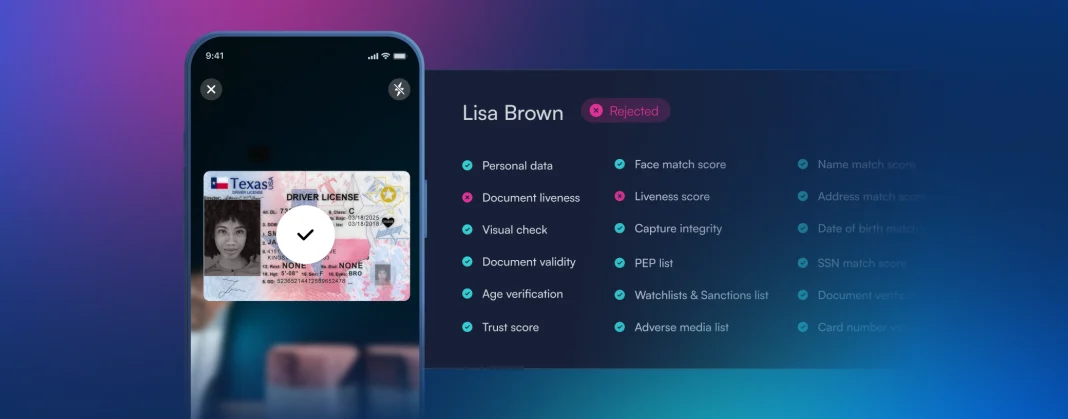
- BlinkID Verify for identity verification: Confirms document authenticity and the physical presence of the user. This helps block deepfakes, synthetic identities, and presentation attacks during onboarding or high-risk transactions.
- On-device and privacy-first processing: Sensitive document and card data can be processed locally rather than routed through the cloud. This reduces breach risk and supports data-sovereignty requirements.
- Adaptive AI models: Microblink’s computer vision and machine learning models are continuously improved to strengthen recognition accuracy across diverse global IDs, varied lighting conditions, and evolving fraud tactics.
Primary use cases
- Real-time e-commerce checkout security: Enterprises can embed Microblink into checkout to confirm cardholder presence and reduce fraudulent CNP purchases before authorization.
- Regulated onboarding and account creation: Businesses can combine card capture, ID verification, and liveness to add KYC-grade controls to new user onboarding and wallet activation.
- High-value or high-risk transaction verification: Microblink is well suited to step-up verification for larger purchases, corporate card usage, or transactions where identity confidence matters more than pure speed.
Recent updates
- Microblink has continued improving its AI models for BlinkCard and BlinkID Verify, expanding recognition accuracy across more global document types and real-world capture conditions.
- The company also released new fraud intelligence around the rise of AI-powered identity fraud, helping enterprises better understand how deepfakes, synthetic identities, and injection attacks are evolving.
- BlinkReceipt was rebranded as Actual, reflecting Microblink’s broader direction in consumer-permissioned data.
Limitations
- Microblink is strongest at the identity verification layer rather than backend transaction scoring. For full CNP coverage, many organizations will still want a complementary risk-scoring or decisioning tool.
- Implementation requires SDK or API integration. Teams without engineering support may need more planning than they would with a zero-setup merchant tool.
- Performance can vary based on the end user’s device and camera quality. Older hardware may result in slower scans or less consistent capture experiences.
Pros
- Privacy-first verification: Microblink processes sensitive card and identity data directly on the user’s device instead of sending everything to the cloud. That reduces centralized exposure of personal data and strengthens its GDPR and data-sovereignty appeal.
- Unified identity toolkit: The platform combines card scanning, ID verification, and biometric liveness within a single experience. This helps enterprises secure onboarding and payment flows without stitching together multiple front-end verification vendors.
- Lower checkout friction: Card scanning reduces manual entry and can help improve completion rates in CNP flows. It delivers deeper verification than basic form entry while keeping the journey relatively smooth.
Cons
- Limited transaction-layer coverage: Microblink is strongest at verifying the person and payment instrument at the point of entry. Businesses still need a separate transaction-scoring or decisioning platform if they want broader CNP fraud coverage across authorization behavior.
- Integration requires development work: Its SDK and API approach gives teams flexibility, but it is not a plug-and-play deployment. Companies without dedicated engineering support may take longer to implement and optimize the experience.
- Device-dependent performance: The quality of the end-user camera and device can affect scan speed and image capture performance. Older devices may create a less consistent onboarding or checkout experience than newer smartphones.
2. Fraudio
Platform summary
- Name: Fraudio
- Description: Fraudio approaches CNP fraud detection through patented Network Effect AI trained on billions of transactions across its connected ecosystem. Rather than relying on one organization’s isolated data, it gives customers access to broader cross-network fraud intelligence from day one.
- Target audience: Issuers, acquirers, PayFacs, payment processors, and regulated payment organizations that need real-time fraud scoring and AML monitoring at scale.
Core features
- Real-time pre-authorization CNP transaction scoring
- Patented Network Effect AI trained on billions of transactions
- Combined payment fraud, merchant fraud, and AML monitoring
- Single integration for multiple payment-risk workflows
Primary use cases
- Scoring high-volume CNP transactions in real time for issuers and acquirers
- Detecting both transaction-level fraud and merchant-level fraud within acquiring portfolios
- Reducing tool sprawl for payment organizations that want fraud and AML controls in one platform
Recent updates
- Fraudio has recently highlighted customer outcomes including 8x ROI and a 600% increase in fraud team efficiency.
- Its platform has also been positioned as identifying fraud patterns weeks earlier than legacy rule-based approaches.
Limitations
- Better suited to payment infrastructure providers than standalone e-commerce merchants
- Does not natively provide document scanning or biometric liveness
- Pricing details are not publicly listed in a granular way
Pros
- Network-level intelligence from day one: Fraudio’s patented Network Effect AI learns from billions of transactions across its connected ecosystem rather than from siloed internal data. That gives customers immediate access to broader fraud pattern recognition without waiting for months of local model training.
- Real-time scoring without latency: The platform returns pre-authorization fraud scores quickly enough to avoid disrupting payment speed. This helps payment organizations strengthen controls while preserving a frictionless experience for legitimate cardholders.
- Broad infrastructure coverage: Fraudio supports payment fraud detection, merchant-initiated fraud monitoring, and AML use cases through one integration. That breadth is especially valuable for issuers, acquirers, and PayFacs looking to simplify their risk stack.
Cons
- Not built for simple merchant plug-and-play: Fraudio is designed primarily for payment infrastructure companies rather than standalone online merchants. Businesses seeking a quick, chargeback-focused tool with minimal technical work may find it less accessible.
- No native front-end identity verification: The platform does not natively provide document scanning or biometric liveness checks. Organizations that need both onboarding verification and transaction scoring usually need partner solutions as well.
- Pricing is not publicly transparent: Fraudio does not list detailed public pricing tiers on its website. Buyers need to engage with sales to understand exact costs and commercial fit.
3. Stripe Radar
Platform summary
- Name: Stripe Radar
- Description: Stripe Radar is a built-in fraud prevention layer for businesses already operating in the Stripe ecosystem. It uses machine learning trained on Stripe’s large global payments network to detect suspicious activity with minimal deployment effort.
- Target audience: Stripe-native e-commerce, SaaS, subscription, and digital businesses that want fast CNP fraud protection without adding a separate vendor.
Core features
- Machine learning trained on Stripe’s global payments network
- Automatic activation for Stripe accounts with minimal setup
- Device fingerprinting and behavioral analytics
- Built-in chargeback prevention and dispute workflows
Primary use cases
- Adding immediate fraud screening for businesses already on Stripe
- Supporting growing startups that want enterprise-style fraud controls without a dedicated integration project
- Reducing unauthorized card usage and suspicious sign-ups in digital businesses
Recent updates
- Stripe has enhanced Radar’s machine learning with stronger device fingerprinting and behavioral analytics.
- These updates have improved its ability to adapt to fast-changing attack patterns, including more sophisticated bot behavior.
Limitations
- Only protects transactions processed through Stripe
- Advanced customization often requires a higher-tier plan
- Less relevant for issuers and acquirers solving fraud at the authorization layer
Pros
- Zero-setup activation: Stripe Radar is automatically available for businesses already using Stripe, so teams can benefit from fraud screening without a separate implementation project. That makes it one of the easiest ways for merchants to add AI-based CNP protection quickly.
- Massive payment network training data: Its machine learning models are trained on a very large global payments dataset across millions of businesses. That scale improves card and behavior pattern recognition, especially for merchants that lack enough internal data to train strong models on their own.
- Built-in dispute support: Radar includes tools that help merchants prevent and manage chargebacks inside the broader Stripe workflow. This can reduce manual review effort and simplify post-transaction fraud operations.
Cons
- Locked to the Stripe ecosystem: Radar only protects transactions processed through Stripe and does not extend to other gateways or custom payment stacks. That creates dependency on Stripe for businesses that want continuity in their fraud tooling.
- Advanced controls cost extra: Basic protection is easy to access, but more granular rules and customization typically require the Radar for Fraud Teams tier. Risk teams that want deeper control may need to pay more than the entry-level rate suggests.
- Limited relevance for payment infrastructure players: Stripe Radar is designed for the merchant checkout layer rather than issuer or acquirer authorization environments. Organizations solving fraud at the network or processor layer usually need a different kind of platform.
4. FraudNet
Platform summary
- Name: FraudNet
- Description: FraudNet is an enterprise fraud platform centered on explainable AI and rich data orchestration. It brings together transaction data, CRM data, ERP data, and third-party signals to produce contextual, auditable risk decisions for complex CNP environments.
- Target audience: Compliance-heavy enterprises, B2B merchants, SaaS companies, travel businesses, and risk teams that need transparent decisions and deeper business context.
Core features
- Explainable AI with human-readable fraud-score reasoning
- Data orchestration across CRM, ERP, payment, and third-party systems
- No-code rule creation and testing
- Audit-ready workflows for regulated environments
Primary use cases
- Protecting high-value CNP transactions where simple approve/decline logic is not enough
- Supporting compliance teams that need explainable, reviewable fraud decisions
- Reducing false declines in complex industries such as B2B commerce and travel
Recent updates
- FraudNet won the Datos Insights Award for its Joint AML and Fraud Transaction Monitoring solution.
- It also launched an Entity Screening module designed to automate business and customer verification.
Limitations
- Initial setup is more complex than lightweight merchant tools
- Best results depend on steady and diverse data inputs
- Pricing is generally aligned with enterprise budgets
Pros
- Strong explainability for compliance: FraudNet provides human-readable explanations for why a transaction was flagged or approved. That makes it particularly valuable for regulated organizations that need auditability and internal confidence in automated decisions.
- Rich data orchestration: The platform combines payment data with CRM, ERP, and third-party inputs to build more contextual risk decisions. That broader view can improve accuracy for businesses with complex customer relationships and nonstandard transaction patterns.
- No-code rule management: Fraud teams can create and adjust decisioning rules without relying on developers for every policy change. This helps operational teams respond faster as fraud patterns evolve or compliance requirements shift.
Cons
- Heavier implementation burden: FraudNet typically requires more planning and integration effort than lighter merchant-focused tools. Smaller teams may struggle to dedicate the technical and operational resources needed for a full rollout.
- Best results depend on data volume: Its models perform best when fed with steady, diverse transaction and business context data. Companies with low transaction volume or thin internal data may not realize the platform’s full value.
- Enterprise-oriented pricing: The platform’s cost structure reflects its depth, configurability, and enterprise positioning. That can make it harder to justify for startups or smaller merchants with tighter budgets.
5. Sift
Platform summary
- Name: Sift
- Description: Sift is a digital trust and safety platform that connects account behavior and payment behavior into a unified fraud decisioning layer. It is particularly effective where account takeover, fake accounts, promo abuse, and CNP fraud are tightly connected.
- Target audience: E-commerce businesses, marketplaces, digital goods sellers, and online platforms that need account-to-payment risk visibility across the user journey.
Core features
- Real-time CNP scoring trained on signals from 16,000+ businesses
- Account-level and payment-level risk correlation
- Device intelligence and adaptive machine learning
- Built-in chargeback and dispute management tools
Primary use cases
- Preventing account takeovers from becoming downstream CNP fraud
- Protecting marketplaces and digital goods businesses from fake accounts and fraudulent purchases
- Providing adaptive ML fraud scoring to merchants that do not want to build internal models
Recent updates
- Sift introduced new API endpoints for real-time decisioning.
- It also expanded device intelligence capabilities to improve speed and detection breadth across digital channels.
Limitations
- Pricing is custom and may be harder for smaller businesses to absorb
- Integration and tuning are more involved than zero-setup tools
- Less focused on issuer-side fraud and deep AML monitoring
Pros
- Connects account and payment risk: Sift links login anomalies, account behavior, and transaction activity into a single fraud decisioning layer. This is especially powerful in environments where account takeovers often lead to downstream CNP fraud.
- Adaptive network-trained machine learning: Its models learn from signals across more than 16,000 businesses, helping customers benefit from shared intelligence. That reduces the need for merchants to maintain large rule sets or build their own fraud models from scratch.
- Strong fit for digital platforms: Sift is particularly effective for marketplaces, digital goods sellers, and other account-centric businesses. It protects the full user journey rather than treating payment fraud as an isolated checkout event.
Cons
- Custom pricing can be hard for smaller teams: Sift does not provide straightforward public pricing, so buyers must go through a sales process to understand cost. For smaller businesses, the resulting quote may be harder to absorb than simpler off-the-shelf tools.
- Implementation requires tuning: The platform generally needs meaningful integration work and ongoing optimization to perform at its best. Teams that want an instant-on fraud tool may find the setup more demanding than zero-configuration alternatives.
- Less focused on issuer and AML needs: Sift is primarily oriented toward merchant-side fraud prevention rather than issuer or acquirer infrastructure. Organizations with deep AML monitoring or regulated payment-network requirements may need a more specialized platform.
Final Takeaway
The best detection tool for card-not-present fraud in 2026 depends on where your biggest risk sits.
- If your priority is verifying the user and payment instrument at the point of entry, Microblink stands out for privacy-first identity verification, card scanning, and biometric liveness.
- If you need network-level, real-time scoring for payment infrastructure, Fraudio is better aligned.
- If you are fully committed to Stripe and want instant protection, Stripe Radar offers the simplest deployment path.
- If compliance explainability and contextual enterprise scoring matter most, FraudNet is a strong fit.
- If account takeover and payment fraud are deeply linked in your environment, Sift deserves close consideration.
For most fraud decision-makers, the right long-term answer is not a single tool but a layered strategy: identity verification at entry, intelligent transaction scoring at authorization, and operational workflows that support compliance, auditability, and fast response.
Why CNP Fraud Costs More Than the Transaction
As global e-commerce continues to expand, CNP fraud has become the leading cause of credit card fraud, making robust detection tools a critical necessity for any digital B2B or B2C business. Failing to intercept these fraudulent transactions leads to devastating financial consequences, including costly chargeback fees, lost inventory, and severe damage to your merchant reputation. Implementing a powerful CNP fraud detection system not only protects your bottom line from direct revenue loss but also safeguards your brand’s integrity, ensuring that your genuine customers enjoy a secure and seamless purchasing experience.
How to Choose a CNP Fraud Detection Tool
Selecting the right CNP fraud detection provider requires a strategic methodology focused on accuracy, integration, and adaptability. Start by evaluating a provider’s false positive rate; the best tools block fraudsters without declining legitimate buyers and costing you sales. Next, assess their technological capabilities—look for solutions that offer real-time machine learning, global threat intelligence networks, and seamless API integrations with your existing payment gateways. Finally, consider scalability and compliance, ensuring the software can effortlessly grow with your transaction volume while adhering to stringent data security standards like PCI-DSS.
What is the difference between identity verification tools and transaction-scoring tools for card-not-present fraud?
Identity verification tools and transaction-scoring tools solve different parts of the card-not-present fraud problem, and most medium-sized businesses and enterprises need both.
Identity verification tools focus on confirming that the person initiating the transaction is real and authorized. They typically use technologies such as payment card scanning, ID document verification, biometric liveness detection, and tamper detection. These tools are especially valuable at onboarding, account creation, wallet activation, step-up verification, and high-risk checkout moments where proving cardholder legitimacy matters.
Transaction-scoring tools operate later in the flow. They evaluate the risk of a transaction using signals such as device intelligence, behavioral patterns, network fraud history, geolocation anomalies, velocity checks, merchant rules, and machine learning models. Their job is to decide whether to approve, decline, or route a transaction for review without adding unnecessary friction for legitimate customers.
For fraud decision-makers, the key takeaway is that identity verification helps stop fraud before it enters the payment system, while transaction scoring helps evaluate risk at scale once a payment attempt is in motion. A layered strategy usually performs best because it reduces fraud exposure while also improving control over false declines.
How should enterprises choose the best CNP fraud detection tool for their environment?
The best tool depends less on who has the longest feature list and more on where your fraud risk actually sits.
If your biggest challenge is proving that the user is the legitimate cardholder during onboarding or checkout, prioritize front-end verification capabilities such as card scanning, document authentication, liveness detection, and privacy-first processing. This is especially important for regulated onboarding, high-value purchases, and industries where synthetic identity or deepfake risk is rising.
If your main challenge is optimizing approval decisions across large transaction volumes, look for strong transaction scoring, real-time decisioning, explainable AI, device intelligence, and broad risk signals. Payment infrastructure providers, issuers, acquirers, and PayFacs often need this type of backend scoring more than merchant-facing identity checks alone.
You should also evaluate:
- Integration model, including SDKs, APIs, no-code tools, and implementation effort
- Compliance alignment with PCI DSS, GDPR, KYC, and AML requirements
- False decline reduction, not just fraud catch rate
- Auditability and reporting for internal auditors, compliance teams, and executives
- Ability to support step-up verification for higher-risk scenarios
- Total cost of ownership, including setup, tuning, operational overhead, and vendor dependencies
For most enterprises, the right decision is not choosing one tool to do everything. It is choosing the right combination of identity verification, transaction decisioning, and operational review workflows.
Can card scanning, ID verification, and biometric liveness actually reduce card-not-present fraud?
Yes, especially when fraud is occurring at the point of entry rather than only at the authorization layer.
In many CNP attacks, the fraudster already has enough stolen information to fill out a payment form. Traditional checkout fields do little to prove that the person entering the details is the real cardholder. That is where card scanning, ID verification, and biometric liveness add value.
Card scanning can help confirm card presence, reduce manual entry errors, and identify signs of manipulated or tampered card images. ID verification adds another layer by checking whether the user’s identity document is authentic and valid. Biometric liveness helps confirm that the person presenting the ID is physically present and not using a deepfake, replay, mask, or spoofed image.
Together, these controls are particularly useful for:
- High-value e-commerce purchases
- Regulated onboarding and account opening
- Wallet activation and stored payment credential setup
- Step-up verification for suspicious transactions
- Environments with elevated synthetic identity or account takeover risk
These methods do not replace transaction scoring, but they can significantly reduce fraud before a risky transaction reaches payment authorization. For fraud decision-makers, that can mean better loss prevention, cleaner downstream payment traffic, and stronger customer trust.
How do CNP fraud tools support compliance with PCI DSS, GDPR, KYC, and AML requirements?
The strongest CNP fraud tools support compliance by reducing unnecessary data exposure, improving identity assurance, and creating more auditable decision processes.
For PCI DSS, relevant tools help protect sensitive payment data through secure capture methods, encryption, tokenization support, and reduced handling of raw card data. For GDPR and similar privacy laws, privacy-first architectures matter because they can minimize how much personal data is transferred, stored, or centrally processed. On-device processing is particularly helpful where data minimization and data-sovereignty requirements are priorities.
For KYC and AML, identity verification capabilities such as document authentication, liveness checks, and customer verification workflows help organizations establish stronger confidence in who is transacting or onboarding. While not every fraud tool is a full AML platform, tools that improve identity quality at the start of the customer relationship can strengthen broader compliance programs.
Compliance teams should also look for:
- Clear data retention and processing controls
- Audit logs and decision transparency
- Explainable AI or reviewable fraud reasoning
- Support for regional privacy requirements
- Flexible deployment options for regulated environments
The main point is that fraud prevention and compliance should not be treated as separate projects. The best tools help organizations improve fraud detection while also supporting privacy, governance, and audit readiness.
What is the best way to reduce false declines without increasing fraud risk?
Reducing false declines requires more context, not just stricter rules.
Many businesses lose legitimate revenue when their fraud stack overreacts to incomplete signals such as unusual transaction size, location changes, new devices, or atypical customer behavior. While blunt controls may block fraud, they can also frustrate good customers and damage long-term conversion.
The most effective approach is a layered one. Use low-friction signals such as device intelligence, behavioral analytics, and network-level scoring to screen transactions in the background. Then apply step-up verification only when risk is elevated. For example, instead of declining a borderline transaction immediately, a business might request card scanning, ID verification, or biometric liveness to confirm legitimacy.
This approach helps by:
- Preserving smooth checkout for low-risk users
- Adding stronger proof only when needed
- Giving analysts better context for manual review
- Improving approval rates on legitimate but unusual transactions
- Reducing chargebacks without sacrificing customer experience
For fraud decision-makers, false decline reduction should be a core evaluation metric when comparing tools. A platform that blocks more fraud but also turns away too many legitimate customers may create hidden revenue loss that outweighs its fraud savings. The best CNP strategy improves both protection and approval quality over time.