KYC Finance: Complete Guide to Customer Identity Verification for Banks


KYC in finance has evolved from a regulatory obligation into a strategic control layer for trust. Chief Compliance Officers are no longer simply ensuring boxes are checked. They are responsible for building systems that can withstand regulatory scrutiny, prevent increasingly sophisticated fraud, and still support business growth. The challenge is not theoretical. Customers expect fast, seamless onboarding, while regulators demand rigorous verification and auditability. Meanwhile, fraudsters are exploiting every gap between those two expectations.
What Is KYC in Finance?
KYC (Know Your Customer) for banks refers to the set of processes financial institutions use to verify customer identities, assess risk, and monitor activity to prevent financial crime. While many organizations still think of KYC as an onboarding requirement, regulators increasingly expect it to function as an ongoing system. Identity is not static, and neither is risk. A modern KYC framework must continuously validate that a customer is who they claim to be, and that their behavior remains consistent with their risk profile over time.
The Core Components of a KYC Finance Program
At a foundational level, every KYC finance program is built on a structured set of controls designed to establish identity, assess risk, and maintain compliance over time.
| Component | Purpose | Why It Matters |
|---|---|---|
| Customer Identification Program (CIP) | Verifies core identity information using official documents | Establishes a trusted identity baseline |
| Customer Due Diligence (CDD) | Evaluates risk based on behavior, geography, and profile | Enables risk-based decisioning |
| Enhanced Due Diligence (EDD) | Applies deeper scrutiny to high-risk individuals | Protects against complex fraud and regulatory exposure |
| Sanctions Screening | Checks against global watchlists and adverse media | Ensures compliance with AML obligations |
| Ongoing Monitoring | Tracks behavior and transactions over time | Detects emerging risk and suspicious activity |
The key shift is that these components are no longer sequential steps. They must operate as a coordinated, continuous system.
How Identity Verification Prevents Financial Fraud
5
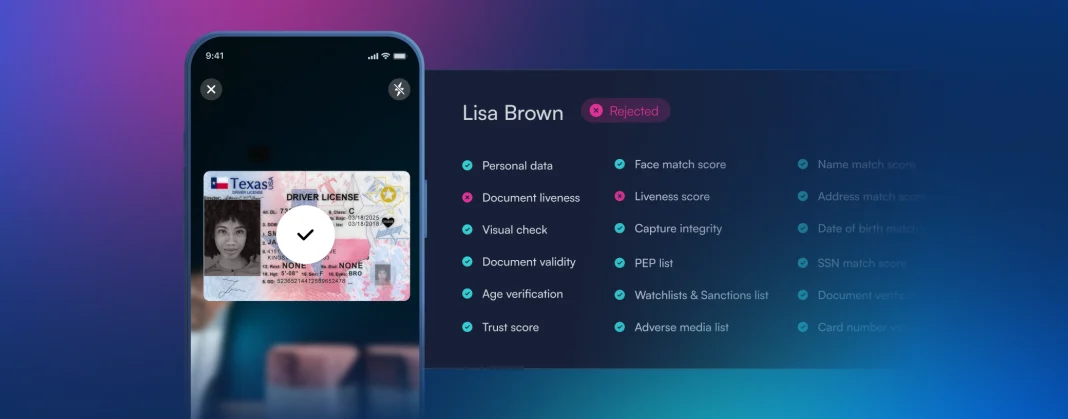
Effective KYC depends on the strength of identity verification at its core. Document verification uses AI to analyze identity documents for authenticity, detecting tampering, forgeries, and synthetic constructs that would be difficult for human reviewers to catch. Biometric verification ensures that the individual presenting the document is its rightful owner, while liveness detection prevents spoofing attempts using static images, videos, or deepfakes. When these signals are combined and bound to an account, device, and transaction context, financial institutions gain a far more reliable understanding of identity than any single method could provide alone.
Balancing Compliance with Low-Friction Onboarding
The tension between compliance and customer experience is one of the most persistent challenges in financial services. Overly rigid verification processes introduce friction that drives abandonment, while overly lenient systems create exposure to fraud and regulatory penalties. The solution lies in precision rather than compromise. Modern KYC systems use automation and adaptive workflows to apply the right level of verification at the right time. Low-risk users can move quickly through onboarding, while higher-risk scenarios trigger additional checks. This approach allows institutions to maintain strong compliance controls without unnecessarily burdening legitimate customers.
Common KYC Challenges and How to Avoid Them
Financial institutions implementing KYC finance solutions consistently encounter a similar set of challenges, many of which stem from fragmented systems and overreliance on manual processes.
- High false positives can block legitimate users and reduce conversion, often caused by relying on a single verification signal instead of a layered approach
- Manual review bottlenecks slow onboarding and overwhelm compliance teams, particularly during peak demand
- Fragmented vendor ecosystems create gaps in visibility, making it difficult to form a complete view of identity risk
- Synthetic identity fraud continues to bypass weak verification systems that lack document intelligence and real-time liveness detection
Addressing these challenges requires a shift toward automation, unified identity signals, and risk-based orchestration.
The Risks of Inadequate KYC
The consequences of weak KYC controls extend far beyond operational inefficiency. Regulatory bodies expect financial institutions to demonstrate not only that controls are in place, but that they are effective and consistently applied. Failure to meet these expectations can result in significant financial penalties, reputational damage, and increased scrutiny. More importantly, inadequate KYC exposes organizations to fraud that can scale rapidly, particularly in the form of synthetic identities and coordinated attacks. In this environment, compliance is not just about avoiding fines. It is about maintaining control.
The Future of KYC Finance: Continuous Identity Intelligence
KYC is moving away from static verification toward continuous identity intelligence. Rather than verifying a customer once and assuming trust, leading institutions are adopting systems that reassess identity and risk throughout the customer lifecycle. This includes monitoring behavioral signals, transaction patterns, and device interactions in real time. The goal is to create a dynamic understanding of identity that evolves alongside emerging threats. This shift enables financial institutions to respond faster, automate more decisions, and reduce reliance on manual intervention.
How Microblink Supports Modern KYC in Finance
Microblink enables financial institutions to modernize KYC by unifying identity verification, biometrics, and decisioning into a single, automated system. Its technology supports global document verification, on-device biometric and liveness detection, and real-time identity assessment across the customer lifecycle. By reducing manual review and increasing automation, organizations can improve onboarding speed while maintaining strong compliance controls. This allows compliance teams to focus less on processing and more on oversight and risk strategy.