
Top Document Authentication Software in 2026
Intro
Document authentication software is now a core control for enterprises that need to onboard customers digitally without exposing the business to identity fraud, account abuse, or unnecessary compliance risk. For Fraud Decision-Makers, the challenge is no longer just verifying that a document looks legitimate. It is also about detecting deepfakes, stopping synthetic identities, maintaining auditability, and reducing friction for legitimate users.
The strongest platforms in 2026 combine AI-based document analysis, biometric verification, liveness detection, and flexible deployment models. Some prioritize privacy-first, on-device processing. Others focus on configurable workflows or rapid global verification at scale. The right choice depends on your fraud mix, regulatory obligations, engineering resources, and customer experience goals.
Below is a comparison of leading document authentication software platforms for medium-sized businesses and enterprises.
| Product | Compliance Features | Industry Focus | AI Capabilities | User Experience | Developer Experience |
| Microblink | Strong identity proofing with biometric face matching and liveness detection; privacy-first processing supports GDPR- and SOC 2-sensitive deployments, but AML screening typically requires an additional tool. | Financial services, payments, age-restricted platforms, and privacy-sensitive organizations. | Sub-second OCR and data extraction, deepfake detection, biometric matching, and fraud analysis optimized for document authenticity. | Very fast onboarding with low friction and reliable performance even in weak connectivity environments. | SDK-based deployment with on-device and self-hosted options; flexible for product teams but requires more engineering effort than no-code platforms. |
| Entrust | Well-suited for enterprise KYC with configurable workflows, auditability, and broad global document support; useful for organizations with complex compliance requirements. | Global enterprises, digital banks, marketplaces, and regulated onboarding teams. | Multi-layered AI document analysis, repeat-attempt detection, and deepfake-focused fraud defenses through its Fraud Lab. | Flexible user journeys, though flagged cases may fall into manual review and add friction in conversion-sensitive flows. | No-code workflow studio reduces engineering dependency, but platform breadth can create a steeper learning curve during setup. |
| Veriff | Strong document and biometric verification for global identity checks, though less focused on being a full end-to-end AML platform. | Global marketplaces, mobility platforms, and businesses prioritizing rapid customer onboarding. | Rapid AI decisioning, assisted image capture, cross-session fraud signals, and broad support for 11,500+ document types. | Excellent guided capture flow and sub-6-second verification speed improve completion rates, though strict quality thresholds can lead to retries for some users. | Cloud deployment is straightforward for many teams, but workflow customization is less extensive than more configurable enterprise platforms. |
1. Microblink
Platform summary
Microblink is an AI-first document authentication and identity verification platform built for enterprises that need strong fraud defenses without sacrificing speed, privacy, or conversion. Its biggest differentiator is its privacy-first architecture: instead of relying heavily on cloud processing, Microblink can perform document capture, data extraction, and biometric checks on-device or in self-hosted environments.
For compliance officers, risk leaders, and heads of fraud, that deployment model matters. It helps limit sensitive data exposure, supports stricter data residency requirements, and reduces latency during onboarding. Microblink is particularly well-suited for organizations that need to verify identities at scale while staying resilient against deepfakes, injection attacks, and sophisticated document fraud.
Key benefits
- Privacy-first verification architecture: Sensitive biometric and document data can be processed on-device, reducing unnecessary data transfer and supporting stricter privacy requirements.
- Fast enterprise onboarding: ID data extraction and verification can happen in under three seconds, helping reduce user drop-off in high-volume onboarding funnels.
- Fraud automation at scale: Microblink automates up to 95% of identity checks, which can reduce manual review pressure and reviewer fatigue.
- Stronger defense against AI-enabled fraud: The platform is designed to detect deepfakes, synthetic identities, presentation attacks, and virtual camera or injection-based attacks.
Core features
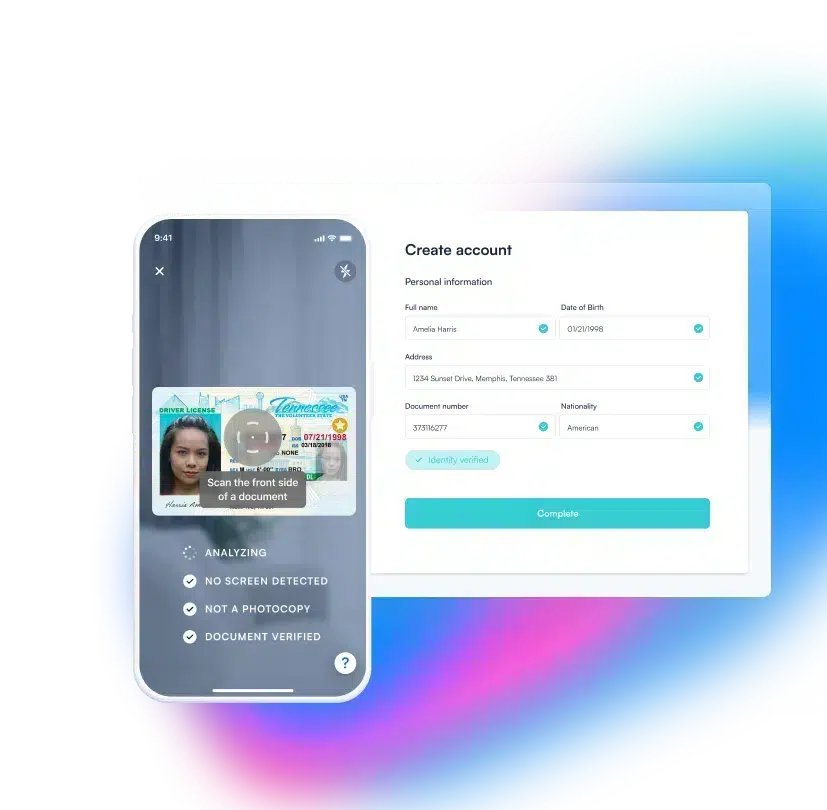
- Passive liveness and face-to-document matching: Users complete a single capture without extra prompts like blinking or turning their head, while the system confirms a live person matches the ID portrait.
- Advanced deepfake and injection attack detection: Microblink targets both traditional spoofing and newer generative AI attacks that attempt to bypass camera-based verification.
- On-device processing and self-hosted deployment options: Enterprises can choose architectures aligned to privacy, compliance, and latency requirements.
- In-house Fraud Lab model training: Microblink’s Fraud Lab generates more than 100,000 attack images per month to continuously train models against emerging fraud patterns.
- Sub-second OCR and document data extraction: Rapid capture and extraction improve onboarding speed and reduce form-fill abandonment.
- Global document support: The platform supports more than 2,500 document types across 195+ countries and territories.
Primary use cases
- Seamless customer onboarding: Enterprises can verify IDs and bind accounts to real users in real time, accelerating account creation while blocking fraudulent applications.
- KYC and fraud operations automation: Teams use Microblink to detect document alterations, template swaps, counterfeit IDs, and biometric mismatches without expanding manual review headcount.
- Step-up authentication for high-risk events: Businesses can trigger biometric rechecks during withdrawals, payout changes, device changes, or account recovery events.
- Card-not-present fraud prevention: By combining BlinkCard with BlinkID Verify, organizations can validate both card data and customer presence during checkout.
- Age verification: Regulated businesses can enforce age gates with low-friction ID scanning.
Recent updates
- DHS RIVR performance milestone: In March 2026, Microblink became the only vendor to meet every U.S. Department of Homeland Security RIVR accuracy threshold, with a reported 0.00% system error rate while remaining within false accept and false reject limits.
- 100% deepfake detection on IDNet: Microblink achieved a perfect detection rate on the DHS-backed IDNet benchmark for distinguishing AI-generated faces from real ones.
- Massive enterprise scale: The platform processed 2.9 billion identities globally in 2025.
- Expanded fraud prevention suite: Microblink integrated checkout protection by pairing BlinkCard with BlinkID Verify.
- Product portfolio update: BlinkReceipt was rebranded to Actual.
Limitations
- Requires developer involvement: Its SDK-based approach gives enterprises flexibility, but implementation typically requires engineering resources and testing across platforms.
- Not a full AML suite on its own: Microblink is strongest in identity proofing and document authentication, so sanctions screening and continuous AML monitoring may require additional tools.
- Best fit for medium-to-large programs: Enterprise pricing is generally better aligned to organizations with meaningful verification volume.
2. Entrust
Platform summary
Entrust is a strong choice for enterprises that need configurable identity verification workflows and broad global document coverage. Its expanded document verification capabilities, strengthened through Onfido integration, make it well-suited for organizations operating across multiple jurisdictions and product lines.
For Fraud Decision-Makers, Entrust’s value lies in flexibility. Teams can build onboarding flows without relying entirely on engineering, while also layering AI document analysis, liveness, and repeat-attempt detection into the verification process. That makes it a practical fit for businesses with complex compliance requirements and evolving fraud policies.
Core features
- No-code workflow studio: Compliance teams can design and modify verification flows with less engineering dependency.
- Multi-layered AI document analysis: Entrust evaluates visual, data, and metadata elements to identify forged or manipulated documents.
- Repeat attempts detection: The platform helps identify serial fraud patterns across prior onboarding attempts.
- Global document support: Built for enterprise use cases that span many countries, regions, and document formats.
Primary use cases
- Global enterprise onboarding: Useful for large organizations that need to scale identity verification across jurisdictions.
- Digital bank KYC compliance: Supports auditability and automation for regulated banking onboarding programs.
- Marketplace trust and safety: Helps verify buyers and sellers while reducing fraudulent account creation.
Recent updates
- Deeper Onfido integration: Entrust has continued embedding Onfido’s document verification technology into its broader identity security portfolio.
- Expanded Fraud Lab capabilities: The company has invested further in defenses against deepfakes and generative AI-enabled fraud.
Limitations
- Limited pricing transparency: Quote-based pricing can make vendor budgeting and side-by-side evaluation more difficult.
- Manual review can add friction: Flagged applicants may fall into fallback review paths that slow conversions.
- Steeper learning curve: The platform’s breadth is an advantage for large teams, but smaller teams may need more time to operationalize it fully.
3. Veriff
Platform summary
Veriff is built for organizations that prioritize speed, global coverage, and a smooth applicant experience. Its rapid decision engine and guided capture experience make it especially attractive for digital businesses where onboarding abandonment directly affects revenue.
For compliance and risk teams, Veriff offers a practical balance: fast AI-based document and biometric verification with broad international document support. It is a strong fit for marketplaces, mobility platforms, and other businesses scaling across geographies where verification throughput and customer experience both matter.
Core features
- Rapid decision engine: Veriff returns AI-based verification decisions in under six seconds on average.
- Assisted image capture: Real-time capture guidance helps users submit higher-quality document and selfie images.
- Broad global document coverage: Supports more than 11,500 document types across 190 countries.
- Cross-session fraud signals: Helps identify suspicious behavior and repeat fraud patterns beyond a single session.
Primary use cases
- High-velocity onboarding: Helps consumer-facing businesses reduce abandonment during account creation.
- Global marketplace verification: Supports broad buyer and seller verification across diverse regions.
- Mobility and workforce onboarding: Useful for verifying drivers, contractors, and gig workers quickly.
Recent updates
- Faster decisioning at scale: Veriff has optimized its engine to maintain average verification times below six seconds.
- Improved cross-session fraud detection: The platform introduced stronger signals for identifying repeat bad actors across sessions.
Limitations
- Premium per-verification pricing: Starting pricing around $0.80 per verification may be less attractive for cost-sensitive programs.
- Less workflow depth than some enterprise platforms: Organizations with highly customized branching logic may want more orchestration control.
- Strict image quality thresholds: Users on older devices or in poor lighting conditions may encounter more retries.
Final thoughts
For Fraud Decision-Makers evaluating document authentication software in 2026, the shortlist should reflect your operating model as much as your fraud stack.
- Choose Microblink if privacy-first architecture, on-device processing, and strong protection against deepfakes and injection attacks are top priorities.
- Choose Entrust if your team needs configurable enterprise workflows and broad global coverage across complex compliance programs.
- Choose Veriff if your business depends on fast, low-friction onboarding across a large international user base.
If your organization is balancing fraud prevention, conversion, and privacy requirements at scale, Microblink stands out for enterprises that want high-assurance document authentication without defaulting to cloud-heavy verification flows.
What is document authentication software?
Document authentication software is an advanced technological solution designed to verify the legitimacy of identity documents, such as passports, driver’s licenses, and corporate records. Leveraging artificial intelligence, machine learning, and optical character recognition (OCR), this software analyzes the physical and digital security features of a document to detect tampering, forgery, or synthetic fraud. For B2B organizations, it serves as the frontline defense in establishing trust, ensuring that the entities and individuals you transact with are exactly who they claim to be.
Why is it important?
In today’s digital-first economy, the sophistication of identity fraud is escalating rapidly, making robust document authentication critical for risk mitigation and regulatory compliance. Implementing this software is essential for meeting stringent Know Your Customer (KYC) and Anti-Money Laundering (AML) mandates, protecting your business from costly regulatory fines and severe reputational damage. Furthermore, automated authentication streamlines the onboarding process, significantly reducing manual review times and friction for legitimate clients while effectively blocking bad actors at the point of entry.
How to choose the best software provider
Selecting the right document authentication provider requires a strategic methodology focused on accuracy, global reach, and integration capabilities. Begin by evaluating the provider’s document coverage and their underlying technology—look for solutions that utilize multi-layered checks, including biometric liveness detection and forensic-level image analysis, to minimize false positives. Additionally, prioritize vendors that offer seamless API integration into your existing compliance workflows, robust data security certifications (such as SOC 2 and GDPR compliance), and a proven track record of adapting to emerging fraud vectors.
What is document authentication software, and how is it different from basic OCR or ID scanning?
Document authentication software does more than capture an image of an ID and extract text. Basic OCR or ID scanning tools are primarily designed to read document fields such as name, date of birth, address, or document number. Document authentication software goes further by assessing whether the document itself is legitimate and whether the person presenting it is real and authorized to use it.
A modern platform typically combines several layers of analysis:
- Document authenticity checks: Looks for signs of tampering, counterfeit templates, altered fields, missing security features, or inconsistent formatting.
- Data validation: Compares extracted fields for internal consistency and checks whether data patterns match expected document structures.
- Biometric verification: Matches the user’s selfie or live face capture to the portrait on the document.
- Liveness detection: Confirms the applicant is a live human being rather than a printed photo, screen replay, mask, deepfake, or injection attack.
- Fraud intelligence: Detects repeat attempts, suspicious device or session patterns, and known attack behaviors.
For Fraud Decision-Makers, this distinction matters because OCR alone may improve form-fill speed, but it does not reliably stop identity fraud. If your risk includes fake IDs, synthetic identities, account takeovers, deepfakes, or mule account creation, you need software that can authenticate the document and the presenter—not just read the text.
What capabilities matter most when evaluating document authentication software in 2026?
In 2026, strong document authentication software should be evaluated as part of a broader fraud and compliance control—not just as a point solution for capture. The most important capabilities usually fall into five categories:
- Fraud detection strength: Look for detection of forged or altered documents, deepfakes, presentation attacks, injection attacks, and synthetic identity patterns.
- Biometric and liveness performance: The platform should verify that the person is real and that their face matches the ID portrait with minimal user friction.
- Deployment flexibility: Depending on your privacy and regulatory requirements, you may need cloud, on-device, or self-hosted processing options.
- Global document support: Enterprises operating across regions need broad support for document types, languages, and country-specific formats.
- Operational fit: Consider API/SDK quality, workflow configurability, fallback review paths, reporting, audit logs, and integration with downstream fraud or compliance systems.
It is also important to measure business outcomes, not just vendor claims. Ask how the solution affects:
- onboarding completion rate
- manual review volume
- false accepts and false rejects
- verification speed
- data exposure risk
- total cost per approved user
For medium-sized businesses and enterprises, the best choice is rarely the one with the longest feature list. It is the one that best fits your fraud mix, compliance obligations, customer experience goals, and internal implementation capacity.
Can document authentication software prevent deepfakes and synthetic identity fraud on its own?
Not entirely. It is a critical control, but it should be part of a layered identity and fraud strategy.
Modern document authentication platforms can significantly reduce risk from:
- Deepfakes: AI-generated or manipulated face imagery used during selfie or video verification
- Presentation attacks: Printed photos, screen replays, masks, or other spoofing attempts
- Injection attacks: Virtual camera feeds or manipulated video streams inserted directly into the verification process
- Document fraud: Counterfeit, altered, or template-swapped IDs
However, synthetic identity fraud often extends beyond the document itself. A synthetic identity may use a mix of real and fabricated information, supported by stolen credentials, manipulated device signals, or coordinated account behavior. That means document authentication should ideally work alongside other controls such as:
- device and behavioral risk analysis
- velocity and repeat-attempt detection
- watchlist or sanctions screening where applicable
- phone, email, and account reputation checks
- transaction monitoring
- step-up verification for high-risk actions
For Fraud Decision-Makers, the right expectation is not that document authentication software eliminates all fraud. The goal is to make identity fraud materially harder, reduce manual review burden, improve auditability, and catch high-risk applications earlier in the customer lifecycle.
Does document authentication software replace AML, sanctions screening, or manual review?
No. In most enterprise environments, it complements those controls rather than replacing them.
Document authentication software is strongest at answering questions such as:
- Is this ID likely genuine?
- Has this document been altered or spoofed?
- Does the selfie match the document portrait?
- Is the user physically present and live during the check?
AML and sanctions controls answer different questions, such as:
- Is this person on a sanctions or watchlist?
- Is there adverse media or politically exposed person exposure?
- Does the account show signs of money laundering risk over time?
Manual review also remains relevant for edge cases, including:
- low-quality image submissions
- unusual or rare documents
- borderline fraud signals
- policy-based escalations
- cases requiring extra evidence or human judgment
What strong document authentication software can do is reduce the number of cases that need manual intervention and improve the quality of the cases that are escalated. It can also create better audit trails by documenting what was checked, what risk signals were triggered, and how the final decision was reached.
For enterprises, the practical question is not whether manual review disappears completely. It is whether the software helps your team reserve manual review for genuinely ambiguous or high-risk cases instead of routine identity checks.
How should enterprises think about privacy, compliance, and deployment when choosing a document authentication platform?
Privacy and deployment architecture can have a major impact on both risk posture and implementation feasibility. For many organizations, this is as important as verification accuracy.
Key considerations include:
- Where sensitive data is processed: Some platforms rely mainly on cloud processing, while others offer on-device or self-hosted options that reduce external data transfer.
- Data residency requirements: If your organization operates in regulated markets, you may need tighter control over where biometric and identity data is stored or processed.
- Retention and audit policies: Make sure the platform supports your requirements for evidence retention, deletion, and access controls.
- Security certifications and controls: Review available security documentation, logging, permissions, encryption standards, and incident response practices.
- Regulatory alignment: Depending on your industry, you may need support for KYC, GDPR-sensitive workflows, internal audit requirements, or sector-specific identity proofing obligations.
Deployment model also affects user experience and operations:
- On-device processing can reduce latency, improve performance in poor connectivity conditions, and limit exposure of sensitive data.
- Self-hosted deployments can provide more control for organizations with stricter infrastructure or residency requirements.
- Cloud-first models may be faster to implement and easier to scale globally, but may require more legal and security review.
For Fraud Decision-Makers, the best platform is not only the one that detects fraud well. It is the one that aligns with your internal risk controls, legal requirements, implementation resources, and customer experience expectations without creating unnecessary compliance overhead.