Best Liveness Detection Software in 2026

Securing the Digital Frontier: The Best Liveness Detection Software for 2026
In an era where generative AI and sophisticated deepfakes can bypass traditional security in seconds, liveness detection has evolved from a niche requirement into the backbone of digital trust. As businesses move toward fully remote onboarding, the ability to distinguish a living, breathing human from a high-resolution spoof or a synthetic digital injection is the difference between a secure ecosystem and a catastrophic data breach.
Modern liveness detection software leverages advanced computer vision and neural networks to verify physical presence in real time, ensuring that KYC (Know Your Customer) and AML (Anti-Money Laundering) protocols are not just checkboxes, but robust barriers against fraud. Whether you are a fintech leader looking for frictionless passive liveness or a security team evaluating high-assurance biometric controls, choosing the right provider is critical for balancing user conversion with enterprise-grade protection.
This guide breaks down the best liveness detection software leading the market in 2026 so Fraud Decision-Makers can compare security strength, compliance readiness, user friction, and implementation fit.
Liveness Detection Software Comparison
Liveness detection software is a critical component of modern digital onboarding, providing AI-driven solutions for fraud prevention, risk management, and compliance. By analyzing biometric data to ensure a user is physically present, these platforms protect businesses from sophisticated spoofing attacks, deepfakes, and synthetic identity fraud. The top tools in this space combine seamless user experiences with rigorous security standards to streamline identity verification workflows.
| Product | Compliance Features | Industry Focus | AI Capabilities | User Experience | Developer Experience |
|---|---|---|---|---|---|
| Microblink | ISO 30107-3; supports KYC/AML-ready identity checks through document scanning and face matching. | Digital banking, e-commerce fraud prevention, telecom onboarding. | Passive AI liveness, face matching, document OCR, improved deepfake and screen replay detection. | Very low-friction passive selfie flow with fast processing; works best with solid lighting conditions. | Lightweight mobile and web SDKs speed deployment, but custom UI workflows and advanced setup require effort. |
| MetaMap | SOC2 Type II, SOC3, ISO 27001:2013, CSA Star Level One CAIQ; strong KYC/AML and database-driven verification. | Global fintech, compliance-heavy onboarding, age-restricted platforms. | Active and passive liveness, document matching, government database checks, proprietary data-source integrations. | Highly customizable journeys, though selfie/video upload steps can increase user friction and drop-off. | Strong workflow builder and integration flexibility, but the platform can feel complex for simpler use cases. |
| BioID | ISO/IEC 30107-3 Levels 1, 2, and 3; well suited for high-assurance remote identity verification and PVID-style use cases. | Enterprise security, regulated remote verification, payment authentication. | Fusion PAD, 3D object validation, deep neural network analysis, deepfake checks, challenge-response liveness. | Hardware-agnostic and secure across standard cameras, but active challenge-response adds friction and time. | Works across common webcams and phones, though APIs and documentation are technical and there is no built-in OCR. |
| Identomat | iBeta Level 2 PAD; supports AML/KYC with adaptive, risk-based verification flows. | Crypto exchanges, iGaming, digital banking. | Adaptive hybrid liveness, deepfake detection, screen replay protection, puppet and spoof detection. | Balances conversion and security by keeping low-risk flows smooth while escalating checks for risky users. | Hyper-configurable workflows are a strength, but native integrations and dashboard depth are lighter than some rivals. |
| FaceTec | iBeta Level 2 PAD; built for high-assurance enterprise and government-grade identity verification. | Government, enterprise access control, high-value financial transactions. | Proprietary 3D face authentication, advanced anti-spoofing, challenge-response, ongoing spoof bounty-driven model updates. | Delivers very strong security, but the 3D capture and close-up “zoom” step introduce more friction than passive options. | Mature cross-device SDK support helps enterprise deployments, though pricing and implementation are geared toward larger teams. |
Quick Summary
| Product | Liveness Type | Key Certification | Best For |
|---|---|---|---|
| Microblink | Passive AI Liveness | ISO 30107-3 | Frictionless Digital Onboarding |
| MetaMap | Active & Passive | SOC2 / ISO 27001 | Customizable KYC Workflows |
| BioID | Hybrid (Fusion PAD) | ISO 30107-3 (L1, L2, L3) | Deepfake Defense |
| Identomat | Adaptive Hybrid | iBeta Level 2 | Crypto & iGaming |
| FaceTec | 3D Active Liveness | iBeta Level 2 | Enterprise & Government |
1. Microblink
Platform Summary
Microblink delivers enterprise-grade liveness detection software built for organizations that need to verify real users instantly while keeping onboarding smooth. Its platform is rooted in 12 years of proprietary computer vision R&D and processes more than 10 million identity documents each month across 140+ countries.
For Fraud Decision-Makers, the main value is balance: strong anti-spoofing protection, fast deployment options, and a low-friction user experience that helps reduce abandonment during onboarding and high-risk authentication events. Microblink is especially compelling for teams that want liveness, document verification, and face matching in one workflow rather than stitching together multiple vendors.
Key Benefits
- Reduces onboarding friction with passive liveness that works without requiring awkward user actions.
- Strengthens fraud prevention with dual-layer checks across both the face and the presented identity document.
- Supports compliance and audit readiness with enterprise-grade identity verification workflows for KYC and AML programs.
- Improves operational efficiency through sub-second, on-device AI processing that helps limit manual review volume.
Core Features
- Dual-layer liveness detection: Verifies both that a live person is present and that they are presenting a physical, authentic ID.
- Active and passive liveness modes: Lets teams choose between silent background analysis and prompted actions based on risk appetite and UX goals.
- iBeta Level 2 PAD certification: Independently validated against sophisticated spoofing methods such as masks, high-resolution photos, and video attacks.
- On-device AI processing: Captures and extracts data in under one second to reduce latency and support privacy-conscious deployments.
Primary Use Cases
- Enterprise customer onboarding: Helps banks, fintechs, and digital platforms verify new users quickly while preserving conversion.
- Global KYC/AML compliance: Supports regulated onboarding flows across international markets and risk frameworks.
- Deepfake and synthetic identity prevention: Gives fraud teams stronger defenses during account creation, account recovery, and high-risk transactions.
Recent Updates
- Enhanced AI models to better detect advanced deepfakes and high-resolution screen replay attacks.
Limitations
- Custom UI workflows can require meaningful integration effort.
- Pricing is typically enterprise-oriented and may be less transparent for smaller buyers.
- Passive liveness performs best when image capture conditions, especially lighting, are well controlled.
2. MetaMap
Platform Summary
MetaMap is a flexible identity orchestration platform designed for businesses with complex compliance requirements across multiple markets. Its liveness capabilities can be used alongside document verification, government database checks, and proprietary data integrations, making it a strong option for organizations that want a broader verification stack rather than a point solution.
For compliance officers and risk managers, MetaMap stands out for workflow customization. Teams can build decisioning journeys that align with different user segments, geographies, and risk profiles. That said, the tradeoff for flexibility can be a steeper setup and a more involved user journey in some flows.
Core Features
- Active and passive liveness options using selfie and video-based verification.
- ID document matching and government database checks for layered identity proofing.
- Proprietary data integrations that let teams incorporate internal and third-party signals.
- Drag-and-drop workflow builder for configurable compliance journeys.
Primary Use Cases
- Global KYC and AML compliance programs.
- Customer onboarding flows that require market-specific verification logic.
- Age-restricted access and regulated user verification.
Recent Updates
- Expanded its certification portfolio to include SOC2 Type II, SOC3, ISO 27001:2013, and CSA Star Level One CAIQ.
- Continued strengthening its position for enterprise buyers that need more auditable and customizable compliance workflows.
Limitations
- Active video uploads can increase friction and cause drop-off.
- The platform may feel too complex for teams that only need straightforward liveness detection.
- Support responsiveness can vary depending on plan and service tier.
3. BioID
Platform Summary
BioID is a specialized biometric security vendor focused on high-assurance liveness and presentation attack detection. It is particularly relevant for organizations facing elevated deepfake, mask, and replay attack risk, as well as businesses operating in heavily regulated environments where stronger biometric assurance matters.
Its biggest differentiator is the depth of its PAD capabilities. BioID combines multiple detection techniques into a fusion approach that prioritizes security over absolute simplicity. For Fraud Decision-Makers, that makes it a solid fit when spoof resistance is more important than a fully frictionless user flow.
Core Features
- Fusion PAD that combines 3D object validation, neural network analysis, and deepfake detection.
- Challenge-response liveness for stronger proof of user intent and participation.
- Hardware-independent performance across standard webcams and mobile cameras.
- Strong support for high-assurance remote identity verification use cases.
Primary Use Cases
- Deepfake defense for enterprise login and secure system access.
- Remote identity verification in regulated markets and PVID-style scenarios.
- Biometric authentication for payment approval and sensitive transactions.
Recent Updates
- Achieved ISO/IEC 30107-3 Level 1, 2, and 3 compliance for Presentation Attack Detection as tested by TÜViT.
- Further strengthened its reputation as a specialist in advanced anti-spoofing and biometric assurance.
Limitations
- Challenge-response steps can slow down the user journey.
- API documentation and platform setup can be technical for lean teams.
- Lacks built-in document OCR, so many buyers will need a separate document verification provider.
4. Identomat
Platform Summary
Identomat positions itself around adaptive verification, using a hybrid liveness engine that changes the intensity of checks based on risk. This is especially relevant for industries like crypto, iGaming, and digital banking, where businesses need to stop sophisticated fraud without putting every user through the same high-friction process.
For Fraud Decision-Makers, the value is risk-based control. Rather than choosing purely passive or purely active liveness, Identomat lets businesses escalate only when the situation warrants it. That can help protect conversion while still tightening defenses around high-risk users and suspicious sessions.
Core Features
- Adaptive hybrid liveness that blends passive and active methods.
- Deepfake, screen replay, and puppet detection for emerging biometric threats.
- Hyper-configurable workflows tied to compliance and onboarding requirements.
- Risk-based escalation logic that keeps low-risk user journeys lighter.
Primary Use Cases
- Crypto exchange onboarding with stronger AML and fraud controls.
- Age verification and identity proofing for iGaming platforms.
- Banking KYC automation with lower manual review overhead.
Recent Updates
- Passed the iBeta Level 2 PAD compliance test.
- Enhanced deepfake puppet detection capabilities to better address real-time AI manipulation attacks.
Limitations
- Brand recognition is lower than some larger identity verification vendors.
- Hybrid flows can still trigger active checks that frustrate some users.
- Reporting and analytics depth may be lighter than what some enterprise teams want.
5. FaceTec
Platform Summary
FaceTec is best known for its 3D Face Authentication technology, which emphasizes strong spoof resistance for enterprise and government-grade use cases. Its approach relies on 3D depth mapping to make bypass attempts with photos, videos, and some masks substantially harder than with standard 2D-only systems.
For organizations handling high-risk access decisions, large-value transactions, or sensitive government workflows, FaceTec offers a strong security story. The tradeoff is that its verification experience is generally less seamless than passive-first products, especially for businesses prioritizing onboarding conversion.
Core Features
- Proprietary 3D face authentication based on depth-aware capture.
- Advanced anti-spoofing and challenge-response defenses.
- Cross-device compatibility without requiring specialized user hardware.
- Ongoing model hardening supported by an active spoof bounty program.
Primary Use Cases
- Government and public-sector identity verification.
- Enterprise access control and secure workforce authentication.
- High-value financial transfers and other elevated-risk approvals.
Recent Updates
- Continued updating its 3D liveness models to respond to new generative AI threats.
- Maintained its active spoof bounty program to surface and patch emerging attack vectors.
Limitations
- The 3D capture process introduces more friction than passive 2D options.
- Users may find the close-up “zoom” step unintuitive.
- Pricing and implementation are generally better suited to larger enterprises.
Final Takeaway
For Fraud Decision-Makers in 2026, the right liveness detection software depends on what matters most in your environment:
- Choose Microblink if you want the strongest mix of low-friction onboarding, document-centric identity verification, and scalable enterprise deployment.
- Choose MetaMap if your team needs broad workflow customization and database-driven compliance orchestration.
- Choose BioID if advanced spoof resistance and high-assurance biometric security are your top priorities.
- Choose Identomat if you need adaptive, risk-based liveness in fast-moving digital industries.
- Choose FaceTec if your use case demands 3D biometric assurance for government or high-security enterprise contexts.
If your organization is trying to reduce onboarding abandonment without weakening fraud controls, Microblink is the standout option to evaluate first in 2026.
What is Liveness Detection Software?
Face liveness detection software is an advanced biometric technology used during the digital identity verification process to confirm that the user behind the screen is a real, physically present human being. By analyzing facial movements, depth, skin texture, and micro-expressions, this software effectively distinguishes a live person from presentation attacks—such as printed photographs, pre-recorded videos, 3D masks, or AI-generated deepfakes.
For modern B2B enterprises, it serves as a foundational layer of defense within broader Know Your Customer (KYC) and Anti-Money Laundering (AML) compliance workflows.
How the Technology Works
At a functional level, liveness detection software combines several AI and computer vision techniques to determine whether a submitted biometric sample comes from a real, present person:
- Facial texture analysis: Machine learning models examine the surface of the captured face for artifacts that indicate a flat or printed image—such as unnatural reflections, moiré patterns, or pixel-level inconsistencies that appear on paper or screen surfaces but not on real skin.
- Depth sensing and 3D mapping: More advanced systems use depth cues—either from dedicated sensors or inferred from standard cameras—to determine whether the face has genuine three-dimensional structure. A flat photograph or screen replay lacks the depth variation of a real face, which these models are trained to detect.
- Motion and temporal analysis: The software evaluates how the face moves across frames. Real faces exhibit natural micro-movements, subtle skin deformation, and consistent motion patterns. Replayed videos or injected synthetic feeds often fail to replicate these signals accurately.
- Neural network classification: Deep learning models trained on large datasets of both genuine and spoofed biometric samples classify each submission as live or non-live. These models are continuously updated to address new attack types, including generative AI-produced faces.
- Challenge-response verification (active liveness): Some systems prompt the user to perform a specific action—such as blinking, turning their head, or following an on-screen target—to confirm that the face is responding in real time rather than being replayed from a static source.
Together, these techniques allow liveness detection software to distinguish a real person from a wide range of spoofing attempts, even as attack methods become more sophisticated.
Why is it Important?
As fraudsters increasingly deploy sophisticated tactics like deepfakes and synthetic identities, relying solely on static ID document checks is no longer sufficient to protect your business. Liveness detection is vital because it actively neutralizes these high-tech spoofing attempts in real time, safeguarding your platform from account takeovers, financial fraud, and costly data breaches. Furthermore, integrating robust liveness checks ensures your business remains compliant with stringent global regulatory mandates while maintaining a frictionless, secure onboarding experience that builds trust with legitimate customers.
How to Choose the Best Software Provider
Selecting the best liveness detection software requires a rigorous methodology focused on proven security, user experience, and technical adaptability. When evaluating providers, prioritize solutions that are independently tested and certified to ISO 30107-3 standards (such as iBeta Level 1 and 2 compliance) to guarantee their efficacy against presentation attacks. Additionally, assess whether the provider offers passive liveness detection—which requires no active user movements and significantly reduces onboarding abandonment—alongside seamless API and SDK integration capabilities, cross-device compatibility, and AI models trained to eliminate demographic bias.
Types of Spoofing Attacks Liveness Detection Software Prevents
Not all spoofing attacks are the same, and not all liveness detection systems address them equally. Understanding the distinct threat categories—and why each requires specific detection capabilities—is essential for evaluating vendors against your actual risk exposure.
Printed Photo Attacks
A fraudster presents a high-resolution photograph of a real person’s face to the camera. This is one of the oldest and most common attack types. Detection relies primarily on texture analysis and depth sensing: a printed photo lacks the three-dimensional structure and natural skin texture of a real face, and ML models trained on print artifact patterns can identify the telltale surface characteristics of paper or glossy media. Basic liveness systems can typically handle this attack type, but high-resolution prints on professional photo paper can challenge weaker implementations.
Video Replay Attacks
A pre-recorded video of a real person is played back in front of the camera. This attack is more convincing than a static photo because it includes natural motion. Detection requires temporal analysis—evaluating motion consistency, frame-level artifacts, and the absence of genuine micro-movements that occur in live faces. Screen replay attacks, where the video is displayed on a monitor or phone screen, introduce additional artifacts such as screen flicker, pixel grid patterns, and unnatural color rendering that trained models can identify.
3D Mask Attacks
A fraudster uses a silicone, resin, or paper-craft mask modeled on a target individual’s face. This attack is more resource-intensive but significantly harder to detect with 2D-only systems because the mask has genuine three-dimensional structure. Effective defense requires depth-aware analysis, infrared sensing where available, and texture models trained to distinguish synthetic materials from real skin. Challenge-response liveness—prompting the user to perform unpredictable actions—can also help, since rigid masks cannot replicate natural facial deformation.
Deepfake and AI-Generated Face Attacks
Generative AI tools can produce highly realistic synthetic faces or swap a target’s face onto a live video feed in real time. These attacks are increasingly accessible and scalable, making them one of the fastest-growing threat categories. Detection requires models specifically trained on generative AI artifacts—such as unnatural blending at face boundaries, inconsistent lighting, temporal flickering, and subtle asymmetries that current generation models produce. This is a rapidly evolving arms race: liveness vendors must continuously retrain their models as generative AI improves.
Virtual Camera and Digital Injection Attacks
Rather than presenting a spoof to a physical camera, a fraudster injects a synthetic or manipulated video stream directly into the software’s input pipeline, bypassing the camera entirely. This attack type is particularly dangerous because it circumvents physical detection methods entirely. Defense requires the liveness system to verify the integrity of the camera feed itself—detecting signs of virtual camera drivers, emulated hardware, or tampered input streams—rather than relying solely on face analysis. Not all liveness vendors address injection attacks, making this an important differentiator to evaluate explicitly.
Synthetic Identity Combinations
Sophisticated fraud operations combine multiple techniques: stolen or fabricated PII, forged identity documents, and spoofed biometric inputs assembled into a coherent false identity. No single detection method stops this attack type on its own. Effective defense requires layered controls—liveness detection combined with document verification, face matching, and database checks—so that inconsistencies across layers can be identified even when individual components appear credible.
FAQ
What is liveness detection software, and why is it essential for digital onboarding in 2026?
Liveness detection software verifies that the person submitting a selfie, video, or biometric scan is a real, physically present human rather than a spoof such as a printed photo, replayed video, silicone mask, injected feed, or AI-generated deepfake.
In 2026, this matters because fraud attacks have become more scalable, cheaper to launch, and more convincing. Traditional identity checks like static document uploads or simple face matching are no longer enough on their own. Fraudsters can now combine stolen PII, synthetic identities, high-resolution document forgeries, and generative AI face manipulation to bypass weak onboarding flows.
For Fraud Decision-Makers, liveness detection plays several critical roles:
- It helps prevent account opening fraud and synthetic identity abuse.
- It strengthens KYC and AML controls by confirming that the applicant is physically present during verification.
- It reduces the likelihood of biometric spoofing during account recovery, password resets, and step-up authentication.
- It supports trust in remote onboarding, where there is no in-person employee verifying the user.
- It can reduce manual review workload when paired with automated document verification and face matching.
The best liveness detection software is not just a biometric add-on. It is a key control layer in a broader identity proofing strategy that protects conversion, compliance, and fraud-loss performance at the same time.
What is the difference between passive, active, and hybrid liveness detection?
The main difference is how the system determines whether the user is real and how much the user must do during verification.
Passive liveness detection works in the background with little or no user effort. The user typically just takes a selfie or looks at the camera, while the software analyzes signals such as facial texture, reflections, depth cues, motion consistency, and signs of screen replay or image injection. Passive liveness is often preferred for low-friction onboarding because it reduces user confusion and abandonment.
Active liveness detection requires the user to complete a prompted action, such as turning their head, blinking, smiling, following an on-screen dot, or moving closer to the camera. This creates an additional proof-of-presence step and can improve spoof resistance in higher-risk scenarios, but it usually adds more friction.
Hybrid liveness detection combines both approaches. A platform may use passive liveness by default and escalate to active checks only when risk signals increase—such as suspicious device behavior, poor image quality, repeated failed attempts, or inconsistencies between the face and the identity document.
For most enterprises, the right choice depends on the balance between fraud risk and user experience:
- Choose passive-first if conversion and ease of use are top priorities.
- Choose active or challenge-response if you need stronger assurance for sensitive transactions or regulated use cases.
- Choose hybrid or adaptive if you want to tailor verification intensity to the risk of the session.
A good evaluation should look beyond the label. Two vendors may both claim “passive liveness,” but differ significantly in spoof detection strength, deepfake resilience, device compatibility, and real-world abandonment rates.
Which certifications and standards matter when evaluating liveness detection vendors?
The most commonly referenced benchmark is ISO/IEC 30107-3, which defines testing for Presentation Attack Detection, often called PAD. This standard is used to evaluate whether a biometric system can detect spoofing attempts such as photos, masks, or replay attacks.
You will also frequently see references to iBeta testing, because iBeta is one of the best-known independent labs that tests vendors against ISO 30107-3 requirements. A vendor stating they have passed iBeta Level 2 PAD generally means their liveness technology has been independently tested against a defined set of spoofing attacks.
Other certifications may also matter depending on your buying criteria:
- SOC 2 Type II for security and operational controls
- ISO 27001 for information security management
- GDPR compliance for organizations operating in or serving users in the European Union, covering biometric data processing, consent, and data subject rights
- CCPA compliance for organizations handling personal data of California residents
- Regional KYC/AML framework alignment for jurisdictions where you operate, including FATF guidelines, EU AMLD requirements, and local financial regulator mandates
- Auditability and controls that support KYC, AML, and internal governance requirements
That said, certifications should not be the only decision factor. Fraud Decision-Makers should also ask:
- What attack types were included in testing?
- How recent was the certification?
- Does the system address modern threats like deepfakes, screen replay, virtual camera injection, and synthetic media?
- How does the tool perform across different devices, lighting conditions, and global user populations?
- What are the false acceptance and false rejection tradeoffs in real production environments?
A certification is a strong signal of maturity, but it is not a guarantee that a solution is the best fit for your onboarding flow, threat model, or customer base.
How does liveness detection work with document verification and face matching?
Liveness detection is most effective when it is part of a layered identity verification workflow rather than used as a standalone control.
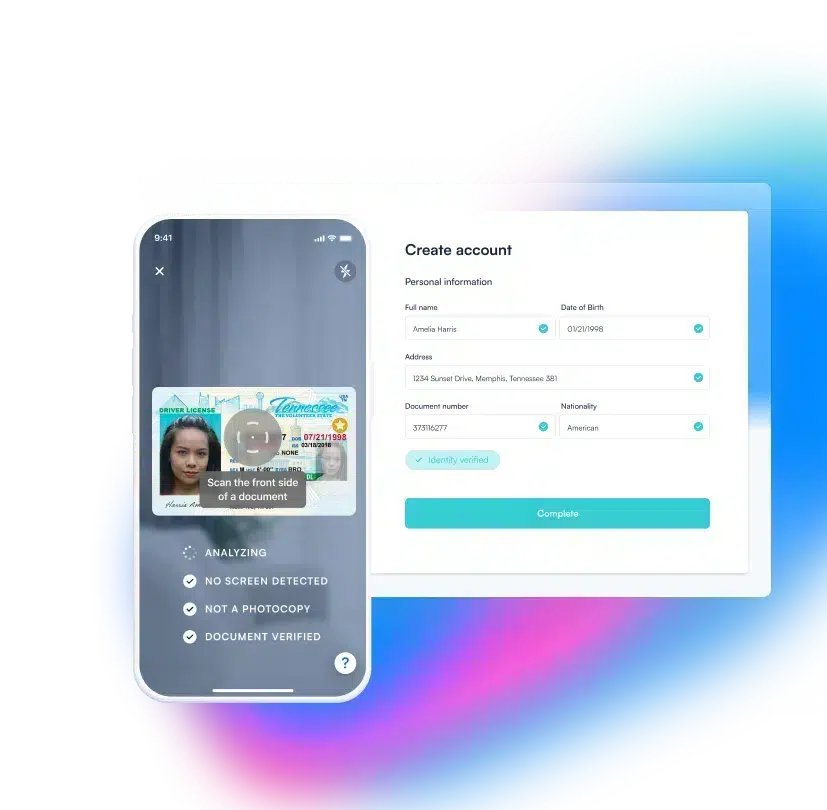
A typical remote onboarding flow includes:
- Document capture and verification to determine whether the user’s ID appears authentic and readable.
- Data extraction from the document, often using OCR, to populate identity fields.
- Face matching to compare the selfie or live face capture to the portrait on the ID.
- Liveness detection to confirm the selfie or video came from a real, present person instead of a spoof.
- Optional database, sanctions, AML, or watchlist checks depending on compliance requirements.
This layered approach matters because each control solves a different problem:
- Document verification helps confirm the credential itself is legitimate.
- Face matching checks whether the person and the ID portrait appear to be the same.
- Liveness detection confirms the submitted biometric sample is not fake or replayed.
Without liveness, a fraudster might use a stolen or fabricated ID plus a spoofed face input. Without document verification, a real person could present a forged document. Without face matching, a live user could present someone else’s ID.
For Fraud Decision-Makers, the goal is to build a workflow that minimizes both fraud and friction. Platforms that combine document verification, face matching, and liveness in one journey often simplify deployment and reduce integration complexity, while also giving risk teams a clearer audit trail.
What deployment models are available, and how should enterprises evaluate them?
Liveness detection software is typically available in three deployment configurations, each with different implications for data residency, latency, privacy, and operational control:
SaaS (cloud-hosted): The vendor hosts and operates the liveness detection infrastructure. This is the most common model and typically offers the fastest time to deployment, automatic model updates, and lower internal infrastructure burden. It is well suited for organizations without strict data residency requirements. The tradeoff is that biometric data is processed outside your own environment, which requires careful review of the vendor’s data processing agreements, retention policies, and regional hosting options.
On-premise deployment: The liveness detection software runs within your own infrastructure. This model is preferred by organizations with strict data sovereignty requirements, regulated industries where biometric data cannot leave a controlled environment, or government buyers with security mandates. On-premise deployments typically require more internal engineering resources and may receive model updates less frequently than cloud-hosted alternatives.
Edge or on-device processing: The liveness analysis runs directly on the user’s device—such as a mobile phone or browser—without transmitting raw biometric data to a server. This model offers strong privacy properties, reduced latency, and resilience in low-connectivity environments. It is increasingly common for mobile SDK deployments. The tradeoff is that on-device models may be more constrained in size and complexity, and ensuring consistent performance across a wide range of device hardware requires careful testing.
When evaluating deployment options, consider:
- Do your data residency or sovereignty requirements restrict where biometric data can be processed or stored?
- Does your compliance posture under GDPR, CCPA, or sector-specific regulations affect your choice of deployment model?
- What are your latency and connectivity requirements for the markets you serve?
- Does your internal team have the resources to manage on-premise infrastructure and model updates?
- Does the vendor offer flexibility across deployment models, or are you locked into a single approach?
How should enterprises choose the best liveness detection software for their risk profile?
The best solution depends on your fraud exposure, compliance obligations, user journey, and internal technical resources. There is no universal winner for every environment.
A practical evaluation framework should include these questions:
Use case and assurance level:
– What is your primary use case? New account onboarding, account recovery, workforce access, age verification, or high-value transaction approval all have different assurance needs.
– How much user friction can you tolerate? High-conversion consumer onboarding may favor passive liveness, while government or high-security enterprise workflows may justify active or 3D verification steps.
Threat model:
– What threats are you trying to stop? Printed photos, replay attacks, masks, deepfakes, virtual camera injection, and synthetic identities are not always addressed equally well by every vendor.
– Does the vendor explicitly address injection attacks, not just presentation attacks?
Compliance and regulatory alignment:
– What level of compliance or auditability is required? Regulated organizations may need stronger documentation, reporting, and standards alignment.
– Does the vendor support your obligations under GDPR, CCPA, or regional KYC/AML frameworks?
– Can the vendor provide evidence of bias testing across demographic groups, and what are the false acceptance and false rejection rates across different populations?
Integration and deployment:
– How easily will the solution integrate into your stack? SDK quality, API clarity, mobile and web support, workflow orchestration, and analytics all affect time to value.
– Does the vendor support your required deployment model—SaaS, on-premise, or edge?
– What are the vendor’s uptime SLAs, and what support is available during integration and in production?
Device and platform compatibility:
– Does the solution perform consistently across iOS, Android, and web browsers?
– How does performance vary across different device generations, camera quality levels, and lighting conditions?
Production performance:
– Look beyond demo claims and ask about abandonment rates, failure rates, false positives, manual review reduction, and performance across geographies and device types.
– Can the platform scale with your fraud strategy? As threats evolve, you may need adaptive verification, deeper document checks, or stronger anti-deepfake defenses.
Specific questions to ask vendors during evaluation:
– What is your uptime SLA, and what remedies apply if it is not met?
– Have your models been independently tested for demographic bias, and can you share the results?
– How frequently are your liveness models updated, and how are updates delivered in each deployment model?
– What attack types were included in your most recent iBeta or ISO 30107-3 certification test?
– How does your system detect and block virtual camera injection attacks?
In general:
- A passive, low-friction platform is often best for digital onboarding at scale.
- A customizable workflow platform is useful when rules vary by market, risk tier, or product line.
- A high-assurance biometric specialist is a better fit when spoof resistance outweighs speed and simplicity.
- An adaptive hybrid model can be valuable for businesses that want to escalate only when risk justifies it.
The strongest buying decision usually comes from a pilot that measures both fraud outcomes and user experience, not just technical certification on paper.
What industries use liveness detection software?
Liveness detection is relevant across any industry where remote identity verification is required. The most common verticals include:
- Banking and fintech: Remote account opening, KYC compliance, step-up authentication for high-value transactions, and AML program support.
- Crypto and digital assets: Exchange onboarding, wallet access, and AML/KYC compliance for regulated markets.
- iGaming and online gambling: Age verification, responsible gambling controls, and identity proofing for regulated platforms.
- Government and public sector: Citizen identity verification, benefits access, border control support, and high-assurance credentialing.
- E-commerce and retail: Fraud prevention during account creation, age-restricted product access, and account recovery.
- Telecom: SIM registration compliance and subscriber identity verification.
- Healthcare and telemedicine: Patient identity verification for remote consultations, prescription access, and electronic health record access. As telemedicine adoption has grown, so has the need to confirm that the person accessing a patient account or joining a virtual appointment is the verified patient—not an unauthorized third party. Liveness detection helps healthcare platforms meet both security and regulatory requirements around patient identity.
- Enterprise workforce: Secure employee authentication, privileged access control, and remote workforce identity assurance.