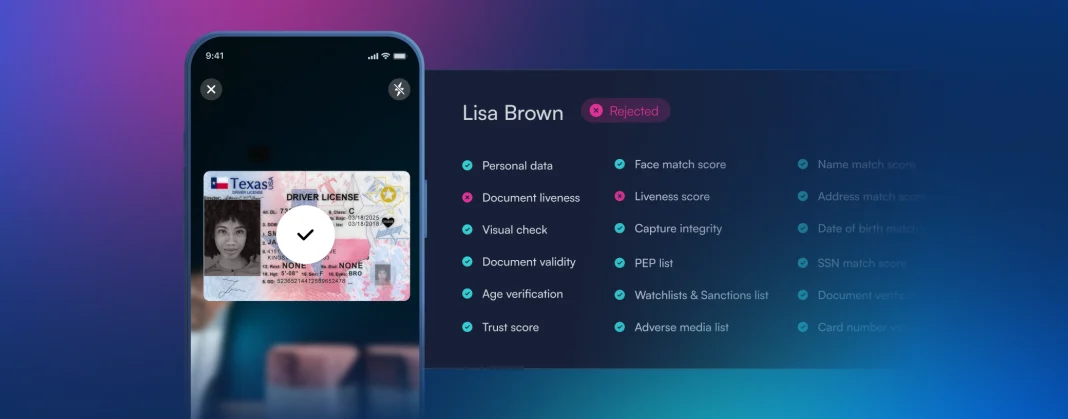
O melhor software de verificação de idade em 2026: as principais soluções de IA para combate à fraude e conformidade


Intro Section
As digital platforms face increasing regulatory scrutiny, implementing robust age verification software has become essential for protecting minors and ensuring compliance. Modern AI solutions for fraud and risk management go beyond simple checkboxes, using biometric authentication, document scanning, and facial age estimation to verify users accurately. For Fraud Decision-Makers, the right tool is not just about blocking underage access. It is about reducing regulatory exposure, controlling fraud losses, preserving conversion rates, and maintaining a defensible audit trail across jurisdictions.
Table with competitors
| Product | Compliance Features | Industry Focus | AI Capabilities | User Experience | Developer Experience |
|---|---|---|---|---|---|
| Microblink | Document-based age verification, [biometric liveness detection](https://microblink.com/resources/blog/best-liveness-detection-software/), and KYC-ready identity checks make it well suited for regulated onboarding and restricted sales. | Best aligned with e-commerce, iGaming, and financial services that need reliable [ID verification](https://microblink.com/resources/blog/id-verification-software/) at scale. | Uses on-device AI for fast document scanning, global ID recognition, and anti-spoofing biometric checks. | Delivers a very fast onboarding flow for users with working smartphone cameras, although it requires an ID rather than a selfie-only check. | Offers robust mobile and web SDKs, but deployment typically requires engineering resources and technical implementation support. |
| Ondato | Supports privacy-first compliance across frameworks such as COPPA, GDPR, and state-level rules, with audit trails and reusable anonymous credentials. | Strong fit for adult content platforms, online retail, and social communities that need age gating without storing extensive PII. | Specializes in selfie-based age estimation, anonymous verification, and tokenized reusable proof of age. | Creates a quick, document-free flow in seconds, though some users may still hesitate to complete facial scanning. | Provides a modern compliance platform with reusable credential support, but the pricing structure and feature set can feel complex for smaller teams. |
| Yoti | Combines privacy-preserving age checks with strong regulatory alignment and reusable digital ID credentials for repeat verification. | Well suited for retail kiosks, parental consent workflows, and e-commerce experiences that benefit from repeat age verification. | Offers facial age estimation, a reusable digital ID wallet, and multiple age-proof methods beyond traditional document checks. | Builds trust with immediate image deletion and flexible verification paths, but app download friction can reduce completion for one-time users. | Gives teams many integration options, although enabling the full range of verification methods may require more implementation effort. |
| iDenfy | Pairs age verification with AML and KYB tools, plus 24/7 manual review fallback for highly regulated business environments. | A strong choice for e-commerce, iGaming, and fast-moving startups that need quick deployment with compliance depth. | Relies on AI-driven document verification backed by human moderators for edge cases, though it does not offer selfie-only age estimation. | High approval rates reduce false rejections for legitimate users, but mandatory ID scans can add friction for simpler access checks. | Its no-code Magic Link builder and native plugins make setup especially friendly for non-technical or lean product teams. |
| Sumsub | Provides country-specific workflows, global document support, and integrated AML screening for businesses operating across multiple jurisdictions. | Best for fintech, multinational e-commerce, and crypto businesses with complex regulatory and geographic requirements. | Includes automated document verification, sanctions screening, and risk-based routing through a flexible no-code workflow engine. | Customizable flows help balance compliance and conversion by market, though charging for failed or abandoned sessions can affect efficiency. | Excellent for product teams that want to adjust verification logic without code, but support quality may vary by account size. |
| Veriff | Combines identity and age checks with layered fraud controls, strong localization, and wide document coverage for global compliance needs. | Fits mobility, online dating, and telehealth organizations that need reliable verification in high-trust user environments. | Uses AI-guided image capture, passive liveness, device fingerprinting, and deepfake detection to improve verification accuracy. | Its multilingual guidance supports high first-time pass rates, though some brands may find the interface less polished than newer alternatives. | Enterprise-ready automation and broad language support help global teams scale, but the pricing model is less startup-friendly. |
1. Microblink
Platform summary
Microblink is an enterprise-grade identity verification solution and age verification platform built on more than a decade of proprietary computer vision R&D. For compliance officers, risk managers, heads of security, and finance leaders, it stands out for combining sub-3-second ID extraction, biometric matching, and privacy-by-design on-device processing in a single workflow.
The platform is especially well suited to organizations that need to enforce age restrictions without sacrificing conversion during high-intent onboarding moments. Because Microblink processes more than 10 million IDs monthly across 140+ countries and supports over 2,500 document types across 195+ countries, it is a strong fit for global programs where scalability, auditability, and fraud resistance all matter.
Target audience: Fraud Decision-Makers at medium-sized businesses and enterprises in iGaming, financial services, and age-restricted commerce.
Key benefits
- Fast verification without conversion drag: Microblink extracts ID data in under a second and is designed to keep onboarding moving at the exact moment user intent is highest. For revenue-sensitive environments like betting, checkout, or account opening, that speed can materially reduce abandonment.
- Privacy-forward architecture: On-device processing reduces the need to transmit sensitive identity images to the cloud. That lowers exposure for organizations trying to align age verification with GDPR, SOC 2, and internal data minimization policies.
- Strong protection against modern identity fraud: Microblink pairs document analysis with biometric face matching and liveness detection. This helps risk teams defend against deepfakes, spoofing, synthetic identities, and image tampering rather than just checking date of birth.
- Enterprise-grade global scale: The platform is built for multi-jurisdiction operations and high monthly volumes. That matters for businesses navigating licensing requirements, cross-border onboarding, and varying age-restricted sales rules.
Core features
- Adaptive document capture and extraction: Microblink instantly extracts data from OCR, MRZ, and NFC-enabled IDs while maintaining a high first-pass success rate even in weaker lighting. This reduces manual intervention and improves throughput for compliance teams.
- Advanced biometric matching and liveness detection: The platform matches a live face to the document holder and detects spoofing attempts, deepfakes, and synthetic identity behavior. This gives security teams a stronger control point than document-only verification alone.
- Global compliance controls and calibratable thresholds: Teams can customize workflows, signals, and risk thresholds by market or use case. That flexibility is valuable for businesses balancing user experience against different regulatory expectations.
Primary use cases
- iGaming and sports betting onboarding: Operators can verify age and identity in seconds during high-pressure signup moments, such as before a live event starts. This helps capture revenue while maintaining licensing compliance.
- Promo abuse and multi-account detection: Biometric matching can identify when the same individual attempts to create multiple accounts under different identities. That makes the tool useful not only for age checks, but also for broader fraud prevention and bonus abuse controls.
- High-value withdrawals and account recovery: Organizations can trigger step-up identity verification when a user attempts a sensitive action. This supports continuous identity assurance across the customer lifecycle, not just at onboarding.
Recent updates
- DHS RIVR Evaluation Benchmark (March 2026): Microblink became the only identity verification vendor to meet all performance thresholds in the U.S. Department of Homeland Security’s RIVR evaluation, recording a 0.00% System Error Rate.
- Product rebranding: BlinkReceipt has been rebranded to Actual, preserving the same underlying capability under a new product identity.
- AI-powered identity fraud intelligence: Microblink released new fraud intelligence based on millions of interactions to help enterprises respond to the rise of AI-generated identity fraud and synthetic identities.
Limitations
- Requires document capture hardware: Users still need a working smartphone or camera-enabled device to complete document-based verification. Older devices or damaged cameras may reduce capture quality and completion rates.
- Not designed around selfie-only estimation: Microblink is strongest in document-backed age verification rather than purely document-free age estimation. Organizations seeking the lowest-friction content gate may prefer a facial estimation-first vendor.
- Enterprise-oriented pricing and implementation: The platform is built for regulated, higher-volume environments and typically requires technical integration resources. Smaller teams looking for a lightweight plug-and-play age gate may find it more sophisticated than they need.
2. Ondato
Platform summary
Ondato takes a privacy-first approach to digital age verification by combining document-based flows with AI-powered facial age estimation. For Fraud Decision-Makers, its biggest differentiator is the ability to verify age without storing large amounts of personally identifiable information, which can simplify data governance and reduce regulatory risk.
Target audience: Compliance and risk teams that need age verification for adult content, online retail, or community platforms and want a lower-PII approach.
Core features
- AI-powered facial age estimation: Ondato can estimate whether a user falls above or below an age threshold from a live selfie. This reduces friction for lower-risk age gating use cases where full identity proofing is not always necessary.
- Reusable age credentials: The platform can issue a secure token after a successful verification. That allows repeat users to avoid undergoing the same check each time, which can improve retention and repeat conversion.
- Multi-jurisdictional compliance tooling: Ondato supports frameworks such as COPPA, GDPR, and state-level requirements while maintaining audit trails. That makes it easier for compliance leaders to evidence enforcement during reviews or investigations.
Primary use cases
- Adult content access control: Ondato is a strong fit for publishers that need to prevent underage access while minimizing document collection. Its selfie-based flow supports privacy-sensitive deployment models.
- Age-restricted online retail: Merchants can verify buyers of goods like alcohol or vape products during checkout. This helps reduce unlawful sales without creating as much onboarding friction as full identity verification in every case.
- Social and community platforms: Platforms can use Ondato to confirm minimum age requirements before account creation or access. That supports digital safety compliance and helps reduce exposure around minors using the service.
Recent update
- OnAge reusable credential: Ondato introduced OnAge, an anonymous age verification token based on one-time selfie verification, extending its privacy-first positioning.
Limitations
- Pricing can be harder to model at lower volumes: Smaller businesses with inconsistent traffic may find tiered pricing less predictable. That can complicate budgeting for compliance programs.
- Feature depth may exceed simple use cases: Teams that only need a lightweight age gate may find the broader compliance suite more complex than necessary. This can lengthen procurement and deployment decisions.
- User hesitation around selfies remains a factor: Even when documents are not required, some users are reluctant to complete facial scanning. That can still create conversion friction for privacy-conscious audiences.
3. Yoti
Platform summary
Yoti is well known for privacy-preserving facial age estimation and its reusable digital ID wallet. It is particularly relevant for businesses that want multiple methods of proving age, including selfie estimation, digital credentials, and alternative proofing options for repeat access.
Target audience: Risk and compliance teams in retail, e-commerce, and digital services that want flexible, privacy-conscious age verification options.
Core features
- Facial age estimation: Yoti estimates age from a selfie and deletes the image immediately after processing. This supports privacy-by-design controls while enabling a relatively low-friction experience.
- Digital ID wallet: Users can store verified age credentials in the Yoti app and reuse them later. For businesses with repeat customers, this can reduce re-verification friction over time.
- Multiple verification pathways: Yoti supports more than one method of proving age, including alternatives such as card or mobile-based checks. That flexibility can help improve coverage across different user groups.
Primary use cases
- Retail kiosks and self-checkout: Yoti enables age proofing at automated retail touchpoints. This reduces dependency on staff intervention while preserving compliance.
- Parental consent workflows: Online services can verify that an adult is providing consent for a child’s digital activity. That supports children’s privacy compliance programs.
- E-commerce age checks: Retailers can insert age verification into checkout without forcing every user through the same path. This helps balance compliance and customer experience.
Recent update
- Improved estimation performance: Yoti reported a 99.3% true positive rate for correctly identifying 13–17 year olds as under 21, reinforcing its focus on safety-oriented age estimation.
Limitations
- Best repeat experience depends on wallet adoption: Some of Yoti’s strongest UX benefits are tied to users already having the app. In markets with lower adoption, first-time friction may be higher.
- Borderline-age users may need fallback checks: Facial estimation is less straightforward when a user is close to the legal threshold. That can require a document-based fallback and interrupt the flow.
- Broader deployment can be integration-heavy: Enabling the full set of verification options may take more product and engineering effort. Leaner teams may only use a subset of its capabilities.
4. iDenfy
Platform summary
iDenfy positions itself as a practical compliance platform for organizations that want age verification plus broader risk controls such as AML and KYB. Its standout commercial differentiator is pay-per-approved pricing, alongside a 24/7 human fallback review model.
Target audience: E-commerce, iGaming, and growth-stage businesses that need fast deployment with stronger compliance depth than a basic age gate.
Core features
- No-code Magic Link builder: Teams can deploy verification flows without a heavy engineering lift. This is useful for organizations that need to move quickly or have limited internal development capacity.
- 24/7 manual review fallback: Human reviewers handle cases the AI cannot confidently resolve. That can reduce false rejections and improve approval rates for legitimate adult users.
- Built-in AML and KYB: iDenfy extends beyond age verification into broader compliance screening. For some organizations, that creates operational efficiency by consolidating vendors.
Primary use cases
- High-volume e-commerce: Retailers can add age verification to checkout with native plugins and fast setup. This is especially useful for restricted goods where compliance has to be enforced consistently.
- iGaming and betting: Operators can combine age checks with sanctions or AML screening in one flow. That helps support licensing obligations and fraud mitigation together.
- Startup launches: Teams can stand up a working age gate quickly before launch. This supports faster time to market without abandoning compliance basics.
Recent update
- Expanded no-code integrations: iDenfy added native integrations for Bubble, Zapier, and Magento, making deployment easier for lean product teams.
Limitations
- No selfie-only age estimation option: iDenfy is centered on document-based verification rather than pure facial age estimation. For low-risk content access, that may add more friction than some businesses want.
- May be too robust for simple gates: Manual review and AML capabilities are valuable in regulated settings, but they can feel excessive for straightforward content gating. That can affect usability and cost efficiency.
- ROI depends on understanding approval patterns: Pay-per-approved is attractive, but buyers still need to model traffic, failure rates, and use case mix carefully. Budget forecasting may require more analysis than flat-rate approaches.
5. Sumsub
Platform summary
Sumsub is a strong fit for enterprises that need flexible, jurisdiction-aware compliance workflows across international markets. Its key appeal is the no-code builder that lets teams tailor verification logic by country, risk profile, or product flow.
Target audience: Compliance officers and risk managers at fintechs, multinational e-commerce brands, and crypto businesses with cross-border requirements.
Core features
- Drag-and-drop workflow builder: Teams can configure verification paths without developer dependency. That supports faster adaptation when regulations or business rules change.
- Global document coverage: Sumsub supports documents from more than 220 countries and territories. This makes it well suited to businesses operating across many regions.
- Integrated AML screening: Age verification can sit alongside sanctions, PEP, and adverse media checks. That supports a more consolidated compliance program.
Primary use cases
- Global fintech onboarding: Firms can verify age and identity across multiple jurisdictions from one platform. This reduces fragmentation in compliance operations.
- Cross-border e-commerce: Retailers can vary age verification logic by geography. That helps match local legal requirements without building separate flows for each market.
- Crypto exchange compliance: Exchanges can combine age and identity verification with AML controls. This is particularly relevant where regulatory scrutiny is high and fraud risk is persistent.
Recent update
- More granular risk-based routing: Sumsub expanded its workflow builder to support more detailed risk routing without code changes, improving operational flexibility for compliance teams.
Limitations
- Pay-per-completed pricing can increase waste: Businesses may be charged for completed sessions even when users are denied. For high-fraud or high-drop-off environments, this can elevate total program costs.
- Support experience may vary by account size: Some mid-market users report slower service levels than enterprise customers. That may matter during implementation or escalation periods.
- No clearly advertised human fallback: The platform leans heavily on automation in standard flows. Edge cases involving damaged or unusual documents may be harder to resolve smoothly.
6. Veriff
Platform summary
Veriff is a globally oriented verification provider known for broad document support, strong localization, and layered fraud controls. It is particularly relevant for businesses that need age and identity verification in high-trust environments with international user bases.
Target audience: Security, risk, and compliance teams in mobility, online platforms, and telehealth that need broad document support and anti-fraud controls.
Core features
- AI-guided image capture: Veriff provides real-time user prompts to improve image quality during document capture. This helps raise first-time pass rates and reduce submission errors.
- Layered fraud prevention: The platform combines passive liveness, device fingerprinting, and IP analysis to identify suspicious activity. That helps detect repeated circumvention attempts and more advanced fraud tactics.
- Broad language localization: Veriff supports 48 languages and recognizes over 12,000 document types. This improves accessibility for international customer bases.
Primary use cases
- Mobility and car sharing: Providers can verify driver age and document validity before granting access to vehicles. This supports both safety and legal compliance.
- Online dating platforms: Veriff helps confirm users meet minimum age requirements while strengthening identity trust. That is increasingly important in safety-focused platform governance.
- Telehealth verification: Providers can verify patient identity and age before issuing age-restricted prescriptions. This supports compliance with healthcare and privacy obligations.
Recent update
- Enhanced passive liveness: Veriff upgraded passive liveness detection to better counter deepfake and injection attacks in real time.
Limitations
- Premium cost profile: Veriff is often priced above many alternatives on a per-check basis. That can be challenging for businesses with high volumes and thinner margins.
- Limited public human fallback positioning: The platform appears more automation-led than some hybrid competitors. That may increase the risk of false rejections in difficult edge cases.
- Interface polish receives mixed feedback: Some users view the UI as less modern than newer entrants. While not a core compliance issue, UX perception can still affect conversion and brand experience.
Conclusion
The best age verification software in 2026 depends on how your organization weighs compliance certainty, fraud exposure, user friction, and operational complexity.
- Choose Microblink if you need fast, document-backed verification with strong liveness, privacy-by-design processing, and enterprise-grade global scalability.
- Choose Ondato or Yoti if privacy-first age estimation and reusable credentials are more important than document-centric identity proofing.
- Choose iDenfy if human fallback and pay-per-approved economics align well with your operating model.
- Choose Sumsub if jurisdiction-specific workflow control is a top procurement priority.
- Choose Veriff if broad document support and international localization are central to your deployment.
For Fraud Decision-Makers, the most important question is not simply which vendor is most accurate. It is which platform gives your organization the strongest balance of regulatory defensibility, fraud prevention, conversion protection, and implementation fit.
What is Age Verification Software?
Age verification software is a specialized digital identity solution designed to confirm that a user meets the minimum legal age required to access restricted products, services, or content. Utilizing a combination of biometric analysis, government-issued document verification, and authoritative database checks, these tools allow businesses to accurately authenticate a customer’s age in real-time. For B2B compliance and fraud prevention, this technology acts as the first line of defense, ensuring that only eligible users can enter your digital ecosystem without adding unnecessary friction to the customer onboarding process.
Why is it important?
Implementing robust age verification is critical for maintaining regulatory compliance and protecting your business from severe financial penalties, legal action, and reputational damage. In highly regulated industries such as iGaming, alcohol delivery, e-cigarettes, and adult content, strict global mandates require businesses to actively prevent minors from accessing their platforms. Beyond checking a compliance box, these customer identity verification software solutions are a vital component of a comprehensive fraud prevention strategy, helping to build brand trust, deter identity theft, and safeguard vulnerable populations from restricted materials.
How to choose the best software provider
Selecting the best age verification software requires a careful evaluation of a provider’s accuracy, regulatory coverage, and impact on the user experience. Our methodology for identifying top ID verification platforms focuses on their ability to offer seamless API integrations, extensive global document coverage, and advanced biometric liveness detection to thwart sophisticated spoofing attempts. Furthermore, we prioritize vendors that adhere to strict data privacy standards—such as GDPR and CCPA—ensuring that your customers’ sensitive personal information is processed securely, swiftly, and with minimal friction at checkout or sign-up.
What is the difference between age verification, age estimation, and identity verification?
Age verification is the broad category of controls used to confirm whether a user meets a legal or policy-based age threshold, such as 13+, 18+, or 21+. Within that category, vendors typically use one of three approaches:
- Age estimation: Usually based on a live selfie and AI models that estimate whether someone is above or below a threshold. This is often the lowest-friction option, but it is generally best for lower-risk use cases or first-pass screening rather than high-assurance compliance.
- Document-based age verification: Uses a government-issued ID or other accepted credential to confirm date of birth. This provides stronger evidence and a clearer audit trail, which is important for regulated industries and enforcement scenarios.
- Full identity verification: Goes beyond age alone by validating the authenticity of the ID, matching the user’s face to the document, checking liveness, and sometimes layering in AML or sanctions screening. This is the strongest option when age checks are tied to onboarding, payments, withdrawals, or fraud risk.
For Fraud Decision-Makers, the right approach depends on the consequences of failure. If the main concern is reducing friction for low-risk content gating, age estimation may be enough. If the goal is regulatory defensibility, chargeback prevention, multi-accounting controls, or audit readiness, document-backed identity verification is usually the safer choice.
What should Fraud Decision-Makers look for when comparing age verification software?
The most important evaluation criteria are not just accuracy claims, but how well the platform fits your risk model, regulatory obligations, and customer journey. Key areas to assess include:
- Assurance level: Does the vendor support selfie estimation, document verification, biometric matching, liveness detection, or all of the above? Higher-risk environments usually need stronger evidence than a simple age guess.
- Fraud resistance: Look for protections against spoofing, deepfakes, synthetic identities, document tampering, repeated sign-up attempts, and promo abuse. Age checks that can be easily bypassed create both compliance and revenue risk.
- Conversion impact: A strong vendor should minimize abandonment with fast capture, clear UX guidance, mobile optimization, and fallback paths for edge cases. The best compliance control is not useful if too many legitimate users drop out.
- Auditability and reporting: Compliance teams need logs, decision data, and workflow records that can stand up to regulator, partner, or internal audit review.
- Privacy and data minimization: Consider where data is processed, how long it is retained, whether images are deleted, and whether the architecture aligns with GDPR, COPPA, or internal security standards.
- Geographic coverage: Global businesses should verify supported document types, languages, jurisdiction-specific workflows, and local age-threshold handling.
- Implementation model: Some tools are best for enterprise SDK integrations, while others are easier to launch through no-code links, plugins, or workflow builders.
- Commercial fit: Pricing based on approved checks, completed sessions, or monthly commitments can materially change total cost depending on traffic quality and fraud rates.
In practice, the best platform is the one that balances compliance certainty, fraud prevention, and user experience for your exact use case, not the one with the longest feature list.
Which age verification method is best for e-commerce, iGaming, adult content, or other regulated use cases?
There is no single best method for every industry. The right model depends on legal exposure, fraud pressure, and how much friction your users will tolerate.
- E-commerce for age-restricted goods: Document-based verification is often preferred when selling products like alcohol, nicotine, or other restricted goods, especially where merchants need stronger proof of age at checkout.
- iGaming and sports betting: Document verification with biometric matching and liveness is typically the strongest fit because operators often need both age compliance and broader identity assurance. It also helps reduce bonus abuse, multi-accounting, and account takeover risk.
- Adult content or community platforms: Selfie-based age estimation or privacy-preserving proof-of-age flows can work well when minimizing PII collection is a priority. However, businesses should assess whether that level of assurance is sufficient for their regulatory environment.
- Fintech, crypto, and high-risk onboarding: Age verification is usually only one part of a larger KYC flow. In those cases, full identity verification with document checks and fraud controls is generally the better approach.
- Retail kiosks or repeat-access environments: Reusable age credentials or wallet-based proofs can reduce repeated friction and improve operational efficiency once a user has been verified.
Many organizations use a tiered approach: start with a lower-friction method for clear-cut cases, then escalate to document verification when the user appears close to the age threshold, attempts a high-risk action, or triggers a fraud signal. That often produces a better balance between conversion and defensibility.
How does age verification software help with compliance across different jurisdictions?
Modern age verification platforms help organizations operationalize compliance by turning legal requirements into configurable workflows, evidence trails, and risk controls. This matters because age-related rules vary by jurisdiction, product type, and user segment.
A strong platform can support compliance by:
- Applying different age thresholds by market: For example, one country may require 18+ while another requires 21+ for the same product category.
- Providing an auditable record of enforcement: This can include timestamped checks, verification results, method used, user consent records, and exception handling.
- Supporting privacy requirements: Some businesses need to verify age without retaining unnecessary personal data, especially in regions with strict data minimization expectations.
- Enabling fallback flows: If a lower-friction method is not enough to satisfy legal or risk requirements, the workflow can step up to document verification or manual review.
- Helping standardize policy execution: Instead of relying on inconsistent internal processes, businesses can enforce the same verification logic at scale across channels and geographies.
That said, software does not replace legal judgment. Fraud Decision-Makers should still align product flows with counsel, compliance teams, and local regulatory guidance. The value of the vendor is that it gives you a practical way to enforce those rules consistently and document that enforcement when challenged.
How can businesses reduce user friction without weakening fraud controls or compliance?
The best-performing programs do not treat compliance and conversion as opposites. They reduce friction by using the right level of assurance at the right moment, rather than forcing every user through the heaviest possible check.
Common ways to improve both security and completion rates include:
- Using risk-based verification: Reserve full document checks for higher-risk users, high-value actions, or ambiguous cases instead of requiring them universally.
- Optimizing capture quality: Real-time image guidance, mobile-friendly flows, and fast extraction reduce failed sessions and repeat attempts.
- Adding reusable credentials: Verified users should not have to repeat the same age check every time if your use case allows secure tokenized proof or wallet-based reuse.
- Implementing strong but invisible fraud layers: Passive liveness, device intelligence, and behavioral signals can strengthen detection without always adding extra user steps.
- Providing fallback paths: If a user cannot complete selfie estimation or document capture, alternative routes can recover otherwise lost conversions.
- Reducing unnecessary data collection: Users are more likely to complete verification when the process clearly matches the risk and does not appear overly invasive.
For high-risk environments, the goal is not the shortest possible flow. It is the most efficient defensible flow: one that stops underage users and fraudsters, preserves legitimate adult conversions, and leaves a record your organization can stand behind.